Monday, August 22, 2005

The Racetrack at the End of the Universe

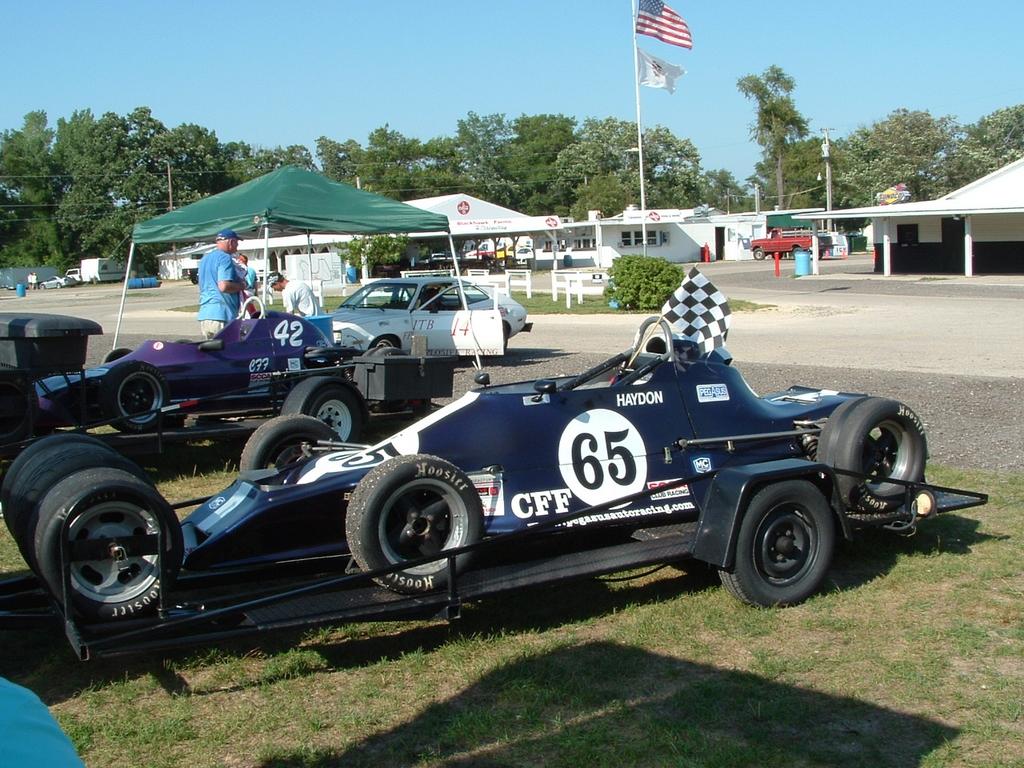
I confess, I didn't get the joke until I saw the graphics on Pete Wood's car: "Arthur Dent" and "Ford Prefect" on the sides... and then he wore a bathrobe to the drivers' meeting. Too bad nobody else got the joke even after that. The title of the race was a play on the title of a book in a series that enjoyed a cult following in the '80s. The central character, Arthur Dent, is a normal Englishman who finds himself a passenger on a spaceship with his new friend Ford Prefect while wearing his bathrobe. Or something like that. I've only read the first book in the series, and it's been a long time since I read that one. (Pete has even run car number 42 for years, which will mean something to those who have read the book.)

We were the fifth group to hit the track, which left plenty of time for worrying and second-guessing about the repairs we had just completed. I did my best to stay calm and rational while I waited for our group to be called to the grid. The car was ready, and I had to trust that we had done everything correctly.

Practice went very well despite some oil on the track in a couple of corners. I managed to keep up with a yellow and blue Sports 2000 -- a much faster car* -- for several laps, which shocked me... until I found out that it was being driven by a racer who had never driven a mid-engined, right-hand-drive car. He is used to the front-engine V8 sedans that he's raced for years, and he was busy learning that the techniques are very different.

Debbie Campbell, a co-worker at Pegasus Auto Racing Supplies, arrived after practice with her parents, who had never been to Blackhawk before. Her father and I chatted about racing while she and her mother chatted with my mother about dogs. Debbie used to show dogs all over the country, and my mother is a dog training instructor, so they had plenty to talk about.

For qualifying I asked my parents to once again time Pete while I monitored my own times on my on-board lap timer. The best number I saw on the pit board was 1:20, while my fastest qualifying time was a 1:18.89. I knew I had turned a few laps in the :19s, so I was confident that I had the pole. The grid sheet confirmed it: I turned a 1:18.89, and Pete's best was a 1:20.26.

Between the qualifying session and the race, there is generally enough time to give the car a thorough inspection and repair most problems that may show up. The between-session checklist includes such things as bleeding the brakes, checking the wheel bearings and rod ends, and retightening any fasteners that may have worked loose. Everything was pretty much normal, with the same old bolts working themselves loose, everything else staying tight as usual, but the right rear hub was suddenly loose. The hub I've been using is a modified VW piece that just doesn't seem to be holding up too well to the stresses of racing. Oh well... take off the wheel, remove the cotter pin, have Dad hold the brakes, torque the axle nut down again, new cotter pin, wheel back on... wow, that's a lot easier and quicker with two people! When it's a one-person operation, you jack up the car, remove the wheel, remove the cotter pin, put the wheel back on, lower the car, somehow stop the wheel from turning -- usually by locking the transmission in two gears at once (a big job on its own) -- tighten the nut, unlock the transmission, jack up the car, take off the wheel, put in a fresh pin, wheel back on, car back down...

The car was ready in plenty of time for the race. I had enough time to watch a couple of other groups race, including the Formula Vee / Spec Racer group, where I used to run. The polesitting Vee, driven by Hal Adkins, spun or got hit on the first lap. By the time the pack went through corner 4, he was at least 15 seconds behind the back of the pack. He drove like a madman, gaining huge chunks of time every lap. Within about 10 laps, he had regained the lead. I confess that Hal is one reason I got out of FV. I realized that I would probably never be able to beat him, at least not with the car I had. I still joke with him that I had to move up a class to have any chance to keep up with him.

We gridded for our race and waited in the cars for ten or fifteen minutes while the safety crews cleaned up after the group before ours. I don't know what it was about this weekend, but every single group -- including ours -- had an incident (or multiple incidents), stranded cars, or blown engines that needed to be cleaned up and cleared away before the next group could hit the track. It was unusual to say the least, and it got us so far off schedule that the last three races had to be shortened by five minutes each and victory laps were cancelled.

I gridded directly behind the yellow and blue Sports 2000 I had followed in practice, and Pete lined up next to me. I was a little concerned that the driver in front of me still wouldn't be familiar enough with the gearbox and might miss a shift on the start. That would give Pete a clear advantage of several car lengths at best -- a good reason for Pete to hope for it. I got lucky, and everyone in front of us got away cleanly. I got a slight edge on Pete and crowded him just a little bit exiting corner 1 to try to keep him behind me. As the race progressed, some cars fell off the track here and there. On the second lap, corner 6 was waving their yellow flag, indicating that there was something dangerous or someone vulnerable on the track or near the track. I slowed and tiptoed around the corner, looking for the incident that caused the flag... but I couldn't see anything out of the ordinary. The next lap, corner 6 still had their yellow flag out, but this time I saw a driver standing next to the track. Apparently he had spun exiting the corner and his car went into the weeds about 50 feet off the track. The car was completely hidden by the foliage, and it stayed there for the rest of the race.

My father was showing me the gap times between Pete and me on the pit board -- :03, :04, :06. About halfway through the race, the board showed :13... and my oil pressure gauge suddenly dropped! The rule of thumb for oil pressure is to have 10psi per 1000rpm. Since we spin the Formula Ford engines to 6000rpm, 60psi would be ideal, but most of us settle for 40psi. My car had 40psi all day, but suddenly it dropped to 20psi. Better than nothing, but it seemed to me that if it started dropping, it was likely to drop the rest of the way to zero. I tried everything I could to nurse the engine, keeping the revs as low as I could while still conserving speed. I don't know which would have been a more disappointing sight in my mirrors: Blue-white smoke indicating a blown motor, or the purple nose of Pete's car!

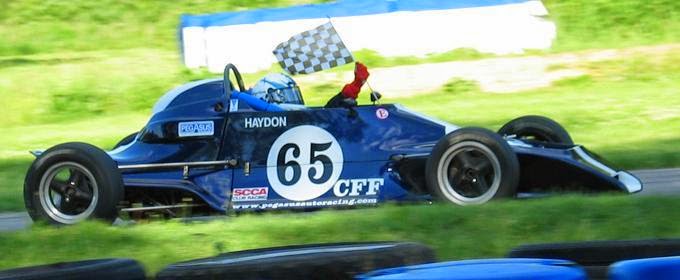
The car held together and the oil pressure didn't drop any farther. I finished about 10 seconds ahead of Pete and shut the car off as soon as I could. Now to diagnose just what happened and what we need to do about it...

The points now look like this:

  1. John Haydon: 150
  2. Pete Wood: 125
  3. Michael Schindlbeck: 69
  4. Denis Downs: 33
  5. Scott Reif: 33
  6. Larry Noble: 17
  7. Jon Borkowski: 16
  8. Paul Schindlbeck: 16
  9. Dick Plank: 13
  10. Bob Fleming: 8

Next stop: Milwaukee's lakefront, Veteran's Park, for the "Masterpiece Style & Speed Showcase" car show.


* A Sports 2000 is a little hard to describe. Imagine a formula car, with a 2.0-liter Ford engine in the back, but with two seats and fiberglass fenders. The design of the fenders can make the car handle better than a Formula Ford, and the larger engine gives it better acceleration and top speed.

Friday, August 19, 2005

Friday

The car is on the trailer and ready to run! Sunday is the 7th Midwestern Council race of the season, once again at Blackhawk. I'm looking forward to being back at my "home" track with the crowd I've known for years.

Not to imply that the crowd I've run with lately is any less than a great bunch, but I know the MC regulars well enough to anticipate what they will do in a lot of situations, and they know me as well. There have been a few situations at the last couple of races where I just wasn't sure how a driver would react to being passed on the outside of the Carousel, for example. Or just how early I'd have to brake to get him to take the line going into corner 5 so we could both carry some speed through instead of tiptoeing through side-by-side. Or whether he would try that optimistic pass going into corner 3...

Thursday, August 18, 2005

Transmission Externals

I'm still not an engineer, but the Internet can be a wonderful tool -- and there's nothing more dangerous than a tool in the hands of someone who thinks he knows what he's doing.

According to a fascinating article on the Key to Steel website, the breakage of the input shaft shows some characteristics of a "brittle fracture":

"Brittle fracture is characterised by the very small amount of work absorbed and
by a crystalline appearance of the surfaces of fracture, often with a chevron
pattern pointing to the origin of fracture, due to the formation of
discontinuous cleavage cracks which join up. It can occur at a low stress of
75-120 MPa with great suddenness; the velocity of crack propagation is probably
not far from that of sound in the material. In this type of fracture plastic
deformation is very small, and the crack need not open up considerably in order
to propagate, as is necessary with a ductile failure."


I'll just repeat the bit that really struck me: This thing broke apart at close
to the speed of sound. No, the fragments didn't necessarily go that fast (and
neither did I), but that's how suddenly the shaft broke, and that explains why
it looks like a grenade went off inside it.

On very close inspection, I can see several cracks at seemingly random angles to the breakage. It does show some signs of "ductile failure," where metal stretches as it is pulled, bent, or twisted apart. Some of the splines are bent, stretched, or twisted, although the surfaces between the fragments show no such signs. That makes some sense. As part of the shaft broke, neighboring areas were stretching to accomodate the change of shape. This same thing happens when you break a glass -- the definition of brittle -- the glass actually deforms a little before it breaks, which is why the pieces never fit together quite right again.

The good news is that the car is nearly together again. The two big pieces of car were reunited last night, and all that remains is a quick alignment check, gear change, and brake and clutch bleeding.

Wednesday, August 17, 2005

Transmission Internals

There's a strange phenomenon that affects people who do repair work. Some call it a philosophy of "as long as"-ism, while others call it an illness, "might as well"-itis. It always begins with a necessary repair which requires disassembly of the item needing repair. The next step -- or several steps -- are characterized by repeated cries of, "As long as it's apart..." and "We might as well replace..." The final step is either a good-as-new item that will not need maintenance for a long time, or else a never-ending money pit.

I try to avoid falling victim to "might as well"-itis while at the same time keeping a healthy amount of "as long as"-ism. In this case, the "as long as"-ism involves having the transmission off the car -- a big project that we hope not to have to do again until the off-season. "As long as" we have the transmission off, we "might as well" replace these parts we now have easy access to... and we "might as well" repair that part that we couldn't reach before... and we "might as well" clean up inside this hidden area...

Opening the transmisssion to replace the input shaft gives us acces to such things as the clutch, the input shaft oil seal, several crevices which collect dirt and oil, the differential and final drive, and the inside of the transmission case. It makes sense to replace the clutch now, since it is a consumable item and mine has outlived the clutches in several competitors' cars. The input shaft oil seal has been seeping a little more oil every weekend, making a bigger and bigger mess to clean up after each race. The differential and final drive deserve to be inspected for any signs of damage or stress -- especially after having bits of the input shaft thrown around inside the gearbox.

There are plenty of other projects we could add on now, but none of them are important enough to risk missing the next race if they don't go as planned. For example, the filler plug in the top of the transmission case had been jammed in and stripped by a previous owner. Since we have access to the inside of the case, we could drill out the plug, catching any shavings that fall into the case, and replace the plug. But having access through that plug is not critical, and if the project doesn't go well, we could end up needing a new transmission case. We wouldn't be able to get a new one before the weekend, and setting up a new case is an expensive, time-consuming operation. Maybe we'll try that plug during the winter.

Everything else looks to be in good shape, so as soon as we can get all the RTV sealant cleaned off the sideplate, we should be ready to begin reassembly tonight. The new oil seal is in, the rest of the new parts are on the bench, and the fragments have been cleaned out of the transmission.

Tuesday, August 16, 2005

Bad News

When we pulled the gearbox last night, we found that the clutch disc is actually just fine. The input shaft had broken.

I have no experience with metallurgy or stress analysis, so I have no idea if this is a sudden catastrophic failure or a gradual breakage. The books I've read have described gradual fatigue fractures as having a visible progression to them; you can see where the initial crack started and how it progressed across the part, until there wasn't enough intact material to take the stress, leaving the last bit to break suddenly with a jagged edge. On the other hand, the sudden catastrophic failures they illustrate show a clean break, with no clear beginning, middle, or end.

The shaft looks almost like a piece of clay that was torn from another piece. There are jagged valleys and sharp ridges radiating from the center, suggesting that the shaft was pulled apart rather than twisted apart. Perhaps the twisting apart is what raised the ridges; I don't know. The transmission is coming apart tonight. With a little luck, the new input shaft will be in and the gearbox will at least be ready to reinstall by the end of the evening.

Monday, August 15, 2005

Kettle Moraine Double: Sunday

Information from the weekend is still filtering in from various sources. Two cars who I thought had tangled in The Kink on the first lap of Saturday's race actually had a very different story. One car had a wheel come loose and lock up in The Kink, sending him spinning. The second car came through at full speed and saw the disabled car in the middle of the track. He barely had time to avoid him at all, and unfortunately avoiding him meant sending himself into the wall, destroying his own car for the sake of the other driver.

Sunday began warmer than Saturday by a few degrees, but it was still not hot. My mother came up to watch and help out. I went out for the morning qualifying session and tried to stay with a group of fast cars. I was able to hang with them during the first lap, but as we approached corner 13, when I shifted to 3rd gear, the car didn't go any faster. I tried to select 3rd gear again, just to make sure I hadn't missed, but no difference. I tried 4th gear with the same results. The linkage could have come undone, or something in the transmission could have broken. I tried 2nd gear just to be sure. I could feel that the transmission did in fact select 2nd gear, but the car still wouldn't accelerate. Some connection between the engine and the transmission (or between the transmission and the rear wheels) must have broken.

My theory is that the clutch disc splines have probably stripped. This clutch disc has seen at least two seasons of use, maybe more. So I learned something: Replace the clutch disc every season, and don't worry about it again! Replacing the disc should be a relatively inexpensive repair, fairly easy to do, but it wouldn't be a good job to do at the track. Several people offered to help change the clutch, and we could have done it before lunch, but I decided that it was time to sit back and just watch the race.

I think I was better off sitting in the bleachers than I would have been in the driver's seat. Of 45 cars entered, 38 started the race and only 27 were still running at the finish. Between what I saw and what I was told, about 5 or 6 cars were damaged or destroyed. Add that to Saturday's toll, and almost a dozen cars will need major repairs before they can race again. A few of those may never see the track again. I have been told that all the drivers are uninjured.

Speedy Petey grabbed 4th in CFF on Sunday. He could have had 3rd, but he got stuck in a battle for 4th while 1st through 3rd pulled away. Allen Wheatcroft got 9th in FF, and I think he turned his best-ever lap time in the process. Good job guys!

Kettle Moraine Double Regional: Saturday

Win or learn something. I didn't win on Saturday, but I learned something important on Sunday.

The Saturday morning qualifying session at Road America started poorly. The track was very slippery and had a visible line of oil all the way around. We spent the first two laps sliding around, trying not to spin. The track was scrubbed off pretty well by the third lap, but then cars started going off everywhere. I'm not quite sure how that works. No traction, everyone stays on the track. Get traction back, people start spinning off. There were so many yellow flags, it was basically impossible to pass the slower cars or get into a rhythm. I had to settle for 5th on the CFF grid with a 2:44, six seconds slower than my time in July. But this weekend was about relaxing and having fun racing, so my starting position wasn't that important.

My father and I began working on the car to get ready for the race, and we were just starting to think about lunch when Cindy Lindstrand came buzzing up on a scooter and handed us a plate with two Italian beef sandwiches, leftovers from the big Lindstrand Motorsports lunch. They go all out for their drivers, and they're willing to share the leftovers with people like me. Thanks, Cindy, they were great!

As we ate, the sky got darker and the breeze suddenly got much cooler. The temperature dipped from about 75 to below 70 in just a few minutes. The rain started during the race for big GT cars (Corvettes, Camaros, Mustangs, Cobras -- the big fire-breathing V8s). The huge horsepower and wide, slick tires made the slightly slippery conditions downright treacherous, and cars were sliding everywhere. Formula Ford tires are much narrower and we have much less horsepower, but racing any car with slick tires on a wet track is an adventure. I asked my father for advice, and he pointed out that there were no puddles. Rain tires generally work only if there is standing water on the track. If the pavement is only damp, the rain tires will overheat and come apart. As we were discussing it, the rain stopped. The sun came out and the track dried completely before we went out.

I gridded next to Allen Wheatcroft's red Van Diemen FF, in front of Pete Wood's Crossle CFF, pretty much in the middle of the pack. The pace lap was a little slow, but not at all bad. The pack seemed to be well grouped, but when we slowed and just about stopped for corner 5, Allen's car stalled. He got it going again eventually, but he wasn't able to get back to his grid position before the start.

The car in front of me seemed to be much too slow, but I couldn't get around him. I lost three positions in class on the first lap while following him. Every corner, I felt I could have gone faster than he did, but he would just pull away from me on the straights. Two other cars were stuck behind him with me, and we were all looking for a way around him. Finally we passed him, and then the other two cars passed me (no problem, they were in a different class). The first lap we were clear of him, I turned a 2:38. Within a couple of laps, I caught up to and passed Bill Ehrlinger and Michael Neylon, both in CFFs, which got me back up to 5th place.

As the race progressed, cars began to accumulate at the corner stations and along the walls. Two cars nearly tangled in The Kink, a very high-speed corner where going off track usually means hitting the concrete wall, hard -- and one of them did just that. A third car joined them about halfway through the race. Another car got hit in corner 3. A car pulled off in corner 12, smoke still rising from the engine. Fiberglass bodywork littered the track at corner 14. A car spun in corner 5 and couldn't get off the damp grass without spinning again. Corner 12 was yellow for several laps while they pulled a car out of the gravel trap. I could see that several cars would not be back out for Sunday.

The car ran well and handled great. Almost every time I followed a car around the Carousel turn or through The Kink, I felt like I could have just driven right around them. In fact, most of the passes I made were driving around cars in the Carousel. The car is so stable and forgiving and solid!

Next update: The Kettle Moraine Double Regional, Sunday...

Monday, August 08, 2005

East-West Challenge

In recent years, one question has been asked over and over at road races across the country: “Where have all the cars gone?” In the ‘70s and ‘80s, so many cars would show up to a race that some classes (Formula Ford among them) would have to be run as two separate groups because all the cars couldn’t fit on the track at once.

Something happened in the ‘80s and ‘90s, and nobody can pin down what it was. Maybe it was the “me” era, maybe it was the rising cost of racing, maybe it was the advent of VCRs and video games. Whatever the reason, race attendance dropped. Classes which once enjoyed 80-car fields now saw 10-car fields. Where were all the cars?

Steve Beeler, a Club Formula Ford racer from Michigan, realized several years ago that the cars still existed, but the owners just weren’t racing them. He asked around, and most people agreed that the reason they didn’t race was because there were so few cars racing. A depressing catch-22.

Steve began a concerted effort to promote several specific races within the SCCA Central Division. Since CenDiv is roughly divided by Lake Michigan, all drivers were either on the “East” team or the “West” team based on each driver’s hometown. Continuing the east/west theme, two of the four race weekends would take place east of the lake, and the other two would be on tracks west of the lake.

The “East-West Challenge” was an instant success. Companies pitched in with contingency awards, which attracted more drivers. Car counts were back up in the 20s and 30s, which was enough to convince most Regions to give the FF/CFF race its own group instead of mixing them with other classes. Over 70 drivers have raced in the series, with more joining every race.

My initial plan for the season was to run the East-West Challenge again this year with only a few Midwestern Council races mixed in. But as I said once before, a racing schedule is at best flexible, a mere suggestion of what may happen. After winning the first two MC races and breaking the car at the first EWC race, I decided to concentrate on the MC season. I still want to run at least one or two EWC weekends, including this weekend’s races at Road America. Since I have missed the first four rounds of the series, I won’t be trying quite so hard to finish in the points. I plan to hook up with someone – maybe Speedy Petey – and just race for the fun of it. It is impressive to see a pack of 30 Formula Fords, even from the back!

Thursday, August 04, 2005

Driver's Suits

Of all the possible injuries a driver could suffer in an auto racing incident, burn injuries probably scare me the most. Niki Lauda will tell you how bad burns can be. (He looked quite a bit better when he had ears.) Because of that, my safety equipment -- especially my driver's suit -- has always been a high priority for me.

My first driver's suit was a hand-me-down from my father. Obviously, this suit means a lot to me. My mother gave it to him for Christmas back in the '70s, when it was cutting-edge and the best that money could buy. It was custom-tailored in bright yellow to match his car, and his name was embroidered above the chest pocket. It was constructed of a single layer of Nomex, which was common for firesuits back then. Drivers generally wore Nomex long underwear under their suits to get adequate protection. At the time, more protection meant more layers, which meant bulky, heavy suits. Drag racers wore multi-layer firesuits that looked like quilted snowmobile suits.

In 2002, my co-worker Michael Marmurowicz told me he wanted to sell his old driver's suit, a modern 3-layer suit by Italian manufacturer OMP. He never had a chance to wear it before he retired from racing some 10 years ago. I talked him out of listing it on eBay, and he sold it to me for less than it was worth. This suit has acquired some special meaning for me as well. One sleeve bears a patch of quilting fabric in memory of my friend Carol Nappi, and the other sleeve still has some of my friend Frank Nelson's ashes. Unfortunately, this suit is mostly black. It looks great and sleek and fashionable, but it is awful on sunny days. It sucks up sunlight like a sponge, and oddly enough, the medical crews aren't very sympathetic when you overheat while wearing it. Especially if you still wear a layer of Nomex long underwear under it.

After my last visit to the Med Shed, I was persuaded to get a lighter suit. OMP has been supplying safety equipment to Formula 1 teams for years, and they have done a lot of research and development on driver's suits. They recently introduced a new suit called the "Tecnica Light" which they claim is lighter and cooler than the previous generation of 3-layer suits. They only offer it in two colors, shiny silver and shiny red with a shiny silver chest -- the McLaren-Mercedes and Marlboro Ferarri F1 team colors. I chose silver, since red wouldn't go so well with a blue car.

The suit arrived this week, and it's more than a half a pound lighter than a standard OMP three-layer suit. I tried it on this morning, and right out of the box it feels softer, less stiff and less bulky than my old suit. It has knit panels on the knees and around the arms to allow sweat to evaporate instead of boiling the driver. Another nice feature about this suit is that it is not second-hand, so it's actually my size! I'm looking forward to trying it next weekend at Road America. Sorry everyone, I'll be crossing my fingers for 100 degrees and sunny!

Monday, August 01, 2005

Drive the Autobahn

Meet the newest Club Formula Ford track record holder.

Sunday was the first SCCA race at the Autobahn Country Club in Joliet, Illinois. Because it is a new facility, one driver in each class would finish the weekend as a track record holder. Despite that draw, the turnout was surprisingly light. Pete Wood and I were the only two Club Formula Fords entered.

The schedule for the day was very calm, with only two track sessions. We would have a 25-minute qualifying session in the morning, and a 26-lap race after lunch. On the 1.4-mile "North" track, a 26-lap race should take just over half an hour.

I had the luxury of doing some low-speed laps on this track in April, in a borrowed Dodge Durango and then in Lynn Serra's Formula Ford. Although I kept both vehicles at touring speeds, I was able to get a very good education in which way the track went, and in how it would look from a low formula car perspective. Still, Pete had raced here in May with Midwestern Council, so he had three high-speed sessions in his own race car. He certainly knew the track better than I did, so I concentrated on doing my best to keep up with him during qualifying.

Fortunately for me, Pete took it fairly easy for the first part of the session, maybe letting me keep up with him while he showed me the line. Within ten laps, we were already turning faster times than he had turned in May. Several laps from the end, he moved over to let me pass. I found a little more speed in a couple of corners and got the pole position (and the qualifying track record) with a 1:10.523 to Pete's 1:11.089. Once again, a car in another class (Formula First, "FST") had gridded between us.

The race got off to a very bad start. We were all clean through the first few corners, but coming out of corner 5 I saw a large cloud of dust in my mirrors. When we came up the front straight, we saw that all corner stations were showing the black flag, which is a signal for all drivers to report to the pit lane. In other words, something big had happened, and the officials needed us to clear the track so they could deal with it. We slowed down to come back to the pit lane, and as we came to corner 5, we found out what the big deal was. Two Formula Vees had come together (kicking up the cloud of dust), and were now in the middle of the track, a pair of conjoined twins joined at the bellypan. One car was upside down, facing traffic, with the driver's helmet touching the track, and the other car was upright, on top of the other car, facing the correct direction. Don't ask me how they got that way.

We all proceeded to the pit lane (without the two FVs which were otherwise engaged) to wait for the restart. Before we had come to a full stop, the crew from Lindstrand Motorsports had set about distributing umbrellas and cold water to the drivers. Although they were only responsible for one car in our group, they checked on every driver to make sure that everyone would be able to continue. A grid worker began to lug a big water jug down the line of cars, but Zach (one of the Linstrand crew) stopped her and carried the jug for her on their ATV. They are a great group of people, and I'm not just saying that because they've saved me more times than I can count.

We lined up for a single-file restart and set off behind the pace car. The two Vees had left some gouges in the asphalt at corner 5, but the corner and safety crews had cleaned up all of the scattered dirt and spilled fluids. We took the green flag again and expected a much cleaner start. That was our second mistake.

The FST gridded between Pete and me was pressing me in the corners, but I was not interested in racing him. Meanwhile, Pete had a horsepower advantage over him and wanted to pass him on the straight. I didn't want to tangle with the third car -- I just wanted to settle down for a fun race with Pete. Unfortunately, the FST tried to pass me at the same time that Pete tried to set up to pass him... Pete got the short end of that deal and was forced to do a little off-road driving in a particularly rough spot. He was lucky to continue with only minor damage to the fiberglass bodywork. I decided to slow a bit to let Pete catch up, but the next time I saw him I was behind him, about to put him a lap down. As I passed, I noticed that his nosecone was missing. That has two problems: the car was less aerodynamic without it (not such a big deal on a short course like this), and the air that the nose would have directed through the radiator to keep the car cool was free to flow around the radiator instead. That could have been a big problem on a 90 degree day, and is the more likely reason that he slowed down.

For the victory lap, the pit marshall handed me the largest checkered flag I have ever seen in my life. This thing had to be 3 feet by 3 feet. I held it as far in front of me as I could, and it still flapped against my helmet. It was a pretty good feeling!

Since this was an SCCA Regional race, the MC points have not changed. I am now much more familiar and comfortable with the track than I was, so I should be ready when MC returns in October.

Next up: The SCCA Central Division East-West Challenge Double Regional Race at Road America on August 13 & 14. We will race on Saturday and again on Sunday. MC will run at Blackhawk the week after, and the week after that, the Wisconsin Region of the Classic Car Club of America will host "The Masterpiece Style & Speed Showcase" car show at Veteran's Park in Milwaukee. See you there!

Thursday, July 28, 2005

Last Sunday's race at Blackhawk was sponsored by Botham Vinyards in Wisconsin. The trophy (for those of us over 21, of course) included a bottle of Botham wine. My personal trainer Amy Stecker and I tried it last night -- "Go Racing Red" -- and it was delicious. If you want a red wine that doesn't burn your throat or taste like purple grape juice, you should really consider this wine.

I couldn't pick out any flavors of spices or wood or flowers or anything silly like that, and even if I could I probably wouldn't waste my energy on it. Botham uses words like "bold fruit character" and describes the "finish" as "long, smooth, and slightly tart." I think we used words like "sweet but not overpowering" and "mmmm" (as opposed to the typical *kawf kawff*).

Botham proclaims that it works well with sandwiches, grills, and picnic food. Peter, add pizza to the list.

And put in my order for a case.

Tuesday, July 26, 2005

Driving the Autobahn

Well, it's official. I will be racing on Sunday, July 31 at the new Autobahn Country Club (North track) in Joliet, Illinois. It's an SCCA Regional event, so it doesn't count towards the Midwestern Council championship...

But Speedy Petey mentioned to me on Sunday that he was planning to run it, since he is planning to be in the area for an open house at Arres Racing the day before. I'll be at the same open house on Saturday, and even though the track is actually a bit farther from Arres Racing than from my home, it still makes sense for me to run the event. Pete ran the MC race there the weekend that I was at Grattan, so he already knows the track better than I do. I don't want to be too far behind and unprepared when MC returns in October.

Since I'm going for the track time and learning experience, I will be running my full MC weight (1175 pounds) instead of lightening the car to the SCCA weight (1100 pounds). I need the experience, not an SCCA win!

Monday, July 25, 2005

Lance and Fernando and Me

Sunday was hot with a breeze so humid it made you think you were sitting in a sauna next to a dryer vent. I was surprised to learn that yesterday's official temperature was only 99 degrees. Hot weather is great for traction, since the tires get hot enough to melt and get really sticky. The drawback is that heat is bad for horsepower, engines, brakes, and drivers.

The morning practice went smoothly, with no big problems. The brakes were locking a bit entering some corners, but a small adjustment to the brake bias* cured it. Good thing, too -- I wanted to play around with the bias a little more, but the adjusting knob must have fallen off right after I adjusted it!

Remembering the minimum weight issue from June, I took the car to Impound after practice and ran it across the scales. My official weight: 1184 pounds, 34 pounds over the minimum. The car probably had a couple more gallons of fuel in it than when it was last weighed. At approximately 6 pounds per gallon, a gallon and a half of fuel would account for the 9 pound difference over last month. I decided to leave the extra weight in the car -- at least until I saw how qualifying would turn out.

Since I had the luxury of an in-car lap timer and a crew (my mother, my father, and my friend and personal trainer Amy Stecker), I instructed them to show me Pete Wood's lap times. My theory was that if I could compare our times, I would know if I needed to drive harder, remove weight from the car, or just relax and enjoy the drive. I went out behind Art Jahn's VW-powered sports racer, a fendered car built on a formula car chassis. My plan was to try to follow him for as long as possible, since the bodywork on his car creates a big draft, and that would give me quite a boost -- like being pulled along by a vacuum cleaner.

I almost stayed behind Art for one lap. At the end of that first lap, my on-board timer showed 1:20, which I later found out would have been almost good enough for the pole position. But since the car really wasn't warmed up yet (neither was the driver), I stayed out and tried to go faster. As I edged the car down through the 1:19s, my father showed me the pit board reading 1:21, 1:22, 1:20. Pete turned a best lap of 1:20.2, while my best was a 1:19.2.

I would start fifth on the grid, in front of all of the more modern Formula Fords, two Formula A cars (one running a 2-liter Alfa Romeo twincam engine, and one running a 1600cc Lotus twincam engine), and of course the other 4 Club Formula Fords. Frank Reimann qualified his yellow Formula Ford between Pete and me, which meant that Pete would line up directly behind me on the pace lap. That was a bit of luck for me, since it is much easier to defend your position against a car starting directly behind you than against a car starting next to you.

The rest of the morning was spent checking over the car and getting it ready for the race. I debated taking some weight out of the car, but with a one second per lap advantage over Pete, I decided to leave it in. We spent the lunch break trying to keep cool, moving as little as possible, and drinking as much water and Gatorade as we could stand.

Pushing the car to the false grid before the race, getting buckled in, and waiting for the start of the pace lap are probably the longest, most exciting, nervous, nerve-wracking, tense, intense fifteen minutes in a race driver's life. I could write 1000 words describing why, but the opening montage in the movie Grand Prix and the race start sequence in the movie Le Mans capture the mood effectively. Waiting on the false grid, with all the revving engines around you, all you can hear is the pounding of your heart, the sound of your own engine, and the sudden shriek of the grid workers' whistles as they count down the last five minutes before the pace lap.

I poured some ice water down the neck of my driver's suit just before we left for the pace lap. The cars line up for the pace lap in two-by-two formation behind the pace car, then spread out single-file again as the pace lap rolls off to weave back and forth to scrub their tires, wiping off any gravel and trying to bring the rubber up to optimum temperature. The corner workers give a thumbs-up as the field passes, and wave to the drivers they know. Coming into the last turn, the pace car slows enough to let the cars get back into a tight two-by-two formation. We crawl side by side through the last turn and watch the pace car dart into the pit lane. Our attention shifts to the starter on the bridge overlooking the start/finish line. He waves the green flag, and as soon as the drivers catch the first glimpse of green, all drivers slam the throttles wide open, jockeying for position and trying to stay in front and maybe move up a spot or two before the first corner.

Pete got a little bit of a jump on me, though I'm not sure how. I heard a loud pop when I hit the gas pedal, which may have been my carburetor clearing itself out (clearing its throat, you might say). That could have delayed my acceleration for just a hundredth of a second, which could have given Pete just a bit more speed. Maybe he saw the flag a hair sooner or reacted to it a hundredth of a second earlier than I did... Whatever the cause, I saw him trying to come up between the two rows of cars. He wasn't gaining ground on me very quickly, but it was enough to worry me. I edged just a bit to the middle to take a slightly defensive line into corner 1. He stuck behind me for the first lap as I tried to keep up with the faster cars in front of us. After about five laps, my father held up the pit board with "+06" on it -- I had already built up a lead of six seconds.

Apparently Pete got into a struggle with a sports racer, which slowed him down considerably. I watched the pit signals climb (+10, +11, +13, +16) and tried to take it easy and save the car. After about twenty minutes, I realized that the car was likely to last longer than I was. The heat was starting to make me feel sick, and my flesh felt like it was cooking -- literally simmering. I had to force myself to concentrate on driving so that I wouldn't be able to think about how I felt.

I made it to the end of the race and took my victory lap. I felt pretty good when I got out of the car, but after sitting down for a few minutes, I realized I was getting dizzy and weak. Amy and my father carried me to the medical building to get checked out and cooled down. After several cold, wet towels and a couple of bottles of PowerAde, I was able to get my legs under me again. Before I left their air-conditioning to go back out into the blast furnace outside, the paramedics scolded me for wearing a black driver's suit on such a hot, sunny day.

The CFF points after this weekend:
  1. John Haydon - 125
  2. Pete Wood - 105
  3. Michael Schindlbeck - 53
  4. Denis Downs - 33
  5. Scott Reif - 33
  6. Larry Noble - 17
  7. Jon Borkowski - 16
  8. Paul Schindlbeck - 16
  9. Dick Plank - 11
  10. Bob Fleming - 8

Next up: I don't know yet! There is an SCCA Regional race at the new Autobahn Country Club track in Joliet next weekend. I may try to get some track time there in preparation for the MC race there in October. Otherwise, the SCCA Double Regional (East-West Challenge) race at Road America is next month. I'll post when I decide.

*Most race cars are able to adjust the bias, or ratio of braking force on the front wheels vs. the force on the rear wheels. When the brakes are applied hard -- as in a race car -- the wheels slow down but the rest of the car wants to continue forward. This shifts the weight of the car off of the rear wheels and onto the front wheels. This gives the front wheels more traction than the rears, which means the front brakes can do more braking than the rears. If you adjust the bias too much to the front wheels, the brakes will overpower the tires, and lock the front wheels.

Friday, July 22, 2005

Crystal Tack Cloth Challenge

Road America is always a special race. It's four miles long -- more than twice the length of most other tracks on our calendar. The scenery and surrounding area are beautiful, the food is great, and the track requires a lot of guts.

Most importantly, when non-racing people ask where I race, if I mention Road America, suddenly they understand. Blackhawk is our home, Grattan is unparalleled fun, and GingerMan has great facilities, but none of those names mean anything to the uninitiated. Road America has been on television.

Because of the length of the track, we can't easily follow our typical schedule for a one-day race. A fifteen-minute practice session on that 4-mile track would give most drivers about five laps. So we have a 20-minute practice and a 25-minute qualifying session, which makes a two-day schedule much more sensible. The schedule this year called for one practice and one qualifying session on Saturday, and a morning qualifying session and afternoon race on Sunday.

Saturday's morning practice session went well, with no issues or problems. The afternoon qualifying session was a little disappointing. My new In-Car Timer told me I had actually gone almost two seconds slower than I had in the morning. It was still fast enough for pole position, but just barely. Pete Wood (two spots behind me on the grid) suggested that we hook up and draft* during Sunday's morning qualifying session so that we could qualify in front of some faster cars, one of which was currently gridded between us.

Sunday's morning qualifying session went much better, due mostly to Pete's plan. He was in front of me for the first several laps, so I used his draft to pull me along. But I noticed during those laps that it can actually be very relaxing to draft a skilled driver. Maybe it's because your vision is full of his gearbox instead of the scenery rushing past. Maybe it's because you begin to notice that you could have been on the throttle already, but he hesitates just a bit coming through corner 3... and he feathers the throttle a lot more through the carousel than you do... and he enters corner 14 on the other side of the track -- and then you try his way, and find that it's faster!

After about 4 laps, I felt well warmed up and in a solid rhythm, so I took the lead. But a few corners later, I couldn't see Pete in my mirrors at all. The next lap, I had cut two full seconds off my lap time. Our drafting trick worked for Pete, too -- he also cut a full second off his lap time and jumped two grid spots. Fortunately, mine was not one of them. We would be side-by-side on the grid.

The start of the race was a bit of a muddle. The pace car went much too fast for most of the lap, which prevented us from scrubbing our tires or warming our brakes. When we reached the front straight, the back of the pack was still very strung out. The pace car pulled into the pit lane, and the fast cars at the front of the grid slowed. As those of us a few rows back began to slow in response, the lead cars took off up the hill at full throttle. By the time Pete and I crested the hill, they were long gone. We were actually lucky. I was worried that we would crest the hill and then see the starters giving us a "no-start" signal because the pack was so strung out. If that happened, the lead cars would have slowed down, but we were now full throttle trying to catch them. A very similar scenario occurred the very next week at the vintage races, with disastrous results. Their start destroyed some 17 cars.

Fortunately, we got away cleanly. I was able to get just in front of Pete before corner 1, and I managed to pull out a little bit of a lead. My only fear now was that a faster car behind us would eventually pass me, pulling Pete along with him in his draft. Frank Reimann did pass us both in his Swift, but he couldn't stay in front of me for long. He ran wide exiting corner 14 and had to slow down. At that point he realized that he had a big lead on the other cars in his own class, so he took it easy for the rest of the race. It was a big relief to see him getting farther behind me.

But on lap 5, I got a good scare. As I approached corner 1, I started thinking about a fellow driver who claimed he drove corner 1 in third gear, instead of second gear as I did. I was preparing to try third gear, but I chickened out at the last moment and dropped down to second gear. I got halfway through the turn, when the car suddenly stopped turning. It was plowing straight ahead! I thought I had blown the left front tire or lost another suspension piece -- hardly the way I wanted to end the weekend! I got the car slowed down and managed to turn the corner. As I came around, the sun hit the track at just the right angle to reflect off a wide, thick strip of oil that a sports racer had spilled the lap prior. It took a few laps to work up the nerve to got through that corner at anything faster than a crawl.

That delay cut my lead at the end of the race to 4.4 seconds. Apparently "Speedy Petey" lost a lot less time tiptoeing through the oil.

The victory lap was especially enjoyable because I actually had some fans to wave to. My sister Leigh had brought her two daughters Kathryn and Elizabeth.

The CFF points race now stands:
  1. John Haydon - 100
  2. Pete Wood - 85
  3. Michael Schindlbeck - 53
  4. Denis Downs - 33
  5. Scott Reif - 33
  6. Jon Borkowski - 16
  7. Dick Plank - 10
  8. Bob Fleming - 8
  9. Larry Noble - 7

The next race is this Sunday at Blackhawk. Wish me luck!

*Racing along at speeds around 100mph, a car punches a big hole in the air. The air rushes back in to close up the hole behind the car, but if a second car is immediately behind the first car, the second car gets pulled along. The second car does not have to push the air out of the way, so it does not have to work as hard. The lead car also benefits, since the displaced air rushing in behind the car would normally slow it down, too.

Thursday, July 21, 2005

Midterms

Once the car was back together, I was ready to go back to Blackhawk for the next MC race: "Midterms". We try to give our races humorous names (partly to remind us not to take ourselves too seriously), and since this race was in conjunction with a driver's school, it made sense to give it a school-themed name. This school was the second of three this season, so "Midterms" makes as much sense as anything.

Race day was similar to the others: short practice in the morning, qualifying before lunch, and the race in the afternoon. The car was running and handling well, and I was confident after qualifying that I had qualified on the pole. Then something very unusual happened. A Steward met me at the end of pit lane at the end of the session and handed me a note that read, "Please report to Impound."

Some backgound: The rulebook lists a minimum weight for each class. In general (all other things being equal), lighter equals faster*. Impound is the area where we weigh cars to ensure they meet or exceed the specified minimum. This occasion was very unusual because for several years, MC did not have a set of scales that worked. We had to trust everyone to keep their cars up to the minimum weight. This was in fact the first instance since I have been racing where cars were spot-checked.

I was not worried, since I had just weighed the car after the SCCA National, and it was 12 pounds under the MC minimum weight (but 38 pounds over the SCCA minimum). I had added two 10-pound barbell weights to ensure that I would be well over the MC minimum of 1150 pounds. The car actually should have weighed 1158 pounds. Imagine my surprise when the scales proclaimed my car to weigh 1138 pounds! Somehow I had installed a pair of 10-pound barbell weights without adding any weight to the car. Either I had found some magical weightless lead, or the car went on a diet without consulting me.

Well, okay, those are not the only explanations. Another explanation is that one of the two sets of scales was inaccurate. Makes no difference which set -- we have a rule which states, "The scales at the event are the official scales for the event." In other words, just because SCCA's scales said the car should weigh 1158, that's not a valid defense against MC's scales weighing in at 1138. And that's a good rule to have. The alternative would be for everyone to claim, "But SCCA's scales last week said..." And where would it end? Why not just claim, "My scales last night said..." Better to put all our trust and faith in the one set we use. Shame on me for not checking in the morning. I knew the rules, I knew how they were checked, and I did not double-check. My bad, my mistake, my problem. Nobody's fault but mine.

The Chief Steward was notified, and we discussed the situation with Jack Bartelt, the Formula Committee Chair. We all agreed that the only fair thing would be for me to add weight to the car before the race, and to get bumped back on the grid. I was assessed a two-second penalty, which put me in second spot, directly behind Pete Wood. Jack offered to let me use a 25-pound ballast weight he had with him, and as soon as we had it in the car, we took the car back to Impound to check it.

Now here's the funny part. The car now weighed 1175 pounds -- twenty-five pounds over the minimum weight! I'll go over the math again. A car weighing 1138 pounds, plus 20 pounds of lead, weighed 1138 pounds. A car weighing 1138 pounds, plus 25 pounds of lead, weighed 1175 pounds. A 12-pound error is not all that much in the grand scheme of things. It's actually 1% of the weight of the car, well within the accuracy of the scales we use. But it was 12 critical pounds, 12 pounds that cost me a pole position and caused me to add a 25 pound weight to the car. By this time it was too late to go back, so I resigned myself to having to start second and run heavy. But I wasn't going to give up.

I managed to squeeze past Pete on the start, and I drove every lap like it was the last. Towards the end of the race, Pete was nowhere in sight. He got slowed down lapping some slower cars, so I had a comfortable lead at the end. The best part? Even with the extra 25 pounds, I got within 0.5 seconds of my (original) qualifying time.

The CFF points after that race looked like this:
  1. John Haydon - 75
  2. Pete Wood - 65
  3. Michael Schindlbeck - 53
  4. Denis Downs - 32
  5. Scott Reif - 17
  6. Jon Borkowski - 16
  7. Dick Plank - 10
  8. Bob Fleming - 8
  9. Larry Noble - 7

Next time: Draft Dodging

*If you don't believe me, imagine you had to push an SUV around. You had to push it forward, you had to stop it by pulling on the bumper, and you had to push it sideways to change direction. Now imagine doing all that with a go-kart. Much easier, right? The engine, brakes, and tires all think so, too.

The Michigan Curse Continues

During my racing career, I've gone to Michigan tracks about 18 times. I've had good luck in Michigan three times, uneventful trips three other times... and dismal problems every other trip. Guess which one this trip was?

I was looking forward to going back to Grattan Raceway. It's my favorite track, with wild elevation changes, off-camber turns, and at least one spot where the car actually gets airborne. I declined the opportunity to run the first wheel-to-wheel race at the Autobahn Country Club in Joliet, IL in order to race at Grattan. It meant passing up valuable points towards the MC championship, but this weekend was also the first in the East-West Challenge series, and I was looking forward to some different competition and seeing the SCCA bunch again.

My crew helper and I left for Michigan Thursday night in the hopes of avoiding most of the Chicago traffic (it worked), and we got to Grand Rapids around 1am. We checked into a much nicer hotel than I expected and tried to rest up for the Friday test day. That didn't work. I was exhausted when the alarm went off at 6am.

We got to the track early enough to claim a good paddock space and unload the car for the first track session. I got in, started it up, and tried to put it in first gear. But there was no first gear. No first gear?? Never mind, don't lose track time, just make do with second, third, and fourth... even though Grattan is a track that REALLY requires first gear for at least two or three very slow corners. I needed to practice the track, since I hadn't driven Grattan in a year.

After a disappointing first session, we immediately set about fixing the gearbox problem. As it turned out, I had made two boneheaded mistakes when I put the gears in the transmission. First, I had installed first gear backwards, so it could not engage. Second, when I put it together, I never checked that each gear could be engaged. Immeasurably stupid -- I wrote the directions on changing gears. The last three steps in the directions are all reminders to check everything, including checking that each gear can be engaged.

We fixed the gearbox, and we only lost one track session and a few ounces of blood. (I never realized the edge of the exhaust bracket was that sharp until I saw the blood dripping off my hand.) When I went out for the next session, my lap times didn't improve at all. That was really disgusting. There should have been some improvement, since I now had 4 gears instead of 3, but I guess I was just so tired I was not driving well at all. Oh well, get through the day, get some rest tonight, and be better prepared for Saturday, right?

It's funny how plans can change in seconds. The very last lap of the very last session, I went through corner 1 without much trouble, although the car didn't feel quite right. When I braked for corner 2, the right rear wheel locked up briefly -- very unusual, since it's not a heavy braking zone and I wasn't driving that hard. Corner 3, normally a tricky corner, was almost impossible -- the car was all over the road. As I went into corner 4, I looked back and saw my right rear wheel leaning over at a crazy angle. I slowed and heard the back end of the car dragging on the track.

As I limped the car into the paddock, I pondered what had happened. I knew without looking which part had broken*, and the reason was obvious. I was being greedy, trying to race every weekend. Car preparation suffered as a result, and the proof was a broken (expensive) part. In a way, I was relieved. After we shoveled the car onto the trailer, we headed back to the hotel, and I went right to bed. I think I slept about 15 hours that night.

When we got back, we unloaded the car and took it apart far enough to replace the broken part and check for any hidden collateral damage. Nothing else was hurt, but we now had easy access to several other highly-stressed parts. I took the opportunity to make amends for my transgression by replacing all of them as a matter of preventative maintenance.

Thanks to fellow Tiga owner Corky Jahn, the car was back on its wheels again with a loaner replacement part just in time for the next MC race at Blackhawk.

Next up: The Tiga goes on Atkins, apparently...

*As Carroll Smith points out, it is not fair to claim that race car parts "fail". We break them.

Wednesday, July 20, 2005

Great Lakes Grand Prix

(Note: during the next several days, my posts will recap the season so far.)

The Milwaukee Mile is the oldest continuously-operating racetrack in the world.* In the 1950s, an infield section was added to the one-mile oval to create a 1.9-mile semi-road course (we sometimes call this type of track a "roval"). The infield track was used until the early 1980s, by which time it had been allowed to deteriorate so badly that it was no longer safe. The infield section was repaved in 2004, and the first wheel-to-wheel road race was held on the "new" course on May 15, 2005.

I had seen races on the original road course in the '70s. My father actualy held the Formula Vee lap record there (he may still, I haven't checked). But I had never been around the track before. I studied a track map for weeks and picked my father's brain for anything he could remember. He remembered quite a lot. I got some low-speed laps in a street car and some high-speed laps during a test day. When race day came, I felt very well-prepared.

Still, I was pleasantly surprised to find that I had qualified on the pole. Pete Wood -- the most recent prior owner of my car -- was next on the grid. The infield track is very narrow, without many good passing opportunities. I felt that if I could keep "Speedy Petey" behind me on the start, it could be an easy lead to defend. I was half right. Pete was very well prepared, too.

(Since there is a limited amount of track time, each class shares the track with several other classes. More than 30 classes get combined into 5 groups. Theoretically, all classes in the group will turn roughly similar lap times and/or have similar car construction. Club Formula Fords are grouped with other formula cars and sports racers, mostly with bigger engines, wings, and bigger tires. Theoretically, CFF should be the slowest class in the group.)

I did manage to keep Pete behind me on the start -- barely. He kept the pressure on throughout the entire race. Every time I checked my mirrors, they were full of his purple Crossle. Halfway through the race, we caught up to and passed a faster car driven by Frank Riemann. (Frank scolded me after the race -- "You know, Club Fords aren't supposed to be that fast!" I blamed it on Pete. If he hadn't been pressing me so relentlessly, I wouldn't have had to go so fast...)

To give you an idea how close it was, the official results show that Pete crossed the finish line 0.149 seconds behind me. That was probably the largest gap of the entire race.

The CFF points after this race:
  1. John Haydon - 50
  2. Michael Schindlbeck - 20
  3. Pete Wood - 20
  4. Jon Borkowski - 16
  5. Scott Reif - 1

Next chapter: Michigan hates me sometimes.

*Okay purists, you're right, the track was not paved until 1954, but cars have been racing on the same one-mile oval since 1903. It was actually built as a private horse track in the 1800s, and that extra history has to count for something.

A Successful Test

(Note: during the next several days, my posts will recap the season so far.)

After the 3-cylinder run at Blackhawk on April 10, I had some work to do. Fortunately, I had recently purchased a fresh cylinder head from fellow Tiga racer Rick Roellig. The day after the race, I got to work bolting on the new cylinder head and making the necessary adjustments to make everything match up. But I needed to get some seat time in the car with the fresh cylinder head, preferably at the same track. The next race at Blackhawk was an SCCA National race.

A bit of explanation on the different types of races: Midwestern Council of Sports Car Clubs is a regional group of clubs that banded together almost 60 years ago. It's a very family-friendly, low-pressure group. Most of us regard each other as family, so we're very nice to each other on and off the track. Many drivers aim to win, but many simply enjoy racing, no matter how they finish.
SCCA (Sports Car Club of America) also has a Regional series, and those races are also pretty low-pressure and friendly, but winning is much more important to most of these drivers. There is still a lot of respect and camaraderie, but the atmosphere is a bit more charged.
SCCA's National series is much more competitive. The focus here is on earning an invitation to the Runoffs, the championship-deciding race at the end of the year. Each race during the season is an opportunity to gather points towards an invitation to the Runoffs. It doesn't matter if you won every National event you entered if you didn't qualify for the Runoffs. The atmosphere at National events is downright tense.

On a technical note, Formula Fords have changed a lot since 1979. Back then, the Tiga had a great balance of simplicity, reliability, and current technology. In the early 1980s, radical new suspension design concepts and more streamlined cars threatened to make existing Formula Ford cars obsolete. Club Formula Ford was created in response to the new technology, to give the older cars a place to compete. Club Formula Fords are required to have the shock absorbers and suspension springs mounted outside the body, which hurts aerodynamics but makes for a more conventional appearance. Club Formula Fords are also required to run a hard-compound racing tire (Hoosier R60), where Formula Fords are allowed to use any brand of racing tires. Only MC races and Regional races recognize CFF as a separate class. If a Club Ford runs a National race, it will be classed with the current Formula Fords.

All that explanation is really just offered as an excuse for the fact that I finished sixth. But I was not there to get points. I was primarily using the track time as a test to make sure the car was prepared and tuned correctly for the upcoming MC race at the Milwaukee Mile.

Okay, that's not entirely true. I was thrilled that I was listed in the top 10 in National Formula Ford points for Central Division. I was bumped the very next race, and five races later, I'm tied for 17th... but it was still a fun bragging point.

Next chapter: Back to the Milwaukee Mile for the first time!

Tuesday, July 19, 2005

2005 MC Race I

(Note: during the next several days, my posts will recap the season so far.)

The first race on the 2005 Haydon Racing schedule was on April 10 at Blackhawk Farms Raceway in South Beloit, IL. The day followed the typical Midwestern Council schedule for a one-day race, with a 15-minute practice session in the morning, followed by a 20-minute qualifying session before lunch, and a 30-minute sprint race in the afternoon.

A couple of times during the day, helpful people warned me that my engine didn't sound quite right -- maybe the exhaust header was cracked, or a spark plug wire had failed. A visual inspection showed nothing unusual, and the car seemed to have plenty of power...

Finally, Bruce Lindstrand (a former owner of this car and proprietor of Lindstrand Motorsports Inc) suggested to me that the car had a definite, audible problem. I had qualified on the pole, but I respect Bruce's expertise and asked him to help me investigate further. When he started the engine to listen to it, I thought he was going to be sick*. The look on his face when he heard the engine idle... he clearly did not like what he heard.

Bruce immediately recognized that the car was not firing on all 4 cylinders. He checked the easy things first -- spark plug wire, spark plug, distributor cap -- but nothing made a difference. Finally, he decided to check if the offending cylinder had any compression at all. It didn't. We determined that when the motor exploded last year, the exhaust valve in the #1 cylinder must have been bent. I couldn't see it when I inspected the cylinder head over the winter, but it was enough to let all of the compression and combustion pressure (= energy) leak out of that cylinder.

As I mentioned, I regard Bruce Lindstrand very highly. So of course I asked him what he thought I should do. There wasn't time to fix the problem, so my choices were
  1. Run it on 3 cylinders
  2. Put it on the trailer (throwing away the pole position) and call it a day.

Bruce admitted that it was a tough choice. "This is one of those situations that can make you a hero or a zero in a heartbeat," he said. "If you run it and win, wow, you're a genius. But if you run it and damage it further... wow, you're an idiot."

I'm not good at taking hints, so I pressed him for a bit more. "I didn't hear you tell me to put it on the trailer," I observed.

"I am not telling you to put it on the trailer," he agreed.

When I heard that Scott Reif (second on the grid) had to pull out due to an oil pressure problem, I decided to race, but to shift about 1000 RPM below my normal shift point (5500 RPM instead of 6500). After a few laps, I got into a rhythm, braking later and carrying more speed through the corners to compensate for the decreased acceleration and top speed. My crew helper for the weekend kept trying to signal me to slow down, to nurse the car more. So I began to shift at 5200 RPM. Well, my helper went nuts. He was frantically waving his arms, trying to slow me down. Apparently, the more relaxed driving style really agreed with the car -- I had beaten my qualifying time by trying to go slower!

I won the race, which gave me the championship points lead for CFF:

  1. John Haydon - 25
  2. Michael Schindlbeck - 20
  3. Denis Downs - 16
  4. Scott Reif - 1 (DNS)

Next chapter: A Points-Paying Test Day...

*In the racing business, when an unhappy or abused machine causes such a physical reaction in a person, he is said to have "mechanical empathy." This is one quality that can separate the good drivers from the exceptional drivers. It also separates the drivers of reliable cars from the owners of broken cars.

2005 Schedule

Racing schedules are flexible at best. The initial plan for this year was to run the SCCA Central Division East-West Challenge series plus the three Midwestern Council driver's school weekends. After an (unexpected) win at the first MC race and a suspension failure at the first EWC event, the plan did a 180. The 2005 schedule and results so far look like this:

April 10 - MC @ BFR: 1st
May 1 - SCCA National @ BFR: 6th*
May 15 - MC @ MM: 1st
May 28-29 - EWC @ GRA: Withdrawn
June 12 - MC @ BFR: 1st
July 10 - MC @ RA: 1st
July 24 - MC @ BFR (Sunday only)
August 13-14 - EWC @ RA (2 races)
August 21 - MC @ BFR (Sunday only)
August 28 - CCCA Masterpiece Show at Milwaukee Art Museum
September 3 - MC @ GM (Saturday only)
September 10-11 - EWC @ M-O (2 races)
September 17-18 - MC @ BFR (instructing Saturday; race Sunday)
October 1-2 - MC @ ACC (Sunday only)
October 15-16 - MC @ BFR (100 mile race)

* This was my first SCCA National event. Being 25 years old and prepared to a slightly different set of rules, the car was hopelessly outclassed. A bit like driving a Model T on the freeway.
MC = Midwestern Council of Sports Car Clubs
EWC = SCCA Central Division East-West Challenge (Regional series)
CCCA = Classic Car Club of America
BFR = Blackhawk Farms Raceway, South Beloit, IL
RA = Road America, Elkhart Lake, WI
GIN = GingerMan Raceway, South Haven, MI
GRA = Grattan Raceway, Grand Rapids, MI
MM = Milwaukee Mile, West Allis, WI
ACC = Autobahn Country Club, Joliet, IL