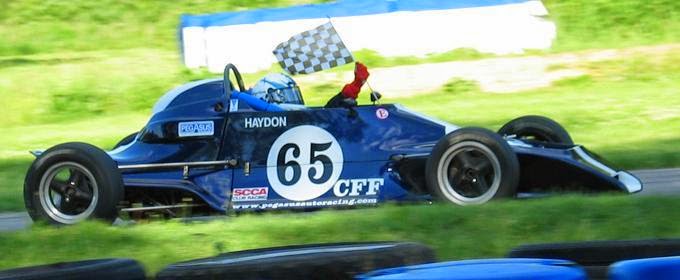
Yes, I am writing this post purely out of shame. The kind of shame that comes with not writing anything in three months.
It's that time of year, though, and the excuses are the same as last year: It's too cold to do anything with the car, I've been working on the catalog, and I'm in hibernation. There is a new excuse on this year's list: We're still dealing with the basement rebuild. This week was the first time in 6 months that actually mopping the (new) basement floor looked like it wouldn't be a total waste of time. And even that took three hours and almost an entire box of Swiffer pads. The construction dust was so thick that it would completely clog a pad after about 5 square feet. The sponge mop only rearranged the dust into fascinating new patterns.
The catalog just arrived today (it will be in the mail to you shortly, don't panic), and once again it looks like the best we've ever done. I can't take as much credit this year though. The choice of paper and ink and printer and presses combined to make the photos and really pop. The blacks are actually black this year, not just dark grey. The type looks sharper as well. And then there's all that wonderful text and layout work. I'll autograph your copy if you bring me a Sharpie. (No, not a Shar Pei. It's hard to write with a dog.)
If I may be permitted to whine a bit about the weather: BRRR!! I heard last night that we had 24 consecutive days this month with a high temperature below freezing. Three days in a row we had a high in the single digits, and for three nights the lows were in the teens below zero. That's Fahrenheit, folks. Not Celsius.
I have been told to be thankful for cold winters, because that helps to control the bug population. On the other hand, the mountains of snow on the ground have probably insulated the little critters pretty well. I'll bet they're loving life right now. Jerks. I should probably mention here that I was stung by a bee at the last race. Stupid little thing flew right into me, landed on my neck under the collar of my driver's suit, and then the little turkey had the nerve (and the stinger) to blame me for it. Moron.
The trailer is currently buried behind the garage, and the car is buried inside the garage. I expect that's how things will stay for at least a few more weeks. I had planned all kinds of projects for the car to get it ready for the Formula Ford 40th Birthday Party race at Road America in July, but of course I haven't started any of them. The good news is that only two of them are really important: Checking the engine bearings and revising the shoulder harness mounting points.
What's wrong with the current shoulder belt mounts? The Tiga was designed before anyone ever thought about head and neck restraint devices, so the mounts are about 10 inches apart. Unfortunately, the HANS Device (virtually the standard head and neck restraint these days) requires the shoulder belt mount spacing to be no more than 6 inches center-to-center. Bruce Lindstrand had modified the mounts on the LMI Tiga, and I was hoping to copy his design. It is a very clever design: It brings the belts closer together, it's a stronger mount (the belts are anchored to two square tubes instead of just one), and it allows for vertical adjustment to accomodate taller and shorter drivers. He also eliminated a somewhat questionable piece of anchoring hardware, which can't be a bad thing.
Changing the mounts will require stripping the car to the bare frame. Stripping the car will require room in the garage. Room in the garage will require moving about two tons of assorted things that don't really have a permanent home. Finding them a home will require clearing household items out of the storage garage that we rented while the basement was being redone. Moving those items will require a clean basement floor. Oh, wait...
Showing posts with label Nuts and Bolts. Show all posts
Showing posts with label Nuts and Bolts. Show all posts
Friday, January 30, 2009


Friday, February 22, 2008
Hibernation
Have I mentioned that I am not a fan of winter? I'm not. Especially winters where the snowfall total is more than I am tall, the windchills are below zero for days at a time, and even the plow trucks get stuck. Winter Wonderland? Sure, if by "wonder" you mean “I wonder if I’ll make it to work today… I wonder when I’ll feel my toes again… I wonder if I should buy a few more sets of long underwear... I wonder if I still have ears...”
Our one-year-old snowblower is going to need a major overhaul if summer ever comes, because it has seen some very hard use this winter. I think the racecar has seen less abuse in 30 years than the snowblower has seen in 3 months. I should be thankful that snowblowers don’t have logbooks. That would be an embarrassing read: “Crashed into ice-packed snowbank; repair auger hood damage before next snowfall… Stalled by choking on heavy snow; check engine case for cracks before next storm… Rolled, total damage to everything, tech sticker pulled…”
Last Sunday was a refreshing change. Instead of shoveling ice and snow, I spent the day shoveling ice and water. The mercury finally poked its head up over the 30 degree mark as a warm (storm) front came through town. For the first time in months, we got rain instead of snow. It was a terrific opportunity to get the two-inch layer of ice off the driveway, but underneath the ice was a lot of water. The rain and melting snow combined to make some epic puddles (which couldn’t get past the snowbanks on either side of the driveway into the soil which was frozen anyway), so I basically worked on corralling the water from the garage to the street, which was also flooded and iced over. I was thrilled with the rain, but I also wasn’t sad when it finally changed to snow in the afternoon.
Fortunately, the warm weather (well, relatively warm) gave me an opportunity to finally get the car up on stands, and just in time too. All that water in the garage has now frozen into a fascinating display of freeze expansion. Depending on your point of view, the garage floor looks either like a 3-D map of the glaciers during the ice age, or like a snapshot of the tide coming in. The ice actually sits up so high that it just touches one of the rear wheels, which is hanging 2 inches off the floor.
That’s enough talk about winter. I’m getting cold.
I mentioned before that this is the first time that I’ve had a running car in my garage during the off-season. I’m used to panicking with a three-page to-do list a couple of weeks before the first event, so this is an unusual situation for me to say the least. I do have a brief list of projects to keep me busy, like fixing some stripped threads on the gearbox and re-doing a hasty exhaust repair, but the car is essentially ready to run. So what do I do now?
My other big area of indecision is in planning the 2008 season. I have a list of events I really want to run, but they don’t really add up to a season. I’m looking at an SCCA Regional here and a Midwestern Council race there, but I’m not leaning towards a commitment to any one series right now. Each group has at least one event that I'm willing to miss the other group's race for, so I won't be running a full season with either group.
Another question mark on the horizon is my license renewal. Because of my abbreviated 2007 season, I ran enough races to renew an SCCA Regional license, but not enough to automatically renew my National license*. For an extra fee I can apply for a waiver to renew my National license, and for another extra fee I can also apply for a waiver to renew my Midwestern Council license. MC will let me run on an SCCA license, but I won’t be awarded any points (which won’t be a big deal if I’m not running the full MC schedule anyway, since I won’t be in the running for a championship).
Here are the not-quite-set-in-concrete, definite maybe events that I’m considering, possibly:
April 19-20 Driver’s School & Race, MC, Blackhawk Farms
April 27 SCCA Regional Race, Blackhawk Farms
May 24-25 SCCA Double Regional, Grattan (MI)
May 31-June 1 SCCA Double Regional, Road America
June 29 MC Race, Blackhawk Farms
July 12-13 SCCA Double Regional, Blackhawk Farms
July 19-20 Driver’s School & Race, MC, Blackhawk Farms
August 9-10 (a busy weekend) MC Race, Blackhawk
(or) SCCA National, Grattan
(or) SCCA Double Regional, Mid-Ohio
August 30-31 SCCA Double Regional, State Fair Park
Sept 13-14 SCCA Double Regional, Road America
Sept 21 MC Race, Blackhawk Farms
Oct 18-19 SCCA Regional, Blackhawk Farms
Oct 25-26 MC Race, Blackhawk Farms
Whoops, that’s 13. Not that I’m superstitious, but let’s put the June 8 MC Race at Autobahn Country Club on the list too.
My only complaint about that calendar is the same as in many other years: The events are clustered, with back-to-back events separated by long gaps. The back-to-back events at Blackhawk are not too tough because the setup doesn’t need to be changed, but going from Grattan to Road America to Autobahn can be tough. In addition to the major wallet strain, you have to schedule a gear change during the week. That isn’t a big deal for some people named Nicole Temple who can change gears in 15 minutes, but when it takes you an entire evening (hi, that’s me), the week gets pretty hectic. Unload the car Sunday night (if it’s not too late), clean the car and get the tools back together Monday night, nut & bolt Tuesday, change gears Wednesday, load the truck Thursday so you can take the car along Friday morning so you can leave from work Friday afternoon. That doesn’t leave much room for actually fixing problems.
But thinking about it again, the first back-to-back like that is the Memorial Day weekend at Grattan followed by a Road America event. RA is so close to home that I wouldn’t have to load the car until Friday night after work, or even Saturday morning (plus we have a holiday on Monday which will help). The trip back home from RA Sunday night will get us home early enough to get everything unloaded and cleaned up so we can start working on the car on Monday. And the next event (MC at Autobahn) is Sunday only, so I could drive down Saturday night or (ungodly early) Sunday morning, so that’s another half-day on my side at least. The other nasty back-to-back is the September Road America event followed by an MC Race at Blackhawk. The MC race is also a one-day (Sunday) event, which gives me Saturday to finish the car, after an early evening the Sunday before. So what am I worried about?
*To renew an SCCA Regional license, SCCA requires completing 2 Regional races. To renew an SCCA National license, SCCA requires 4 Regionals, or 2 Nationals and 1 Regional, or 3 Nationals. I ran 2 Regionals plus 2 MC events which are not officially recognized by SCCA for licensing purposes.
Our one-year-old snowblower is going to need a major overhaul if summer ever comes, because it has seen some very hard use this winter. I think the racecar has seen less abuse in 30 years than the snowblower has seen in 3 months. I should be thankful that snowblowers don’t have logbooks. That would be an embarrassing read: “Crashed into ice-packed snowbank; repair auger hood damage before next snowfall… Stalled by choking on heavy snow; check engine case for cracks before next storm… Rolled, total damage to everything, tech sticker pulled…”
Last Sunday was a refreshing change. Instead of shoveling ice and snow, I spent the day shoveling ice and water. The mercury finally poked its head up over the 30 degree mark as a warm (storm) front came through town. For the first time in months, we got rain instead of snow. It was a terrific opportunity to get the two-inch layer of ice off the driveway, but underneath the ice was a lot of water. The rain and melting snow combined to make some epic puddles (which couldn’t get past the snowbanks on either side of the driveway into the soil which was frozen anyway), so I basically worked on corralling the water from the garage to the street, which was also flooded and iced over. I was thrilled with the rain, but I also wasn’t sad when it finally changed to snow in the afternoon.
Fortunately, the warm weather (well, relatively warm) gave me an opportunity to finally get the car up on stands, and just in time too. All that water in the garage has now frozen into a fascinating display of freeze expansion. Depending on your point of view, the garage floor looks either like a 3-D map of the glaciers during the ice age, or like a snapshot of the tide coming in. The ice actually sits up so high that it just touches one of the rear wheels, which is hanging 2 inches off the floor.
That’s enough talk about winter. I’m getting cold.
I mentioned before that this is the first time that I’ve had a running car in my garage during the off-season. I’m used to panicking with a three-page to-do list a couple of weeks before the first event, so this is an unusual situation for me to say the least. I do have a brief list of projects to keep me busy, like fixing some stripped threads on the gearbox and re-doing a hasty exhaust repair, but the car is essentially ready to run. So what do I do now?
My other big area of indecision is in planning the 2008 season. I have a list of events I really want to run, but they don’t really add up to a season. I’m looking at an SCCA Regional here and a Midwestern Council race there, but I’m not leaning towards a commitment to any one series right now. Each group has at least one event that I'm willing to miss the other group's race for, so I won't be running a full season with either group.
Another question mark on the horizon is my license renewal. Because of my abbreviated 2007 season, I ran enough races to renew an SCCA Regional license, but not enough to automatically renew my National license*. For an extra fee I can apply for a waiver to renew my National license, and for another extra fee I can also apply for a waiver to renew my Midwestern Council license. MC will let me run on an SCCA license, but I won’t be awarded any points (which won’t be a big deal if I’m not running the full MC schedule anyway, since I won’t be in the running for a championship).
Here are the not-quite-set-in-concrete, definite maybe events that I’m considering, possibly:
April 19-20 Driver’s School & Race, MC, Blackhawk Farms
April 27 SCCA Regional Race, Blackhawk Farms
May 24-25 SCCA Double Regional, Grattan (MI)
May 31-June 1 SCCA Double Regional, Road America
June 29 MC Race, Blackhawk Farms
July 12-13 SCCA Double Regional, Blackhawk Farms
July 19-20 Driver’s School & Race, MC, Blackhawk Farms
August 9-10 (a busy weekend) MC Race, Blackhawk
(or) SCCA National, Grattan
(or) SCCA Double Regional, Mid-Ohio
August 30-31 SCCA Double Regional, State Fair Park
Sept 13-14 SCCA Double Regional, Road America
Sept 21 MC Race, Blackhawk Farms
Oct 18-19 SCCA Regional, Blackhawk Farms
Oct 25-26 MC Race, Blackhawk Farms
Whoops, that’s 13. Not that I’m superstitious, but let’s put the June 8 MC Race at Autobahn Country Club on the list too.
My only complaint about that calendar is the same as in many other years: The events are clustered, with back-to-back events separated by long gaps. The back-to-back events at Blackhawk are not too tough because the setup doesn’t need to be changed, but going from Grattan to Road America to Autobahn can be tough. In addition to the major wallet strain, you have to schedule a gear change during the week. That isn’t a big deal for some people named Nicole Temple who can change gears in 15 minutes, but when it takes you an entire evening (hi, that’s me), the week gets pretty hectic. Unload the car Sunday night (if it’s not too late), clean the car and get the tools back together Monday night, nut & bolt Tuesday, change gears Wednesday, load the truck Thursday so you can take the car along Friday morning so you can leave from work Friday afternoon. That doesn’t leave much room for actually fixing problems.
But thinking about it again, the first back-to-back like that is the Memorial Day weekend at Grattan followed by a Road America event. RA is so close to home that I wouldn’t have to load the car until Friday night after work, or even Saturday morning (plus we have a holiday on Monday which will help). The trip back home from RA Sunday night will get us home early enough to get everything unloaded and cleaned up so we can start working on the car on Monday. And the next event (MC at Autobahn) is Sunday only, so I could drive down Saturday night or (ungodly early) Sunday morning, so that’s another half-day on my side at least. The other nasty back-to-back is the September Road America event followed by an MC Race at Blackhawk. The MC race is also a one-day (Sunday) event, which gives me Saturday to finish the car, after an early evening the Sunday before. So what am I worried about?
*To renew an SCCA Regional license, SCCA requires completing 2 Regional races. To renew an SCCA National license, SCCA requires 4 Regionals, or 2 Nationals and 1 Regional, or 3 Nationals. I ran 2 Regionals plus 2 MC events which are not officially recognized by SCCA for licensing purposes.
Tuesday, November 13, 2007
Catching Up
It's all a blur.
Starting where we left off, Friday (October 26) during lunch I drove to NAPA to pick up the correct bearings. Then the fun began.
If you recall, we had to warm the upright and chill the bearings to loosen the interference fit between them. I put the bearings in the freezer and checked the LP tank on the gas grill at work. Everything was ready to go, but I didn't want to char the uprights or get burger grease on them. Fortunately, we tend to save things here. We had a company lunch a while back, with food from a local restaurant brought in inside pans of heavy aluminum foil. Knowing that the pans would come in handy somehow, we washed and saved the pans and the lids. One lid was the perfect size and shape to wrap the upright to protect it from smoke and hot spots. We fired up the grill and put the upright in to cook for an hour.

Bruce Lindstrand had told me that if I warmed the upright and chilled the bearings, the bearings would slip right in (insert slurping noise here). I confess I'm not used to things going that smoothly. When I hear, "They'll slip right in (slurping noise)," that translates to "You'll only have to fight with them for 15 minutes, not an hour or two." But this was a statement I could have taken at face value. I positioned the first bearing over its hole just to get it ready for the press, but the frost on the bearing made me lose my grip on it, and it fell out of my hand... and slipped right in (slurping noise). We were so thrilled that we flipped the upright over to get the other bearing in from the other side -- and the first bearing slipped right back out. A few minutes of Three Stooges re-enactment later, and both bearings were in. By the time the upright cooled to the point that the bearings would not fall out, it was after 5pm. I wrapped the assembly in racer's tape to ensure that the bearings would still be in the upright when I got home.
Reassembly was only a little more work than disassembly, but not by much. When everything was back together, I spun each axle and listened for any noise. The right axle had a little noise that seemed to be coming from the inner CV joint, so I took that joint apart to examine it. There was a little wear inside, and a couple of the balls had a little discoloration, so I decided to replace it. First I would need to grease the new joint. Which took a little longer than I anticipated, because I had to look for my grease gun (I'm still unpacking from the move). And the grease gun was empty. No problem, I have more grease in the basement. Twenty minutes later, the grease gun was loaded with fresh grease and so was I. Ten minutes later the new CV joint was installed and the car was on the ground. It was about 9pm at this point, so I was well ahead of schedule. I got the car on the trailer and went to bed.
I think I've mentioned before that I'm not a fan of being in the first group of the day. I'm not a morning person to begin with, and I don't like having to rush to be ready. But the truck was running well and the prior weekend's head wind had died down, so I was able to get to the track by 7am. The good people in Registration and Tech got me through in plenty of time to set up a work area. We got the canopy set up with the sidewalls on (50 degrees with a stiff wind is not nearly as pleasant as 50 degrees with no wind at all), unloaded the truck, and got some hot chocolate.
The first practice session was incident-free. Despite the cold, I turned a 1:21. The engine was very strong -- cold weather typically makes more horsepower than hot weather -- but the cold air seemed to be right at the limit of the carburetor jetting. There was a definite lag getting on the throttle, and the exhaust would pop frequently, but I had no competition, so I wasn't too worried.
We huddled around the car under the canopy during lunch. The warm tires, brakes, and engine were like a campfire in our tent. One quick nut-and-bolt check (and refueling) later, and we were ready for qualifying. The afternoon was slightly warmer than the morning, so the engine was running a bit better and the tires were gripping better. I qualified at a 1:19.6, which put be 8th overall in the group, but the official grid confirmed that I had no competition. I was the only car entered in CFF for this race. Of course I have mixed emotions about that. Every trophy and every win still means a lot to me, and running alone makes for a very relaxing race. On the other hand, it also makes for a boring race, both for me and for anyone I talked into coming to watch. It also means that the average number of entrants in the class is coming down. Still, I needed to run this race in order to keep my license current, so I wasn't about to go home.
We checked over the car before buttoning it up for the night. Everything looked good, but we struggled for a while with the zippers on the sidewalls. The car is just a little bit longer than the canopy is, and the sidewalls are only just barely long enough to go all the way around the canopy -- IF the legs are perfectly vertical. Which they weren't.
It was a bit like another Three Stooges episode. We'd close the zipper a little bit, then it would refuse to budge because the opening was too wide. Then we'd pull up the stakes holding a couple of legs down, move the legs in a bit, stake them back down, and try the zipper again. Better, closer, but still a bit too snug. Pull up the stakes, move the legs in, stake them back down, try the zipper. That one got us another 3/4 of an inch. (Before you yell, "Idiots! Why do you keep pounding the stakes back in before you try the zipper?" Please understand, it was windy. As soon as a stake came up, the canopy began dancing in the wind. We had to get the stakes back in the ground as quickly as we could or we'd lose the whole thing.)
We finally got the zippers almost all the way to the ground and called it good. Driving away, my father remarked that the canopy looked remarkably like a tomb. Yeah, let's not bring up death at a racetrack, okay?
Sunday morning was clear and nowhere near as windy, but we were greeted by a layer of frost on everything. Thankfully the sun was coming out when we got to the track, so it felt even warmer than Saturday. Unfortunately, that meant the frost on the canopy was melting quickly, and it was dripping on everything. We pushed the car out and left the canopy to dry in the sun.
I warmed up the car, changed into my driver's suit, and waited for the calls to grid. Normally, they will announce three calls to the grid over the PA system. When they give "third and final call," they will often warn that the grid will close soon (typically 5 minutes). Anyone who is not on the grid when the grid closes will lose his starting position and will have to start the race from the back of the grid.
The PA was eerily silent. Several of us were standing around, wondering out loud when the grid calls would start. Finally, about 5 minutes before the race was scheduled to start, they gave first call. I walked to the car and suddenly heard an oddly frantic voice over the PA shrieking, "Grid is at 5 minutes!! Grid is at 5 minutes!!" The grid had signalled that the race would begin in 5 minutes. I drove the 50 feet to the grid and was informed that I was late and would have to start at the back. Was this someone's idea of a joke? One grid call, and then we're suddenly late? What happened to second call, third call, and the warning that the grid was closed?
Actually, I wasn't that close to the back. Only four or five cars had made it to the grid "on time." The rest of us were being lined up as we came, and at least four cars were behind me. Suddenly I was very glad that I didn't have any competition. If I had been trying to beat someone, I'd have been furious. Or at least as upset as my dad was. I actually had to try to calm him down while I waited for the pace lap to start.
For the start of the pace lap, cars pull out from the grid and stop on the front straight as they wait for the rest of the field to line up behind them. Once the entire field is lined up on the front straight, the pace car pulls out to start the pace lap. I waited for the cars behind me (maybe it's more than four, this is taking a while) and saw the pace car pull away. The cars in front of me began to move, I went to pull away -- and stalled the car. I have never done that before -- have I? Maybe once before. Or twice. But not in the last 5 years, certainly. I think. I got the car started again and rejoined the field for what was perhaps the fastest pace lap of my life. Nobody had a chance to scrub tires or warm their brakes, but I'm sure we warmed up the track a bit.
The grid mix-up had put me behind several FVs and FSTs, which I decided to use for entertainment. I would gradually pull up behind a slower car and watch the driver's technique, looking for any little tricks that I haven't seen before. I learned a few new lines through some corners (not all of them successful), but after a corner or two behind each car I would begin to look for the safest and easiest place to pass. Some were easy to pass, either under acceleration or braking. Some drivers nearly pulled over and stopped to let me pass. When I finally reached the F500 which should have been gridded behind me, I realized that I was working very hard to pass him and even harder to keep him behind me. Since we were running in different classes, I let him re-pass me, choosing an easy finish over a potential mistake.
Two cars did make the kind of mistake I was trying to avoid. An F500 and an FST tangled in corner 6 on the first lap. The FST was one of the few cars who had made it to the grid on time, but his qualifying time was the slowest of the group. It appeared that the F500 (who had not made it to the grid on time) may have been trying too hard to pass the slower car, or at least may not have realized how much slower the other car was. Both cars were unable to continue.

I settled in behind the F500 and concentrated on running a conservative race. My fastest lap time in the race was a 1:20.4, which was likely when I was trying to chase down the F500. Most of my laps during the second half of the race were in the 1:22 to 1:23 range. But I finished the race and set a new record -- for the first time, I finished the last race of the season with a car that will not need any repairs over the winter.
While we were resting after the race, a photographer approached me and told me he had been looking for me for two years. He had taken pictures of my victory lap at this same event in 2005, but he hadn't seen me since.
He only needed to look on my couch; I was there pretty much the whole time.
Starting where we left off, Friday (October 26) during lunch I drove to NAPA to pick up the correct bearings. Then the fun began.
If you recall, we had to warm the upright and chill the bearings to loosen the interference fit between them. I put the bearings in the freezer and checked the LP tank on the gas grill at work. Everything was ready to go, but I didn't want to char the uprights or get burger grease on them. Fortunately, we tend to save things here. We had a company lunch a while back, with food from a local restaurant brought in inside pans of heavy aluminum foil. Knowing that the pans would come in handy somehow, we washed and saved the pans and the lids. One lid was the perfect size and shape to wrap the upright to protect it from smoke and hot spots. We fired up the grill and put the upright in to cook for an hour.

Bruce Lindstrand had told me that if I warmed the upright and chilled the bearings, the bearings would slip right in (insert slurping noise here). I confess I'm not used to things going that smoothly. When I hear, "They'll slip right in (slurping noise)," that translates to "You'll only have to fight with them for 15 minutes, not an hour or two." But this was a statement I could have taken at face value. I positioned the first bearing over its hole just to get it ready for the press, but the frost on the bearing made me lose my grip on it, and it fell out of my hand... and slipped right in (slurping noise). We were so thrilled that we flipped the upright over to get the other bearing in from the other side -- and the first bearing slipped right back out. A few minutes of Three Stooges re-enactment later, and both bearings were in. By the time the upright cooled to the point that the bearings would not fall out, it was after 5pm. I wrapped the assembly in racer's tape to ensure that the bearings would still be in the upright when I got home.
Reassembly was only a little more work than disassembly, but not by much. When everything was back together, I spun each axle and listened for any noise. The right axle had a little noise
 that seemed to be coming from the inner CV joint, so I took that joint apart to examine it. There was a little wear inside, and a couple of the balls had a little discoloration, so I decided to replace it. First I would need to grease the new joint. Which took a little longer than I anticipated, because I had to look for my grease gun (I'm still unpacking from the move). And the grease gun was empty. No problem, I have more grease in the basement. Twenty minutes later, the grease gun was loaded with fresh grease and so was I. Ten minutes later the new CV joint was installed and the car was on the ground. It was about 9pm at this point, so I was well ahead of schedule. I got the car on the trailer and went to bed.
I think I've mentioned before that I'm not a fan of being in the first group of the day. I'm not a morning person to begin with, and I don't like having to rush to be ready. But the truck was running well and the prior weekend's head wind had died down, so I was able to get to the track by 7am. The good people in Registration and Tech got me through in plenty of time to set up a work area. We got the canopy set up with the sidewalls on (50 degrees with a stiff wind is not nearly as pleasant as 50 degrees with no wind at all), unloaded the truck, and got some hot chocolate.
The first practice session was incident-free. Despite the cold, I turned a 1:21. The engine was very strong -- cold weather typically makes more horsepower than hot weather -- but the cold air seemed to be right at the limit of the carburetor jetting. There was a definite lag getting on the throttle, and the exhaust would pop frequently, but I had no competition, so I wasn't too worried.
We huddled around the car under the canopy during lunch. The warm tires, brakes, and engine were like a campfire in our tent. One quick nut-and-bolt check (and refueling) later, and we were ready for qualifying. The afternoon was slightly warmer than the morning, so the engine was running a bit better and the tires were gripping better. I qualified at a 1:19.6, which put be 8th overall in the group, but the official grid confirmed that I had no competition. I was the only car entered in CFF for this race. Of course I have mixed emotions about that. Every trophy and every win still means a lot to me, and running alone makes for a very relaxing race. On the other hand, it also makes for a boring race, both for me and for anyone I talked into coming to watch. It also means that the average number of entrants in the class is coming down. Still, I needed to run this race in order to keep my license current, so I wasn't about to go home.
We checked over the car before buttoning it up for the night. Everything looked good, but we struggled for a while with the zippers on the sidewalls. The car is just a little bit longer than the canopy is, and the sidewalls are only just barely long enough to go all the way around the canopy -- IF the legs are perfectly vertical. Which they weren't.
It was a bit like another Three Stooges episode. We'd close the zipper a little bit, then it would refuse to budge because the opening was too wide. Then we'd pull up the stakes holding a couple of legs down, move the legs in a bit, stake them back down, and try the zipper again. Better, closer, but still a bit too snug. Pull up the stakes, move the legs in, stake them back down, try the zipper. That one got us another 3/4 of an inch. (Before you yell, "Idiots! Why do you keep pounding the stakes back in before you try the zipper?" Please understand, it was windy. As soon as a stake came up, the canopy began dancing in the wind. We had to get the stakes back in the ground as quickly as we could or we'd lose the whole thing.)
We finally got the zippers almost all the way to the ground and called it good. Driving away, my father remarked that the canopy looked remarkably like a tomb. Yeah, let's not bring up death at a racetrack, okay?
Sunday morning was clear and nowhere near as windy, but we were greeted by a layer of frost
 on everything. Thankfully the sun was coming out when we got to the track, so it felt even warmer than Saturday. Unfortunately, that meant the frost on the canopy was melting quickly, and it was dripping on everything. We pushed the car out and left the canopy to dry in the sun.
I warmed up the car, changed into my driver's suit, and waited for the calls to grid. Normally, they will announce three calls to the grid over the PA system. When they give "third and final call," they will often warn that the grid will close soon (typically 5 minutes). Anyone who is not on the grid when the grid closes will lose his starting position and will have to start the race from the back of the grid.
The PA was eerily silent. Several of us were standing around, wondering out loud when the grid calls would start. Finally, about 5 minutes before the race was scheduled to start, they gave first call. I walked to the car and suddenly heard an oddly frantic voice over the PA shrieking, "Grid is at 5 minutes!! Grid is at 5 minutes!!" The grid had signalled that the race would begin in 5 minutes. I drove the 50 feet to the grid and was informed that I was late and would have to start at the back. Was this someone's idea of a joke? One grid call, and then we're suddenly late? What happened to second call, third call, and the warning that the grid was closed?
Actually, I wasn't that close to the back. Only four or five cars had made it to the grid "on time." The rest of us were being lined up as we came, and at least four cars were behind me. Suddenly I was very glad that I didn't have any competition. If I had been trying to beat someone, I'd have been furious. Or at least as upset as my dad was. I actually had to try to calm him down while I waited for the pace lap to start.
For the start of the pace lap, cars pull out from the grid and stop on the front straight as they wait for the rest of the field to line up behind them. Once the entire field is lined up on the front straight, the pace car pulls out to start the pace lap. I waited for the cars behind me (maybe it's more than four, this is taking a while) and saw the pace car pull away. The cars in front of me began to move, I went to pull away -- and stalled the car. I have never done that before -- have I? Maybe once before. Or twice. But not in the last 5 years, certainly. I think. I got the car started again and rejoined the field for what was perhaps the fastest pace lap of my life. Nobody had a chance to scrub tires or warm their brakes, but I'm sure we warmed up the track a bit.
The grid mix-up had put me behind several FVs and FSTs, which I decided to use for entertainment. I would gradually pull up behind a slower car and watch the driver's technique, looking for any little tricks that I haven't seen before. I learned a few new lines through some corners (not all of them successful), but after a corner or two behind each car I would begin to look for the safest and easiest place to pass. Some were easy to pass, either under acceleration or braking. Some drivers nearly pulled over and stopped to let me pass. When I finally reached the F500 which should have been gridded behind me, I realized that I was working very hard to pass him and even harder to keep him behind me. Since we were running in different classes, I let him re-pass me, choosing an easy finish over a potential mistake.
Two cars did make the kind of mistake I was trying to avoid. An F500 and an FST tangled in corner 6 on the first lap. The FST was one of the few cars who had made it to the grid on time, but his qualifying time was the slowest of the group. It appeared that the F500 (who had not made it to the grid on time) may have been trying too hard to pass the slower car, or at least may not have realized how much slower the other car was. Both cars were unable to continue.

I settled in behind the F500 and concentrated on running a conservative race. My fastest lap time in the race was a 1:20.4, which was likely when I was trying to chase down the F500. Most of my laps during the second half of the race were in the 1:22 to 1:23 range. But I finished the race and set a new record -- for the first time, I finished the last race of the season with a car that will not need any repairs over the winter.
While we were resting after the race, a photographer approached me and told me he had been looking for me for two years. He had taken pictures of my victory lap at this same event in 2005, but he hadn't seen me since.
He only needed to look on my couch; I was there pretty much the whole time.
Friday, October 26, 2007
Losing my Bearings
I forgot the cardinal rule of auto racing: When everything looks like it's falling into place, you've missed something. Put another way, if anything can be described as "too easy", it is.
I purchased replacement bearings (four, in case we damaged any on installation). I took the upright off the car (it came off without any trouble). I packed everything in a box and arranged to take it all to LMI Thursday evening.
The first thing Bruce did was to take the stub axle out of the upright. As soon as he did, he could see that I had purchased the wrong bearings. Nothing about them was correct -- wrong size (by about 1mm on the OD), wrong type (double-row ball instead of single-row ball), and much too wide to fit the upright. He got the old bearings out without much trouble (he makes it look so easy), but there was nothing else we could do. The parts stores were closed, and none of the other cars in the LMI shop use the bearing I needed. I put all the loose parts back in the box and drove home.
The real shame is not that I wasted all that time driving to Darien. I felt worse that I asked Bruce to stay in the shop three hours after they closed so he could help me. But this morning I have an upright with no bearings, and no access to the proper way to install the new bearings once I get them.
The proper way to install bearings in a cast aluminum part is to start by warming the aluminum part to about 300-350 degrees. This makes the bearing bore slightly larger, making it easier to slip the bearing in. Ideally the bearings should also be chilled to shrink them slightly for even more clearance. Finally, a press should be at hand to squeeze the bearings into place. I have two out of those three here at work and at home. We have a press and a freezer at work, but no oven. We have an oven and a freezer at home, but no press. If the bearings arrive in time today, we may try to warm the upright on a gas grill. If not, I'll have to go shopping for a press on my way home tonight. And then I'll have to do a lot of explaining and apologizing for putting my car parts in the oven.
I'm giving myself until midnight tonight. If the car isn't on its wheels by then (or at least making significant progress), I don't think I'll make the race this weekend.
I purchased replacement bearings (four, in case we damaged any on installation). I took the upright off the car (it came off without any trouble). I packed everything in a box and arranged to take it all to LMI Thursday evening.
The first thing Bruce did was to take the stub axle out of the upright. As soon as he did, he could see that I had purchased the wrong bearings. Nothing about them was correct -- wrong size (by about 1mm on the OD), wrong type (double-row ball instead of single-row ball), and much too wide to fit the upright. He got the old bearings out without much trouble (he makes it look so easy), but there was nothing else we could do. The parts stores were closed, and none of the other cars in the LMI shop use the bearing I needed. I put all the loose parts back in the box and drove home.
The real shame is not that I wasted all that time driving to Darien. I felt worse that I asked Bruce to stay in the shop three hours after they closed so he could help me. But this morning I have an upright with no bearings, and no access to the proper way to install the new bearings once I get them.
The proper way to install bearings in a cast aluminum part is to start by warming the aluminum part to about 300-350 degrees. This makes the bearing bore slightly larger, making it easier to slip the bearing in. Ideally the bearings should also be chilled to shrink them slightly for even more clearance. Finally, a press should be at hand to squeeze the bearings into place. I have two out of those three here at work and at home. We have a press and a freezer at work, but no oven. We have an oven and a freezer at home, but no press. If the bearings arrive in time today, we may try to warm the upright on a gas grill. If not, I'll have to go shopping for a press on my way home tonight. And then I'll have to do a lot of explaining and apologizing for putting my car parts in the oven.
I'm giving myself until midnight tonight. If the car isn't on its wheels by then (or at least making significant progress), I don't think I'll make the race this weekend.
Wednesday, October 24, 2007
Getting My Bearings
The good people at Lindstrand Motorsports have helped me identify the mysterious noises I thought I was hearing. The noises were real, and they were the result of worn wheel bearings. The left rear wheel can be moved about 1/8" up and down, although it is still tight side to side.
The left rear wheel on a formula car is typically the most heavily loaded wheel in road racing. Road racing courses are generally run clockwise, which emphasizes right hand turns. Turning right transfers weight to the outside wheels (the left side), and the rear of the car is heavier than the front, both because of static weight distribution and because weight transfers to the rear wheels under acceleration. I won't speculate on what percentage of the car's weight is carried by the left rear wheel in a right hand turn, but I wouldn't be surprised if it was more than half. This is the same force that ate up the VW wheel hubs I used a couple of years ago.
What appears to have happened is the outer race of the bearing has become egg-shaped (pointy end up) from the extra weight it has been carrying. It hasn't just generally worn out, which would cause the wheel to be loose in every direction. If you put one hand on the tire at 3 o'clock and your other hand at 9 o'clock and push and pull, you won't feel any play. But put your hands at 6 o'clock and 12 o'clock and you can move the wheel up and down with an audible clunk.
The plan for the next few days is to take the upright off tonight so that I can deliver it (and two new bearings) to LMI tomorrow, as Bruce has offered to stay in the shop after hours to help press the old bearings out and install the new ones. Depending on the hour when I get home Thursday night, I may try to get the car back together that night so I can load up Friday night and head to the track Saturday morning. I don't know if I'll make it in time for the first practice session in the morning, but I should be ready for qualifying in the afternoon.
The left rear wheel on a formula car is typically the most heavily loaded wheel in road racing. Road racing courses are generally run clockwise, which emphasizes right hand turns. Turning right transfers weight to the outside wheels (the left side), and the rear of the car is heavier than the front, both because of static weight distribution and because weight transfers to the rear wheels under acceleration. I won't speculate on what percentage of the car's weight is carried by the left rear wheel in a right hand turn, but I wouldn't be surprised if it was more than half. This is the same force that ate up the VW wheel hubs I used a couple of years ago.
What appears to have happened is the outer race of the bearing has become egg-shaped (pointy end up) from the extra weight it has been carrying. It hasn't just generally worn out, which would cause the wheel to be loose in every direction. If you put one hand on the tire at 3 o'clock and your other hand at 9 o'clock and push and pull, you won't feel any play. But put your hands at 6 o'clock and 12 o'clock and you can move the wheel up and down with an audible clunk.
The plan for the next few days is to take the upright off tonight so that I can deliver it (and two new bearings) to LMI tomorrow, as Bruce has offered to stay in the shop after hours to help press the old bearings out and install the new ones. Depending on the hour when I get home Thursday night, I may try to get the car back together that night so I can load up Friday night and head to the track Saturday morning. I don't know if I'll make it in time for the first practice session in the morning, but I should be ready for qualifying in the afternoon.
Friday, December 23, 2005
Racing Checklists
The king of racecar preparation, the late Carroll Smith, once said, “Life without checklists is chaos.” It took me a while to learn that. When I started racing, checklists seemed to be overkill. I recently realized that the racers I admired -- the people with immaculately clean cars that always finished every session (usually toward the front) and never panicked -- all used checklists. Now I swear by them instead of at them. A while ago I promised all you insomniacs a rundown of my now-famous racing checklists. Here are some of the things I've learned about making and using them. Brush your teeth, put on your PJs, and get yourself tucked in.
First, we need to agree that a race car is a complex assembly of fragile parts held together by fasteners that loosen in response to the vibrations of the racing engine. Every session, the engine does its best to shake the car apart while the driver does his best to break it. By the end of a session, something (oftentimes many somethings) will be loose, missing, broken, about to break, worn out, out of adjustment, leaking, burned, or boiled away. If you finish a session and nothing falls into one of those categories, you probably didn't go fast enough.
The constant stress and strain on the car means that dozens of different things need to be checked every time the car comes off the track. In addition to checking all of those things, you also need to add fuel, reset the tire pressures, make any necessary adjustments, and get yourself ready for the next session. It's pretty much impossible to remember all of that every time. Without a checklist, something is bound to be forgotten. That's the fundamental reason behind checklists.
Checklists never forget what needs to be done. Checklists also tell you at a glance what has already been checked so you don't waste time checking it again. Good checklists can create an ongoing record of maintenance and repairs. Checklists also make it easier to delegate work to other people on the crew so that you can take a break. And the best part is the peace of mind you can enjoy while sitting on the grid, knowing that your car is fully prepared for the session.
On the other hand, checklists can't do the maintenance for you. The most detailed checklist does you no good sitting in a desk drawer. Checklists should never, ever be used to assign blame when something goes wrong! The crew should initial when a job is done instead of just checking it off, but that should only be used for things like tracking down the missing 1/2" wrench and knowing who to ask just how far that adjuster nut had backed off. It's also easy to look at a simple checkmark and think to yourself, "I don't remember doing that... what else did I check off without really doing it?"
My own checklists have evolved from a note pinned to my shirt ("Fill Gas!") to a one-page list of jobs to do between sessions (the "Track" list) and a two-page list of jobs to do between race weekends (the "Garage" list). Jobs have been added and deleted, leading to very personal lists tailored to my particular car. The Track list includes items that need attention after every session to keep disaster at bay: Check the critical fasteners, check the fluids, bleed the brakes. The Garage list includes jobs that aren’t easily done at the track: Check the rest of the fasteners, change the fluids, and change the brake pads. All of the items on the Track list are also on the Garage list.
Since my car is water-cooled, "Bleed Radiator" and "Check Water Level" are on both lists. Since it has disc brakes, "Adjust Brake Shoes" is not. The fasteners which are more prone to loosening on my particular car also appear on the Track list. The fasteners which do not frequently come loose are on the Garage list. If they develop the habit of loosening, they are moved to the Track list. If they establish a stable history, they may be moved to the Garage list.
The checklists are organized to allow a good flow of work. The jobs are arranged by chronological order, grouped by physical area, and grouped by similarity to each other.
When I say chronological order, I mean that I want to be able to start almost as soon as the car comes off the track and go down the list without skipping a job because those parts are still too hot to touch. For example, "Check Exhaust Header Bolts" is at the end of the list, after the engine has had a chance to cool off. The very last jobs are setting tire pressures (which could change if the car sits too long in the sun) and pushing the car to the grid.
The jobs are also arranged into areas to try to prevent running laps around the car. For example, the jobs at the rear of the car (checking the rear axle CV joint bolts, checking the rear brake pads, and checking the gearbox for leaks) are together so that you can do them all while you're back there. To be honest, that type of grouping hasn't been entirely successful, because so many jobs require going from one end of the car to the other anyway. Still, checking the rear brake pads should be done between checking the rear CV joints and checking the gearbox, not between checking the front brake pads and the brake fluid level -- which are both at the front of the car.
By similar jobs I mean jobs requiring the same tools. Grouping these jobs together can save a few trips running back and forth to the toolbox, but it can also reduce the chances of two people fighting over tools. For instance, if one person checks all of the critical Allen-head bolts, then he won't be waiting for someone else to finish with the Allen wrench set before he can start. The alternative is to bring a second set of those wrenches to the track, which ties up more money, weighs down the tow rig, and takes extra space in the toolbox. On the other hand, if you're fortunate enough to have a dozen crew members, or if you bring a spare car to the track, then by all means bring a second set of tools.
Next to each job is a box to be initialed when the job is complete. After each job is a space for notes or comments. For example, in the space next to "Add Fuel" you would record how much fuel was added. If you find any worn rod ends, you would note which ones in the space next to "Check Rod Ends." You can also add specifications for torque or clearance next to their respective jobs. The required torque value is printed in the field next to "Torque Lug Nuts," and the ignition timing is printed next to "Check Ignition Timing." Those specifications are added to the sheet before it is printed, so they are always available without having to look them up elsewhere.
If I can figure out a way to post an Excel spreadsheet, I'll put my checklists up here. Otherwise, feel free to ask for them -- just post a request with your email address as a comment. I'll send you both documents via email and then delete your address so you won't get spammed. Copy them, change them as you need, use them as you like, give them to your friends and competitors. I claim no copyright on them, but I also disclaim any responsibility for them or for you. You have to work with them to make them work for you. Use the principles I outlined above to make them fit your program.
First, we need to agree that a race car is a complex assembly of fragile parts held together by fasteners that loosen in response to the vibrations of the racing engine. Every session, the engine does its best to shake the car apart while the driver does his best to break it. By the end of a session, something (oftentimes many somethings) will be loose, missing, broken, about to break, worn out, out of adjustment, leaking, burned, or boiled away. If you finish a session and nothing falls into one of those categories, you probably didn't go fast enough.
The constant stress and strain on the car means that dozens of different things need to be checked every time the car comes off the track. In addition to checking all of those things, you also need to add fuel, reset the tire pressures, make any necessary adjustments, and get yourself ready for the next session. It's pretty much impossible to remember all of that every time. Without a checklist, something is bound to be forgotten. That's the fundamental reason behind checklists.
Checklists never forget what needs to be done. Checklists also tell you at a glance what has already been checked so you don't waste time checking it again. Good checklists can create an ongoing record of maintenance and repairs. Checklists also make it easier to delegate work to other people on the crew so that you can take a break. And the best part is the peace of mind you can enjoy while sitting on the grid, knowing that your car is fully prepared for the session.
On the other hand, checklists can't do the maintenance for you. The most detailed checklist does you no good sitting in a desk drawer. Checklists should never, ever be used to assign blame when something goes wrong! The crew should initial when a job is done instead of just checking it off, but that should only be used for things like tracking down the missing 1/2" wrench and knowing who to ask just how far that adjuster nut had backed off. It's also easy to look at a simple checkmark and think to yourself, "I don't remember doing that... what else did I check off without really doing it?"
My own checklists have evolved from a note pinned to my shirt ("Fill Gas!") to a one-page list of jobs to do between sessions (the "Track" list) and a two-page list of jobs to do between race weekends (the "Garage" list). Jobs have been added and deleted, leading to very personal lists tailored to my particular car. The Track list includes items that need attention after every session to keep disaster at bay: Check the critical fasteners, check the fluids, bleed the brakes. The Garage list includes jobs that aren’t easily done at the track: Check the rest of the fasteners, change the fluids, and change the brake pads. All of the items on the Track list are also on the Garage list.
Since my car is water-cooled, "Bleed Radiator" and "Check Water Level" are on both lists. Since it has disc brakes, "Adjust Brake Shoes" is not. The fasteners which are more prone to loosening on my particular car also appear on the Track list. The fasteners which do not frequently come loose are on the Garage list. If they develop the habit of loosening, they are moved to the Track list. If they establish a stable history, they may be moved to the Garage list.
The checklists are organized to allow a good flow of work. The jobs are arranged by chronological order, grouped by physical area, and grouped by similarity to each other.
When I say chronological order, I mean that I want to be able to start almost as soon as the car comes off the track and go down the list without skipping a job because those parts are still too hot to touch. For example, "Check Exhaust Header Bolts" is at the end of the list, after the engine has had a chance to cool off. The very last jobs are setting tire pressures (which could change if the car sits too long in the sun) and pushing the car to the grid.
The jobs are also arranged into areas to try to prevent running laps around the car. For example, the jobs at the rear of the car (checking the rear axle CV joint bolts, checking the rear brake pads, and checking the gearbox for leaks) are together so that you can do them all while you're back there. To be honest, that type of grouping hasn't been entirely successful, because so many jobs require going from one end of the car to the other anyway. Still, checking the rear brake pads should be done between checking the rear CV joints and checking the gearbox, not between checking the front brake pads and the brake fluid level -- which are both at the front of the car.
By similar jobs I mean jobs requiring the same tools. Grouping these jobs together can save a few trips running back and forth to the toolbox, but it can also reduce the chances of two people fighting over tools. For instance, if one person checks all of the critical Allen-head bolts, then he won't be waiting for someone else to finish with the Allen wrench set before he can start. The alternative is to bring a second set of those wrenches to the track, which ties up more money, weighs down the tow rig, and takes extra space in the toolbox. On the other hand, if you're fortunate enough to have a dozen crew members, or if you bring a spare car to the track, then by all means bring a second set of tools.
Next to each job is a box to be initialed when the job is complete. After each job is a space for notes or comments. For example, in the space next to "Add Fuel" you would record how much fuel was added. If you find any worn rod ends, you would note which ones in the space next to "Check Rod Ends." You can also add specifications for torque or clearance next to their respective jobs. The required torque value is printed in the field next to "Torque Lug Nuts," and the ignition timing is printed next to "Check Ignition Timing." Those specifications are added to the sheet before it is printed, so they are always available without having to look them up elsewhere.
If I can figure out a way to post an Excel spreadsheet, I'll put my checklists up here. Otherwise, feel free to ask for them -- just post a request with your email address as a comment. I'll send you both documents via email and then delete your address so you won't get spammed. Copy them, change them as you need, use them as you like, give them to your friends and competitors. I claim no copyright on them, but I also disclaim any responsibility for them or for you. You have to work with them to make them work for you. Use the principles I outlined above to make them fit your program.
Thursday, November 17, 2005
Winter 1, Ambition 0
I really wanted to work in the garage this week, I promise. But it is cold in Wisconsin right now. No, it isn't as cold as it will be soon, but it has once again dropped from "unseasonably warm" to "unseasonably cold" in record time. As in, last week was 50s with 10mph breezes; last night was 10 with 50mph winds. I'm just not ready for it.
I stayed inside and did paperwork instead. Thrilling, isn't it. But I'm very proud of my recordkeeping paperwork and organization. So proud, in fact, that I have to brag. Prepare to be bored.
For the past few seasons, I have kept a 3-ring binder of information about the car and the season. The binder is separated into sections for the Engine, Gearbox, Chassis / Suspension, Race Results, and Checklists. Each section has sheets of reference information, such as gear charts in the Gearbox section, and torque specs in the Engine section. Any new information is added to the appropriate section.
Each section also has a maintenance record sheet for each area. For example, there is a maintenance log for each engine; one for the gearbox, clutch, and drive axles; and one for the chassis and brakes. Any major maintenance or repair gets logged: date, what was done, and why.
Yes, you're right, that's crazy. But it makes it very easy to see when the oil was last changed, whether the CV joints are due for a rebuild, and how many races are on the rod end that just failed. And yes, I have had to know each of those things during the course of a season. But keeping these records will also help me learn the "service life" of each part. I should be better able to prevent failures without replacing healthy parts. And if nothing else, I'll be able to say without fear of contradiction, "That hub failed after only three races!" Yikes.
I've spent the last few evenings making a new binder for the 2006 season, consolidating and translating notes from the 2004 and 2005 binders, and making a new "Permanent Records" binder. This binder will keep a copy of all reference information (part numbers, chassis history, gear charts) as well as the consolidated setup notes, maintenance logs, and race results from past seasons.
A friend who also races made a new binder for me last year. He prefers to keep his records sorted by track. In his book, each track has its own section with track maps, local hotel information (very handy), car setup records, and driver notes. I do like the idea of being able to visit a track and see at a glance if I'm faster or slower than the last time I visited, how my time compares to the track record, and if I'm close to my best-ever time there. On the other hand, I don't change the setup from track to track, so organizing the car information this way didn't seem to make sense for me.
So I have kept the binder, but I've modified it a bit. Now each section has a track map, driver's notes, hotel information, and directions to the track, but the setup information has been replaced with a single sheet for track records and personal best times. Any changes to the setup are noted on the sheet next to the lap time they produced.
If you're still having trouble sleeping next week, I'll describe my famous racing checklists.
I stayed inside and did paperwork instead. Thrilling, isn't it. But I'm very proud of my recordkeeping paperwork and organization. So proud, in fact, that I have to brag. Prepare to be bored.
For the past few seasons, I have kept a 3-ring binder of information about the car and the season. The binder is separated into sections for the Engine, Gearbox, Chassis / Suspension, Race Results, and Checklists. Each section has sheets of reference information, such as gear charts in the Gearbox section, and torque specs in the Engine section. Any new information is added to the appropriate section.
Each section also has a maintenance record sheet for each area. For example, there is a maintenance log for each engine; one for the gearbox, clutch, and drive axles; and one for the chassis and brakes. Any major maintenance or repair gets logged: date, what was done, and why.
Yes, you're right, that's crazy. But it makes it very easy to see when the oil was last changed, whether the CV joints are due for a rebuild, and how many races are on the rod end that just failed. And yes, I have had to know each of those things during the course of a season. But keeping these records will also help me learn the "service life" of each part. I should be better able to prevent failures without replacing healthy parts. And if nothing else, I'll be able to say without fear of contradiction, "That hub failed after only three races!" Yikes.
I've spent the last few evenings making a new binder for the 2006 season, consolidating and translating notes from the 2004 and 2005 binders, and making a new "Permanent Records" binder. This binder will keep a copy of all reference information (part numbers, chassis history, gear charts) as well as the consolidated setup notes, maintenance logs, and race results from past seasons.
A friend who also races made a new binder for me last year. He prefers to keep his records sorted by track. In his book, each track has its own section with track maps, local hotel information (very handy), car setup records, and driver notes. I do like the idea of being able to visit a track and see at a glance if I'm faster or slower than the last time I visited, how my time compares to the track record, and if I'm close to my best-ever time there. On the other hand, I don't change the setup from track to track, so organizing the car information this way didn't seem to make sense for me.
So I have kept the binder, but I've modified it a bit. Now each section has a track map, driver's notes, hotel information, and directions to the track, but the setup information has been replaced with a single sheet for track records and personal best times. Any changes to the setup are noted on the sheet next to the lap time they produced.
If you're still having trouble sleeping next week, I'll describe my famous racing checklists.
Friday, November 04, 2005
Garage Organization
What was it I said yesterday about only accomplishing some tidying up in the garage? Oh yes, here it is:
On the other hand, I may only accomplish "putting parts in boxes and getting
them out of my way."
How about that, I was right!
This is actually frustrating. Racecar parts are not designed to nest together or fit neatly into boxes. Each attempt to put some parts away ends with a huge box containing two bulky parts and a lot of air. Small parts can usually be crammed together into one box, but the resulting 9 x 6 x 12 inch box that weighs about 50 pounds is going a little too far in the other direction.
My buddy Bob Clark was kind enough to lend me an impact socket for the pinion shaft nut, so I may be able to get the gearbox apart next week. This weekend is an engine weekend. If I'm lucky, I can get it ready for the machine shop before next week.
Friday, October 28, 2005
Fuel Cell Maintenance
Fuel cells – not the hydrogen-oxygen electricity generating things that the EPA is excited about, but the impact-absorbing fuel tanks in racecars – are an important safety item. Unfortunately, they’re expensive and have a finite life span. Foam baffling inside keeps the fuel from sloshing and reduces the possibility of explosion in case the cell is ruptured, but the foam deteriorates after a few years and turns into a fuel pump-clogging sludge that causes racecars to choke to a stop. The bladder that actually holds the fuel typically lasts about ten years before it begins to crack and fall apart. Owners of older cars with older fuel cells dread the day when they find a puddle of fuel under the car.
The cheap and easy part of fuel cell maintenance is the replacement of the foam baffling. The foam only costs between $50 and $200 (depending on the fuel cell size). Having old foam break up can cost fuel filters, fuel pumps, and lost races. In the last two seasons, two of my friends lost a combined 6 races due to fuel cell foam clogging.
I found some interesting information from Eagle Fuel Cells (Eagle River, Wisconsin) about extending the life of fuel cells. Storing the cell empty is bad (oops), because that allows the rubber in the bladder to dry out. Regular pump gasoline is also bad, because it is not as stable as aviation gas, and the formulation is particularly harsh on the rubber ("gasohol" is even worse). I don’t know if race gas counts as pump gas, but AvGas is cheap enough that five gallons for winter storage will be worth the investment if it delays the replacement of the cell for another year.
Someone (sorry, I don’t remember who) recently pointed out that the rubber in the cell bladder doesn’t get along with water either. Cars where the cell sits on the floorpan often trap rainwater between the floor and the cell if there is no provision for drainage. Tiga were clever enough to sit the cell on top of some frame tubes, which minimizes contact with water. That’s what we call “good news.” The bad news is that resting the weight of the cell (and the fuel inside) on such a small area causes a major strain on the bladder. Fixing this should also be inexpensive and easy. A “floor” of heavy wire mesh between the cell and the tubes will at least spread the load a bit without trapping any water against the bladder. A basic frame around the mesh should make it rigid enough that the load will be much more evenly distributed.
All three projects should total about $150 and maybe a weekend. That’s a bargain if it keeps the cell alive through another season.
The cheap and easy part of fuel cell maintenance is the replacement of the foam baffling. The foam only costs between $50 and $200 (depending on the fuel cell size). Having old foam break up can cost fuel filters, fuel pumps, and lost races. In the last two seasons, two of my friends lost a combined 6 races due to fuel cell foam clogging.
I found some interesting information from Eagle Fuel Cells (Eagle River, Wisconsin) about extending the life of fuel cells. Storing the cell empty is bad (oops), because that allows the rubber in the bladder to dry out. Regular pump gasoline is also bad, because it is not as stable as aviation gas, and the formulation is particularly harsh on the rubber ("gasohol" is even worse). I don’t know if race gas counts as pump gas, but AvGas is cheap enough that five gallons for winter storage will be worth the investment if it delays the replacement of the cell for another year.
Someone (sorry, I don’t remember who) recently pointed out that the rubber in the cell bladder doesn’t get along with water either. Cars where the cell sits on the floorpan often trap rainwater between the floor and the cell if there is no provision for drainage. Tiga were clever enough to sit the cell on top of some frame tubes, which minimizes contact with water. That’s what we call “good news.” The bad news is that resting the weight of the cell (and the fuel inside) on such a small area causes a major strain on the bladder. Fixing this should also be inexpensive and easy. A “floor” of heavy wire mesh between the cell and the tubes will at least spread the load a bit without trapping any water against the bladder. A basic frame around the mesh should make it rigid enough that the load will be much more evenly distributed.
All three projects should total about $150 and maybe a weekend. That’s a bargain if it keeps the cell alive through another season.
Wednesday, October 26, 2005
What a Mess!
Yecch.
The minute you bolt a car together, dirt seems to fly in from all over the world to make a new home in the crevices juuuust out of your reach. Equally amazing is the phenomenon whereby oil apparently flows uphill to join the dirt, drawn as if by magnetism. The resulting sludge will stay in place forever, or until the car is taken apart again.
Add to the mix a season of very hard running and three minor off-course excursions (two of them at the last two events), and you've got the recipe for one heck of a mess. This car can scoop up a lot of dirt, grass, and other debris because it sits so low to the ground. The configuration of the bellhousing (the front is open at the bottom) means that a LOT of debris can be stuffed in around the flywheel and starter, and it isn't inclined to come out on its own.
Until you pull the engine from the car, of course. You have to tilt the engine to clear the frame rails, so the dirt falls right out. Most of it lands smack in the middle of the oil that dripped out of the engine when you rocked it the other way. That weird magnetism again.
I could literally start a small garden with all the dirt that's caught up in this engine. That's not such a bad idea, cosmically. Maybe potting a couple of plants with this dirt could go some way towards balancing the bad karma from spilling so much oil...
Ah yes, the oil. How can something so slippery be so sticky? A fine layer of oil acts like flypaper, attracting and holding every available speck of dirt for miles around. For some reason, I keep thinking about putting "lifetime supply of paper towels" on my wishlist. (Before you run out and buy some for me, let me tell you a secret: I've gone through a roll and a half in two evenings so far, and the engine isn't even clean enough to go in the back of the pickup truck yet.)
The rear suspension teardown revealed a couple of surprises. One outer CV joint bolt on the right side had broken (usually they just loosen). The inner rod end on the lower right rear wishbone failed in a perplexing way: the race (the part holding the inner ball in place) actually "walked" out of the housing! I've never seen anything like it, and the confusing thing is that there was (theoretically) no load in the direction that the race travelled. The left rear hub also loosened up again -- time for some stronger hubs! And two of the ball bearings from the transmission layshaft rear bearing were found wedged in between two ribs in the bearing carrier.
Tonight is my night off, but I'll get back to the cleanup work on Thursday. Still planning to begin engine teardown this weekend!
(Leslie, that link is just for you.)
The minute you bolt a car together, dirt seems to fly in from all over the world to make a new home in the crevices juuuust out of your reach. Equally amazing is the phenomenon whereby oil apparently flows uphill to join the dirt, drawn as if by magnetism. The resulting sludge will stay in place forever, or until the car is taken apart again.
Add to the mix a season of very hard running and three minor off-course excursions (two of them at the last two events), and you've got the recipe for one heck of a mess. This car can scoop up a lot of dirt, grass, and other debris because it sits so low to the ground. The configuration of the bellhousing (the front is open at the bottom) means that a LOT of debris can be stuffed in around the flywheel and starter, and it isn't inclined to come out on its own.
Until you pull the engine from the car, of course. You have to tilt the engine to clear the frame rails, so the dirt falls right out. Most of it lands smack in the middle of the oil that dripped out of the engine when you rocked it the other way. That weird magnetism again.
I could literally start a small garden with all the dirt that's caught up in this engine. That's not such a bad idea, cosmically. Maybe potting a couple of plants with this dirt could go some way towards balancing the bad karma from spilling so much oil...
Ah yes, the oil. How can something so slippery be so sticky? A fine layer of oil acts like flypaper, attracting and holding every available speck of dirt for miles around. For some reason, I keep thinking about putting "lifetime supply of paper towels" on my wishlist. (Before you run out and buy some for me, let me tell you a secret: I've gone through a roll and a half in two evenings so far, and the engine isn't even clean enough to go in the back of the pickup truck yet.)
The rear suspension teardown revealed a couple of surprises. One outer CV joint bolt on the right side had broken (usually they just loosen). The inner rod end on the lower right rear wishbone failed in a perplexing way: the race (the part holding the inner ball in place) actually "walked" out of the housing! I've never seen anything like it, and the confusing thing is that there was (theoretically) no load in the direction that the race travelled. The left rear hub also loosened up again -- time for some stronger hubs! And two of the ball bearings from the transmission layshaft rear bearing were found wedged in between two ribs in the bearing carrier.
Tonight is my night off, but I'll get back to the cleanup work on Thursday. Still planning to begin engine teardown this weekend!
(Leslie, that link is just for you.)
Wednesday, September 07, 2005
There has been plenty of action since the last update. August 28 was "The Masterpiece: Style & Speed Showcase" car show at Veteran's Park in Milwaukee. It was the first car show of its type in the area, with some spectacular cars (1931 Cadillac V-16 Coupe Road ster, 1937 Rolls Royce PIII Aero Coupe, and my father's 1932 Packard Coupe Roadster), some great early cars (1902 Curved Dash Oldsmobile, 1926 Stanley "steamer", and a 1905 one-cylinder Cadillac), and competition cars, including my car. The show was carefully planned and staged so that the cars were displayed in groups emphasizing their similarities: finned cars were in a circle with the fins pointing outwards; roadsters were in a circle with the tops down; and competition cars were in a row from oldest (1927 Bugatti Grand Prix car) to newest (1979 Tiga Formula Ford). Proceeds from the show benefitted Jewish Family Services, who are eager to team up for a repeat next year.
Labor Day weekend was unusual for me, to say the least. Races were being held at two tracks in Michigan: Midwestern Council ran at GingerMan in South Haven on Saturday, and SCCA ran two Regional races (Saturday and Sunday) at Grattan near Grand Rapids. I decided that going all the way to Michigan would make more sense if I ran both days. I wanted to get the points for Midwestern Council, and I needed to run more SCCA races to keep that license current. Since the tracks are roughly an hour or two apart, getting a hotel midway between them made sense. The Best Western in Holland turned out to be a great choice. Clean and quiet, with a jaccuzzi tub in the room! Very swank.
Saturday looked like it was going to be uneventful, but looks can deceive. I was the only Club Formula Ford entered, so all I needed to do was finish the race to get a win. I qualified in the thick of the usual group: Dave Knaack's D Sports Racer qualified in front of me, Frank Riemann's FF would be next to me, and Chuck Cassaro's Sports 2000 qualified behind me. When I checked over the car after qualifying, I found that the rear wheel hubs were loose again. I wasn't too concerned, since I know it's due to the relatively soft Brazilian hubs compressing and mushrooming due to the cornering forces that they were never designed for. All I'd have to do would be to retorque the axle nuts and I'd be ready to cruise to an easy win.
Someone once said, "Nothing easy is ever worthwhile." Maybe this was proof that what I'm doing is worthwhile, but when I tried to tighten the right rear axle nut, the threads stripped out of the nut. Bad timing. I don't carry a spare nut (but I will now), and I had about an hour and a half to get the car fixed for the race. I went through the paddock looking for anyone likely to have something to fit. It's an old VW Beetle part, so I checked with some VW Rabbit racers, Porsche drivers, and even the FV brigade, but no luck. As I returned to the Lindstrand Motorsports tent, Nicole Temple told me that a friend of theirs knew a local guy... He had one, but he was 45 minutes away, and the race was in an hour.
A couple of phone calls later, Patrick Ohmann arranged to meet Rob Ritt of Epicenter Design halfway between the track and his shop in Holland. As he sped off, I finished preparing the car and began arranging the details to get the car together and on the track as quickly as possible. Pat would install the new nut as I belted in the car, Nicole Temple from LMI would install the wheel, my roommate David Cox would lower the jack while Amy would take care of the jumpstart battery. All we needed now was the nut. While I waited for Pat and watched the minutes tick away, I mentally prepared myself to start from the pit lane after the other cars had taken the green flag, then just get the required number of laps to be considered a finisher. That was all I needed to do.
As the announcement came over the PA system that the grid for our race was closed*, Pat came running up to me with the new nut in his hand. I jumped in the car and held the brake pedal down as he tightened the nut as much as he dared. As I belted myself in, Nicole got the wheel on quicker than I've ever been able to do, and as I felt the car being lowered off the jack I hit the starter. The engine eagerly barked to life. I got the thumbs-up from Amy and drove toward the grid.
The grid configuration at GingerMan is a little odd. Due to a one-way lane, we had to drive the wrong way down the grid between the lines of cars, turn around, and then join the lineup. When I turned the corner to drive down between the cars, the crews for all the other cars pointed at me in disbelief and began applauding and cheering as though I had already won the race. It's amazing how much the other racers pull for you, even if they're trying to beat you on the track.
Since I was late to the grid, I started from the back. My plan was to just get the required laps, take it easy, get my finish, and pull in. But I don't know a racer who is able to keep his foot off the throttle when the green flag flies. Seeing a slower car disappear in your mirror is just too inspiring. When I got past the first car, I couldn't help trying to pass the next... then the next... I think I passed a car each lap for the first half of the race. I chased down all the cars gridded behind me and actually improved my finishing position by one spot.
We packed up the truck and loaded the trailer after the race to get back to the hotel for the night. I soaked in the jaccuzzi for a while until my throat started to burn a little, which I figured was due to breathing in all of the hot chlorinated water vaporizing all around me. When I woke up Sunday morning, I realized that it was really the start of a cold. There wasn't much I could do about it then except get some hot cider and oatmeal at the hotel's continental breakfast and hit the road to Grattan.
We got to Grattan right on time, got through Registration and Tech without any delays or difficulties, and found a great paddock spot without even looking. After we got the car unloaded I realized that I would have plenty of time to change the gears to suit the longer track. I got the gear change done in record time with Amy's help -- despite a boneheaded error on my part that cost me about 15 extra minutes -- and waited for the morning qualifying session.
Qualifying went well enough, but I didn't set the world on fire. I only needed to finish the race to fulfill the renewal requirements for my SCCA license, but I enjoy Grattan too much not to drive hard. Once I managed to match my best time from May, I cut my session short by a few minutes and pulled in, hoping to save the engine and tires a bit. I was sent to Impound for a spot-check, and I rolled across the scales at 1191 pounds. I had a few more gallons of fuel than I would at the end of a race, so it sounded accurate to me. I returned to my paddock space and began the nut-and-bolt check for the afternoon's race.
I finished two items on the list and started to feel dizzy and exhausted. I realized that the cold was catching up to me, and it was not going down without a fight. I wrapped up in a blanket and a fleece sweatshirt and sat in the sun, shivering for about an hour. I actually felt much better after that little rest, so I set about finishing the preparations for the race. Everything was in order... except the exhaust header pipe from the #1 cylinder had a big crack in the tubing.
The exhaust header's primary job is to direct hot exhaust gasses out of the engine, away from things that need to be kept cool, and eventually out the back of the car via the tailpipe. It also plays a rather significant role in the performance of the engine. The correct length header tubes can work together, harmonizing the exhaust pulses and increasing the power output of the engine. A less appreciated duty of the exhaust header is to prevent cold outside air from coming in contact with the hot exhaust valves. If the header breaks, cold air can suddenly rush in, potentially cracking or bending the exhaust valve. If you've ever dunked a cold glass in steaming hot wash water, you have experienced this same kind of thermal shock: the glass breaks because of the extremely quick change of temperature.
I really like this cylinder head, and I don't want anything to happen to it. Pushing the car hard, especially on the undulating Grattan circuit, would almost certainly cause the cracked header to break. I had to drive as easily as possible, minimizing the bumps and jumps that make Grattan so much fun. I also had to go easy on the throttle, since pushing the engine too hard could also make the crack develop into a full fracture.
We watched the start of the first race group, and I noticed that they were taking a pace lap and a half. The false grid at Grattan enters the track at corner 3. The pace lap would take the field out onto the track at corner 3, make the rest of that lap, cross the start/finish line, then make another full lap before the green flag. I realized that was 4 miles of driving I didn't need to put on the car, so I spoke to the starters about starting from the pit lane after the green flag. I explained that the header was cracked and that I was feeling under the weather, and they were very nice and supportive -- "No problem, we'll take care of it," "Remember, you only need 8 laps to get a finish," "Good luck, hope it holds together," "Feel better!" I already felt better after talking to them.
While puttering around at 4000 rpm, I learned a few things. First, I learned that if I drive down the front straight at 4000 rpm instead of 7000 rpm, I can brake at my usual turn-in point and still make it through corner 1. I learned that there is so much used rubber off the racing line that if you drive down the front straight off the line and then try to carry some speed through corner 1, you get the feeling that you're driving through some kind of weird rubber storm with all the bits of rubber being thrown up by your tires. I also learned that if you drive ten laps at Grattan off the normal line, you gain about 5 pounds of used rubber.
I pulled in after 10 laps and went to Impound. Since there was only one other CFF there, I would get credit for a second place finish. The Impound workers gave me a cold washcloth and two bottles of water and insisted that I stay on the scales in the shade until the other cars were done racing.
The scoreboard for MC looks the same as it did before, but add 25 more points to my total. And it only cost one knee (Amy's -- injured on the trailer before we had gone one block), one nasty wasp sting (Amy again), one 1" strip of skin off my pinky finger (another boneheaded move during the gearchange), and one nasty head cold.
Next up: Showing off the car again, this time at a British car show in Palos Hills, IL on Sunday.
*The grid "closes" five minutes before the start of the race. If a car gets to the grid after the grid is closed, that car must start at the back of the pack.
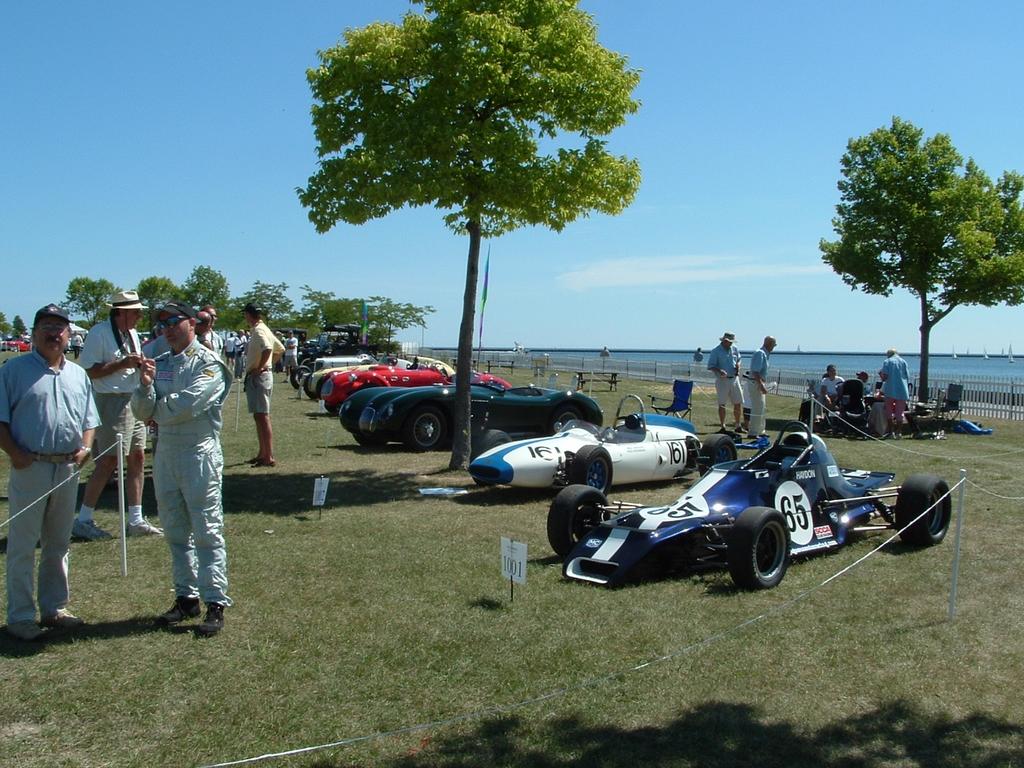 ster, 1937 Rolls Royce PIII Aero Coupe, and my father's 1932 Packard Coupe Roadster), some great early cars (1902 Curved Dash Oldsmobile, 1926 Stanley "steamer", and a 1905 one-cylinder Cadillac), and competition cars, including my car. The show was carefully planned and staged so that the cars were displayed in groups emphasizing their similarities: finned cars were in a circle with the fins pointing outwards; roadsters were in a circle with the tops down; and competition cars were in a row from oldest (1927 Bugatti Grand Prix car) to newest (1979 Tiga Formula Ford). Proceeds from the show benefitted Jewish Family Services, who are eager to team up for a repeat next year.
Labor Day weekend was unusual for me, to say the least. Races were being held at two tracks in Michigan: Midwestern Council ran at GingerMan in South Haven on Saturday, and SCCA ran two Regional races (Saturday and Sunday) at Grattan near Grand Rapids. I decided that going all the way to Michigan would make more sense if I ran both days. I wanted to get the points for Midwestern Council, and I needed to run more SCCA races to keep that license current. Since the tracks are roughly an hour or two apart, getting a hotel midway between them made sense. The Best Western in Holland turned out to be a great choice. Clean and quiet, with a jaccuzzi tub in the room! Very swank.
Saturday looked like it was going to be uneventful, but looks can deceive. I was the only Club Formula Ford entered, so all I needed to do was finish the race to get a win. I qualified in the thick of the usual group: Dave Knaack's D Sports Racer qualified in front of me, Frank Riemann's FF would be next to me, and Chuck Cassaro's Sports 2000 qualified behind me. When I checked over the car after qualifying, I found that the rear wheel hubs were loose again. I wasn't too concerned, since I know it's due to the relatively soft Brazilian hubs compressing and mushrooming due to the cornering forces that they were never designed for. All I'd have to do would be to retorque the axle nuts and I'd be ready to cruise to an easy win.
Someone once said, "Nothing easy is ever worthwhile." Maybe this was proof that what I'm doing is worthwhile, but when I tried to tighten the right rear axle nut, the threads stripped out of the nut. Bad timing. I don't carry a spare nut (but I will now), and I had about an hour and a half to get the car fixed for the race. I went through the paddock looking for anyone likely to have something to fit. It's an old VW Beetle part, so I checked with some VW Rabbit racers, Porsche drivers, and even the FV brigade, but no luck. As I returned to the Lindstrand Motorsports tent, Nicole Temple told me that a friend of theirs knew a local guy... He had one, but he was 45 minutes away, and the race was in an hour.
A couple of phone calls later, Patrick Ohmann arranged to meet Rob Ritt of Epicenter Design halfway between the track and his shop in Holland. As he sped off, I finished preparing the car and began arranging the details to get the car together and on the track as quickly as possible. Pat would install the new nut as I belted in the car, Nicole Temple from LMI would install the wheel, my roommate David Cox would lower the jack while Amy would take care of the jumpstart battery. All we needed now was the nut. While I waited for Pat and watched the minutes tick away, I mentally prepared myself to start from the pit lane after the other cars had taken the green flag, then just get the required number of laps to be considered a finisher. That was all I needed to do.
As the announcement came over the PA system that the grid for our race was closed*, Pat came running up to me with the new nut in his hand. I jumped in the car and held the brake pedal down as he tightened the nut as much as he dared. As I belted myself in, Nicole got the wheel on quicker than I've ever been able to do, and as I felt the car being lowered off the jack I hit the starter. The engine eagerly barked to life. I got the thumbs-up from Amy and drove toward the grid.
The grid configuration at GingerMan is a little odd. Due to a one-way lane, we had to drive the wrong way down the grid between the lines of cars, turn around, and then join the lineup. When I turned the corner to drive down between the cars, the crews for all the other cars pointed at me in disbelief and began applauding and cheering as though I had already won the race. It's amazing how much the other racers pull for you, even if they're trying to beat you on the track.
Since I was late to the grid, I started from the back. My plan was to just get the required laps, take it easy, get my finish, and pull in. But I don't know a racer who is able to keep his foot off the throttle when the green flag flies. Seeing a slower car disappear in your mirror is just too inspiring. When I got past the first car, I couldn't help trying to pass the next... then the next... I think I passed a car each lap for the first half of the race. I chased down all the cars gridded behind me and actually improved my finishing position by one spot.
We packed up the truck and loaded the trailer after the race to get back to the hotel for the night. I soaked in the jaccuzzi for a while until my throat started to burn a little, which I figured was due to breathing in all of the hot chlorinated water vaporizing all around me. When I woke up Sunday morning, I realized that it was really the start of a cold. There wasn't much I could do about it then except get some hot cider and oatmeal at the hotel's continental breakfast and hit the road to Grattan.
We got to Grattan right on time, got through Registration and Tech without any delays or difficulties, and found a great paddock spot without even looking. After we got the car unloaded I realized that I would have plenty of time to change the gears to suit the longer track. I got the gear change done in record time with Amy's help -- despite a boneheaded error on my part that cost me about 15 extra minutes -- and waited for the morning qualifying session.
Qualifying went well enough, but I didn't set the world on fire. I only needed to finish the race to fulfill the renewal requirements for my SCCA license, but I enjoy Grattan too much not to drive hard. Once I managed to match my best time from May, I cut my session short by a few minutes and pulled in, hoping to save the engine and tires a bit. I was sent to Impound for a spot-check, and I rolled across the scales at 1191 pounds. I had a few more gallons of fuel than I would at the end of a race, so it sounded accurate to me. I returned to my paddock space and began the nut-and-bolt check for the afternoon's race.
I finished two items on the list and started to feel dizzy and exhausted. I realized that the cold was catching up to me, and it was not going down without a fight. I wrapped up in a blanket and a fleece sweatshirt and sat in the sun, shivering for about an hour. I actually felt much better after that little rest, so I set about finishing the preparations for the race. Everything was in order... except the exhaust header pipe from the #1 cylinder had a big crack in the tubing.
The exhaust header's primary job is to direct hot exhaust gasses out of the engine, away from things that need to be kept cool, and eventually out the back of the car via the tailpipe. It also plays a rather significant role in the performance of the engine. The correct length header tubes can work together, harmonizing the exhaust pulses and increasing the power output of the engine. A less appreciated duty of the exhaust header is to prevent cold outside air from coming in contact with the hot exhaust valves. If the header breaks, cold air can suddenly rush in, potentially cracking or bending the exhaust valve. If you've ever dunked a cold glass in steaming hot wash water, you have experienced this same kind of thermal shock: the glass breaks because of the extremely quick change of temperature.
I really like this cylinder head, and I don't want anything to happen to it. Pushing the car hard, especially on the undulating Grattan circuit, would almost certainly cause the cracked header to break. I had to drive as easily as possible, minimizing the bumps and jumps that make Grattan so much fun. I also had to go easy on the throttle, since pushing the engine too hard could also make the crack develop into a full fracture.
We watched the start of the first race group, and I noticed that they were taking a pace lap and a half. The false grid at Grattan enters the track at corner 3. The pace lap would take the field out onto the track at corner 3, make the rest of that lap, cross the start/finish line, then make another full lap before the green flag. I realized that was 4 miles of driving I didn't need to put on the car, so I spoke to the starters about starting from the pit lane after the green flag. I explained that the header was cracked and that I was feeling under the weather, and they were very nice and supportive -- "No problem, we'll take care of it," "Remember, you only need 8 laps to get a finish," "Good luck, hope it holds together," "Feel better!" I already felt better after talking to them.
While puttering around at 4000 rpm, I learned a few things. First, I learned that if I drive down the front straight at 4000 rpm instead of 7000 rpm, I can brake at my usual turn-in point and still make it through corner 1. I learned that there is so much used rubber off the racing line that if you drive down the front straight off the line and then try to carry some speed through corner 1, you get the feeling that you're driving through some kind of weird rubber storm with all the bits of rubber being thrown up by your tires. I also learned that if you drive ten laps at Grattan off the normal line, you gain about 5 pounds of used rubber.
I pulled in after 10 laps and went to Impound. Since there was only one other CFF there, I would get credit for a second place finish. The Impound workers gave me a cold washcloth and two bottles of water and insisted that I stay on the scales in the shade until the other cars were done racing.
The scoreboard for MC looks the same as it did before, but add 25 more points to my total. And it only cost one knee (Amy's -- injured on the trailer before we had gone one block), one nasty wasp sting (Amy again), one 1" strip of skin off my pinky finger (another boneheaded move during the gearchange), and one nasty head cold.
Next up: Showing off the car again, this time at a British car show in Palos Hills, IL on Sunday.
*The grid "closes" five minutes before the start of the race. If a car gets to the grid after the grid is closed, that car must start at the back of the pack.
Thursday, August 04, 2005
Driver's Suits
Of all the possible injuries a driver could suffer in an auto racing incident, burn injuries probably scare me the most. Niki Lauda will tell you how bad burns can be. (He looked quite a bit better when he had ears.) Because of that, my safety equipment -- especially my driver's suit -- has always been a high priority for me.
My first driver's suit was a hand-me-down from my father. Obviously, this suit means a lot to me. My mother gave it to him for Christmas back in the '70s, when it was cutting-edge and the best that money could buy. It was custom-tailored in bright yellow to match his car, and his name was embroidered above the chest pocket. It was constructed of a single layer of Nomex, which was common for firesuits back then. Drivers generally wore Nomex long underwear under their suits to get adequate protection. At the time, more protection meant more layers, which meant bulky, heavy suits. Drag racers wore multi-layer firesuits that looked like quilted snowmobile suits.
In 2002, my co-worker Michael Marmurowicz told me he wanted to sell his old driver's suit, a modern 3-layer suit by Italian manufacturer OMP. He never had a chance to wear it before he retired from racing some 10 years ago. I talked him out of listing it on eBay, and he sold it to me for less than it was worth. This suit has acquired some special meaning for me as well. One sleeve bears a patch of quilting fabric in memory of my friend Carol Nappi, and the other sleeve still has some of my friend Frank Nelson's ashes. Unfortunately, this suit is mostly black. It looks great and sleek and fashionable, but it is awful on sunny days. It sucks up sunlight like a sponge, and oddly enough, the medical crews aren't very sympathetic when you overheat while wearing it. Especially if you still wear a layer of Nomex long underwear under it.
After my last visit to the Med Shed, I was persuaded to get a lighter suit. OMP has been supplying safety equipment to Formula 1 teams for years, and they have done a lot of research and development on driver's suits. They recently introduced a new suit called the "Tecnica Light" which they claim is lighter and cooler than the previous generation of 3-layer suits. They only offer it in two colors, shiny silver and shiny red with a shiny silver chest -- the McLaren-Mercedes and Marlboro Ferarri F1 team colors. I chose silver, since red wouldn't go so well with a blue car.
The suit arrived this week, and it's more than a half a pound lighter than a standard OMP three-layer suit. I tried it on this morning, and right out of the box it feels softer, less stiff and less bulky than my old suit. It has knit panels on the knees and around the arms to allow sweat to evaporate instead of boiling the driver. Another nice feature about this suit is that it is not second-hand, so it's actually my size! I'm looking forward to trying it next weekend at Road America. Sorry everyone, I'll be crossing my fingers for 100 degrees and sunny!
My first driver's suit was a hand-me-down from my father. Obviously, this suit means a lot to me. My mother gave it to him for Christmas back in the '70s, when it was cutting-edge and the best that money could buy. It was custom-tailored in bright yellow to match his car, and his name was embroidered above the chest pocket. It was constructed of a single layer of Nomex, which was common for firesuits back then. Drivers generally wore Nomex long underwear under their suits to get adequate protection. At the time, more protection meant more layers, which meant bulky, heavy suits. Drag racers wore multi-layer firesuits that looked like quilted snowmobile suits.
In 2002, my co-worker Michael Marmurowicz told me he wanted to sell his old driver's suit, a modern 3-layer suit by Italian manufacturer OMP. He never had a chance to wear it before he retired from racing some 10 years ago. I talked him out of listing it on eBay, and he sold it to me for less than it was worth. This suit has acquired some special meaning for me as well. One sleeve bears a patch of quilting fabric in memory of my friend Carol Nappi, and the other sleeve still has some of my friend Frank Nelson's ashes. Unfortunately, this suit is mostly black. It looks great and sleek and fashionable, but it is awful on sunny days. It sucks up sunlight like a sponge, and oddly enough, the medical crews aren't very sympathetic when you overheat while wearing it. Especially if you still wear a layer of Nomex long underwear under it.
After my last visit to the Med Shed, I was persuaded to get a lighter suit. OMP has been supplying safety equipment to Formula 1 teams for years, and they have done a lot of research and development on driver's suits. They recently introduced a new suit called the "Tecnica Light" which they claim is lighter and cooler than the previous generation of 3-layer suits. They only offer it in two colors, shiny silver and shiny red with a shiny silver chest -- the McLaren-Mercedes and Marlboro Ferarri F1 team colors. I chose silver, since red wouldn't go so well with a blue car.
The suit arrived this week, and it's more than a half a pound lighter than a standard OMP three-layer suit. I tried it on this morning, and right out of the box it feels softer, less stiff and less bulky than my old suit. It has knit panels on the knees and around the arms to allow sweat to evaporate instead of boiling the driver. Another nice feature about this suit is that it is not second-hand, so it's actually my size! I'm looking forward to trying it next weekend at Road America. Sorry everyone, I'll be crossing my fingers for 100 degrees and sunny!
Subscribe to:
Posts (Atom)