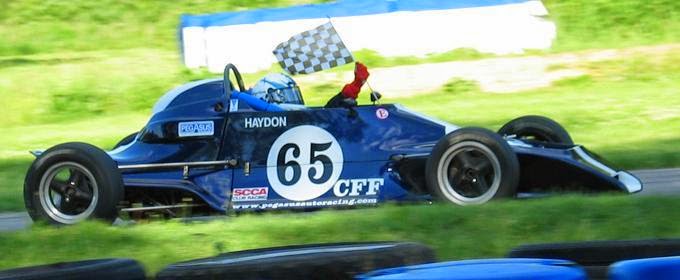
Tuesday, January 24, 2006

Driver of the Year

Last Saturday was the annual Midwestern Council of Sports Car Clubs awards banquet. We gather each year to honor the champions in each class and to present several special awards to members who have excelled in areas that aren’t scored. Sportsman of the Year is one of those awards, given to the competitor who is voted by the other members to have driven hard but always clean, helping others along the way, demonstrating the spirit of fair play, respecting others, and behaving well even in the face of defeat. Driver of the Year is awarded to the driver who has not only finished well in his class, but has also shown excellence in his driving skill (sort of a “champion of champions” award).

I was voted the Sportsman of the Year in 2004, primarily because of a long story involving an engine that I was told was legal, and a fantastic season (including a lap record) that I voluntarily forfeited when I found out that the engine I had been using wasn’t legal. I was glad that people appreciated my honesty, but I couldn’t help wishing that I could have been remembered for something other than that embarrassing episode.

This year, I was nominated again for Sportsman of the Year and also for Driver of the Year. The Sportsman nomination was partially because I helped to honor Frank Nelson, a Formula Vee driver who had passed away over the winter. He had asked to be buried in his racecar, but his family found that the cost was prohibitive. They mentioned that the next best might be to scatter his ashes around the racetrack from his racecar, and I jumped at the chance to be involved. I got his car ready to go, and I gave him his final ride just before the start of the first FV race of the season.

Lynn Serra won the Sportsman of the Year award, which I still enjoyed, since I was one of several people who nominated her. Lynn works on the Safety & Rescue team whenever she isn’t racing her Formula Ford. She frequently solicits help for other drivers who are in a pinch, but I honestly don’t remember her ever asking anyone to help her. I was thrilled to be voted the 2005 Driver of the Year. Even when I do well on the track, I sometimes find myself making excuses for my success (the other cars weren’t running very well, only three cars showed up, Pete must have had an off day), so it was a very pleasant surprise to have my peers give me such a vote of confidence.

I was also presented with a lovely plaque for the Club Formula Ford championship, but the real highlight of my evening was getting the Bartelt Belt.

Let’s back up a little. Despite what they show in movies (Le Mans and Driven being prime examples), racers are generally not a serious, dry, scowling bunch. Racing is a serious enough activity. We like to keep things in perspective by not taking anything else too seriously, even if it means poking fun at ourselves and what we do.

Jack Bartelt reminds us of the humorous side of racing better than anyone else I’ve met. When I first saw Jack race, I noticed that while all the other drivers would wave to the corner workers on their cool-down laps, Jack would instead shake a rubber chicken at them as he drove past. Jack decided to inject some humor into the Club Formula Ford championship while adding a little to the prestige and lure of the class at the same time.

In 1993, Jack made the Bartelt Belt, a pro wrestling-style championship belt with the names of all the past CFF champions on it. Every year since 1993, it has been presented to the CFF champion by “Action Jackson,” Jack’s WWF alter ego. The first Midwestern Council awards banquet I attended was for the 1993 season, and the hilarious presentation stuck with me. Ever since that night, I thought about how much fun it might be to be presented with the Belt. I confess that part of the reason I bought the Tiga was that I wanted a chance at the Belt.

Unfortunately, the people who organize the banquet have all gotten too old to see the humor and value in the belt presentation, so Jack was not given the stage or the microphone. We had to settle for an unofficial mini-presentation in one corner of the banquet hall after the official program was over. Several past CFF champions gathered to pass the belt to me in front of a small crowd of people who still appreciate lowbrow humor.
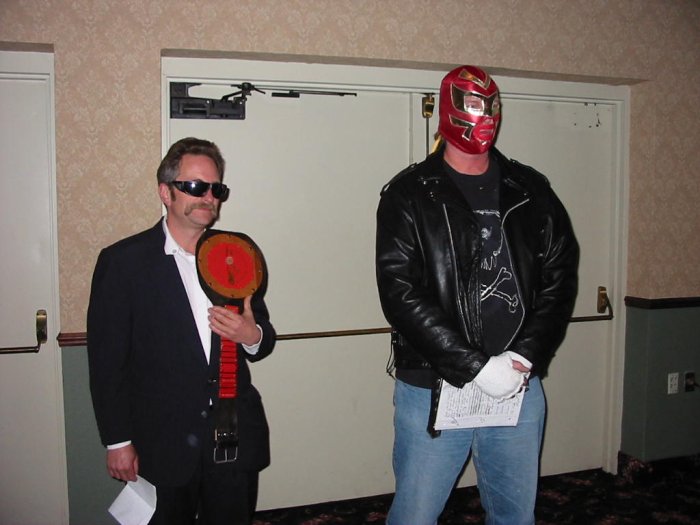
Here, Scott Reif (2003 & 2004 champ, in the glasses) prepares to hand over the Bartelt Belt while Jack “Action Jackson” Bartelt (1995, 96, 01 champ, in the mask) says some surprisingly nice things about me.
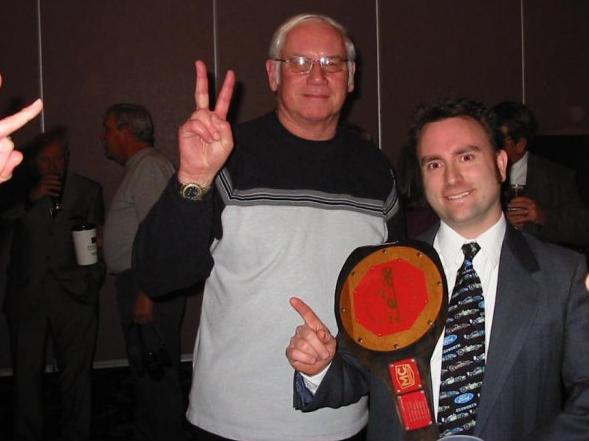


Speedy Petey (1989, 92, 2002 champ) was number 2 behind me this year. How do you like my Ford Cosworth tie??


The 2006 racing schedule is changing already. The June 24 Formula 1 support race has been officially cancelled. The National races at Nelson Ledges (July 29-30 and September 2-3) and Mid-Ohio (June 3-4) are sounding less appealing right now. Those tracks are a pretty long tow, and I’m not likely to gain enough points at those races to make the trip worthwhile. I may replace those races with some Midwestern Council events instead. And if I don’t get enough points early in the season to make the Runoffs, I may just finish the season running MC and SCCA Regional races.

Friday, December 30, 2005

Two seasons, two cranks, two blocks

Last winter I purchased a used race engine from someone getting out of the Formula Ford class after a minor incident (another car landed on top of him). When my engine oil pressure dropped last summer, I was tempted to put this engine in, but he had stressed to me that it was tired and needed to be rebuilt before I ran it. I stripped it and took the block and crank to the machine shop to get it checked. Good thing, too. The center main bearing saddle is cracked.

To say that I am disappointed would be an understatement. Broke-busted-disgusted would be closer to the truth. But at least I can be pretty sure this one wasn’t my fault.

In his defense, the seller made no promises or claims except to warn me that it was due for a rebuild. The engine ran – very well, according to everyone who saw it – when he parked it in 2003. I am absolutely certain that he never knew or suspected it was cracked. His asking price was less than what I thought the engine was worth, so I pounced.

I had high hopes for that engine. I hadn’t decided whether to use it as the spare or the primary engine, but the plan was to have one running engine in the car and a second ready to bolt in at the first sign of trouble or loss of power.

If this cloud has a silver lining, it’s that I will be spending far less this winter than I thought. The crankshaft from this engine is good enough to put in the other engine, and I won’t have to buy a second set of bearings, piston rings, and gaskets. On the other hand, that "savings" was spent on the cracked block.

If it is possible (and not ill-advised) to repair this block, I will definitely do it. These engines are no longer made, and good used blocks are rare. The theoretical "too expensive to be worth fixing" threshold is pretty high on this one.

Friday, December 23, 2005

Racing Checklists

The king of racecar preparation, the late Carroll Smith, once said, “Life without checklists is chaos.” It took me a while to learn that. When I started racing, checklists seemed to be overkill. I recently realized that the racers I admired -- the people with immaculately clean cars that always finished every session (usually toward the front) and never panicked -- all used checklists. Now I swear by them instead of at them. A while ago I promised all you insomniacs a rundown of my now-famous racing checklists. Here are some of the things I've learned about making and using them. Brush your teeth, put on your PJs, and get yourself tucked in.

First, we need to agree that a race car is a complex assembly of fragile parts held together by fasteners that loosen in response to the vibrations of the racing engine. Every session, the engine does its best to shake the car apart while the driver does his best to break it. By the end of a session, something (oftentimes many somethings) will be loose, missing, broken, about to break, worn out, out of adjustment, leaking, burned, or boiled away. If you finish a session and nothing falls into one of those categories, you probably didn't go fast enough.

The constant stress and strain on the car means that dozens of different things need to be checked every time the car comes off the track. In addition to checking all of those things, you also need to add fuel, reset the tire pressures, make any necessary adjustments, and get yourself ready for the next session. It's pretty much impossible to remember all of that every time. Without a checklist, something is bound to be forgotten. That's the fundamental reason behind checklists.

Checklists never forget what needs to be done. Checklists also tell you at a glance what has already been checked so you don't waste time checking it again. Good checklists can create an ongoing record of maintenance and repairs. Checklists also make it easier to delegate work to other people on the crew so that you can take a break. And the best part is the peace of mind you can enjoy while sitting on the grid, knowing that your car is fully prepared for the session.

On the other hand, checklists can't do the maintenance for you. The most detailed checklist does you no good sitting in a desk drawer. Checklists should never, ever be used to assign blame when something goes wrong! The crew should initial when a job is done instead of just checking it off, but that should only be used for things like tracking down the missing 1/2" wrench and knowing who to ask just how far that adjuster nut had backed off. It's also easy to look at a simple checkmark and think to yourself, "I don't remember doing that... what else did I check off without really doing it?"

My own checklists have evolved from a note pinned to my shirt ("Fill Gas!") to a one-page list of jobs to do between sessions (the "Track" list) and a two-page list of jobs to do between race weekends (the "Garage" list). Jobs have been added and deleted, leading to very personal lists tailored to my particular car. The Track list includes items that need attention after every session to keep disaster at bay: Check the critical fasteners, check the fluids, bleed the brakes. The Garage list includes jobs that aren’t easily done at the track: Check the rest of the fasteners, change the fluids, and change the brake pads. All of the items on the Track list are also on the Garage list.

Since my car is water-cooled, "Bleed Radiator" and "Check Water Level" are on both lists. Since it has disc brakes, "Adjust Brake Shoes" is not. The fasteners which are more prone to loosening on my particular car also appear on the Track list. The fasteners which do not frequently come loose are on the Garage list. If they develop the habit of loosening, they are moved to the Track list. If they establish a stable history, they may be moved to the Garage list.

The checklists are organized to allow a good flow of work. The jobs are arranged by chronological order, grouped by physical area, and grouped by similarity to each other.

When I say chronological order, I mean that I want to be able to start almost as soon as the car comes off the track and go down the list without skipping a job because those parts are still too hot to touch. For example, "Check Exhaust Header Bolts" is at the end of the list, after the engine has had a chance to cool off. The very last jobs are setting tire pressures (which could change if the car sits too long in the sun) and pushing the car to the grid.

The jobs are also arranged into areas to try to prevent running laps around the car. For example, the jobs at the rear of the car (checking the rear axle CV joint bolts, checking the rear brake pads, and checking the gearbox for leaks) are together so that you can do them all while you're back there. To be honest, that type of grouping hasn't been entirely successful, because so many jobs require going from one end of the car to the other anyway. Still, checking the rear brake pads should be done between checking the rear CV joints and checking the gearbox, not between checking the front brake pads and the brake fluid level -- which are both at the front of the car.

By similar jobs I mean jobs requiring the same tools. Grouping these jobs together can save a few trips running back and forth to the toolbox, but it can also reduce the chances of two people fighting over tools. For instance, if one person checks all of the critical Allen-head bolts, then he won't be waiting for someone else to finish with the Allen wrench set before he can start. The alternative is to bring a second set of those wrenches to the track, which ties up more money, weighs down the tow rig, and takes extra space in the toolbox. On the other hand, if you're fortunate enough to have a dozen crew members, or if you bring a spare car to the track, then by all means bring a second set of tools.

Next to each job is a box to be initialed when the job is complete. After each job is a space for notes or comments. For example, in the space next to "Add Fuel" you would record how much fuel was added. If you find any worn rod ends, you would note which ones in the space next to "Check Rod Ends." You can also add specifications for torque or clearance next to their respective jobs. The required torque value is printed in the field next to "Torque Lug Nuts," and the ignition timing is printed next to "Check Ignition Timing." Those specifications are added to the sheet before it is printed, so they are always available without having to look them up elsewhere.

If I can figure out a way to post an Excel spreadsheet, I'll put my checklists up here. Otherwise, feel free to ask for them -- just post a request with your email address as a comment. I'll send you both documents via email and then delete your address so you won't get spammed. Copy them, change them as you need, use them as you like, give them to your friends and competitors. I claim no copyright on them, but I also disclaim any responsibility for them or for you. You have to work with them to make them work for you. Use the principles I outlined above to make them fit your program.

Thursday, December 15, 2005

2006 Racing Schedule

Have I mentioned that I’m not a fan of snow and cold? I’m not. I would hibernate if I could. That is why so little has been happening in the garage this month, despite our current heat wave. It’s been in the high 30s the past couple of days, but the temperature is expected to drop again tomorrow.

So let’s pretend winter is over already and start thinking about next summer. Here is my not-very-tentative (and yet not quite firm) 2006 schedule. As I said before, racing schedules are always subject to change.

April 22-23 GingerMan (MI) SCCA National
April 29-30 Blackhawk (IL) SCCA National
May 13-14 Grattan (MI) SCCA National
May 20-21 Blackhawk (IL) SCCA National
May 27-28 Blackhawk (IL) MC Drivers’ School
June 3-4 Mid-Ohio (OH) SCCA National
June 24-25 Montreal (CAN) F1 Grand Prix Support Race
July 29-30 Nelson Ledges (OH) SCCA National
August 12-13 Grattan (MI) SCCA National
August 26-27 Montreal (CAN) CART Support Race
September 2-3 Nelson Ledges (OH) SCCA National
September 16-17 Blackhawk (IL) MC Drivers’ School
October 9-15 Topeka (KS) SCCA Runoffs

The Canadian organizers haven’t confirmed the two support races in Montreal. We also haven’t heard what rules they will use for those races, or if they would accept my license. It might be worth the 16 hour tow to race on the same weekend as F1 or CART, but I may find that I need to focus my energy and resources on the SCCA races instead. On the other hand, this could be my only opportunity to appear on their program. But I’d rather not postpone a promising SCCA season for the sake of one event that may not work out.

The Runoffs will depend on the points standings, as will the National races in Ohio in the second half of the season. The SCCA Runoffs is an invitation-only, “winner-take-all” race for the national championship. Only the top 10 drivers in each Division are invited, with each driver’s best 6 finishes counting towards the total. If I can earn enough points in the first four or five events, I may be able to relax the pace a bit. If I’m hopelessly far behind the top 10 by June, I probably won’t push too hard the rest of the season. And if that happens, then I won’t be attending the Runoffs.

Some other races that are on my “backup” calendar (if the budget allows, if other events fall through, etc) include an early April MC race at the Autobahn (good for a shakedown before the first National race), a June MC race on the Milwaukee Mile infield road course (and a Regional race there in September), and the June Sprints at Road America (on the same weekend as the Canadian Grand Prix).

I will have to miss the Central Division East-West Challenge series races race at Grattan on Memorial Day weekend because of the conflict with the Drivers’ School. The EWC Blackhawk race in July is unfortunately third on the list that weekend, behind the Classic Car Club of America’s Grand Classic event and a National race in Indianapolis. The EWC at Road America also conflicts with the Montreal CART race.

On a different subject, I plan to change the look of the site just a bit in the next week or two. Some people have reported that their browsers only show part of the page, so I need to adjust the size of the page. You may not even notice a difference.

Friday, November 25, 2005

Winter 2, Ambition 1

The weather hasn't eased off up here. On the other hand, there has been a little bit of progress, such as it is.

The replacement transmission arrived last Thursday. We took it to Lindstrand Motorsports for a once-over. Everything is in great shape, as advertised, and some internal parts even appear to be brand new! A big thank-you to Larry Oliver, who sold me the gearbox as well as a set of rear wheel hubs at a great price.

The engine block and crankshaft have been checked. The crank is bent. Boo hiss. But the block is not cracked -- big relief. The center main bearing bore did get moved out of alignment by the bent crank hammering against it, but the machine shop is confident that the alignment can be fixed.

Thursday, November 17, 2005

Winter 1, Ambition 0

I really wanted to work in the garage this week, I promise. But it is cold in Wisconsin right now. No, it isn't as cold as it will be soon, but it has once again dropped from "unseasonably warm" to "unseasonably cold" in record time. As in, last week was 50s with 10mph breezes; last night was 10 with 50mph winds. I'm just not ready for it.

I stayed inside and did paperwork instead. Thrilling, isn't it. But I'm very proud of my recordkeeping paperwork and organization. So proud, in fact, that I have to brag. Prepare to be bored.

For the past few seasons, I have kept a 3-ring binder of information about the car and the season. The binder is separated into sections for the Engine, Gearbox, Chassis / Suspension, Race Results, and Checklists. Each section has sheets of reference information, such as gear charts in the Gearbox section, and torque specs in the Engine section. Any new information is added to the appropriate section.

Each section also has a maintenance record sheet for each area. For example, there is a maintenance log for each engine; one for the gearbox, clutch, and drive axles; and one for the chassis and brakes. Any major maintenance or repair gets logged: date, what was done, and why.

Yes, you're right, that's crazy. But it makes it very easy to see when the oil was last changed, whether the CV joints are due for a rebuild, and how many races are on the rod end that just failed. And yes, I have had to know each of those things during the course of a season. But keeping these records will also help me learn the "service life" of each part. I should be better able to prevent failures without replacing healthy parts. And if nothing else, I'll be able to say without fear of contradiction, "That hub failed after only three races!" Yikes.

I've spent the last few evenings making a new binder for the 2006 season, consolidating and translating notes from the 2004 and 2005 binders, and making a new "Permanent Records" binder. This binder will keep a copy of all reference information (part numbers, chassis history, gear charts) as well as the consolidated setup notes, maintenance logs, and race results from past seasons.

A friend who also races made a new binder for me last year. He prefers to keep his records sorted by track. In his book, each track has its own section with track maps, local hotel information (very handy), car setup records, and driver notes. I do like the idea of being able to visit a track and see at a glance if I'm faster or slower than the last time I visited, how my time compares to the track record, and if I'm close to my best-ever time there. On the other hand, I don't change the setup from track to track, so organizing the car information this way didn't seem to make sense for me.

So I have kept the binder, but I've modified it a bit. Now each section has a track map, driver's notes, hotel information, and directions to the track, but the setup information has been replaced with a single sheet for track records and personal best times. Any changes to the setup are noted on the sheet next to the lap time they produced.

If you're still having trouble sleeping next week, I'll describe my famous racing checklists.

Monday, November 14, 2005

Crack check

The crank and the block are at the machine shop for a full checkup. My father has convinced me that the garage method of checking crank straightness (described a few days ago) is just a rough check, and that the machine shop may find a very different measurement than I did when they use the proper set-up and measuring tools. The worst case scenario is that the crank is really bent, in which case we will know that we're not wasting money getting a new crank.

The suspense, once again, is killing me! My fingers are crossed.

Tonight is another garage straightening / chassis stripping / parts organizing night. The temperature is dropping, so I need to get as much of it done now as I can before I go into hibernation for the winter.

Thursday, November 10, 2005

Caribou Coffee

Brace yourself for a post that has nothing to do with racing.

I'm not a big coffee drinker. I don't just mean that I can go a day without drinking ten cups. I can go ten days without one cup. I usually skip it completely during the racing season and indulge in a cup every once in a while during the winter. The thought of spending $5 a cup for coffee always struck me as a bit excessive. That some people drink one (or more) $5 cups of coffee every day just floors me.

A few weeks ago I was out and about with a friend who took me to a coffee shop called Caribou Coffee. Since I don't drink coffee for the flavor, I wanted something that wouldn't taste quite like coffee. The words "Turtle Mocha" stood out on the menu. I am a huge fan of Turtle (not the hard-shelled reptile, but that perfect marriage of chocolate, caramel, and nuts). Turtle is the ultimate flavor, the closest thing to heaven that your tongue will ever know. Yes, I like Turtle.

Yes, I ordered the Turtle Mocha. It was everything I expected. But that coffee shop was really something else. The employees were friendly without going overboard and hardworking without showboating. The entire atmosphere was warm and inviting. I was so impressed that I wished I drank more coffee than I do.

Last weekend, this same friend and I were out and about again, but not in the Caribou Coffee neighborhood. Instead we found ourselves entering the Caribou Competitor. You know the place I mean. There are at least two of them in your hometown. There are two in Kenosha for crying out loud, and there are only 95,000 people there!

We ordered our drinks (no Turtle on the menu, so I tearfully ordered a Caramel Mocha, the closest thing I could find) and I tipped generously, because the server almost made me feel like he was doing me a favor by taking my order. My friend's drink was up right away. I waited patiently. I watched two other patrons order, get their drinks, and leave. Finally I asked if I had missed mine. The server apologized and handed me something that looked like a sundae. A frozen drink? It's 40 degrees outside! Who would get an iced coffee in this weather? I was so disgusted I couldn't even argue. I just took it, walked out, and threw it away.

The next day, I decided that I still wanted the Turtle Mocha that I didn't get the day before, so I headed to Caribou Coffee. The server greeted me warmly and seemed genuinely happy to be helping me. The coffeeist prepared the drink quickly without rushing. I got the drink I ordered and was on my way in about a minute and a half. And that Turtle Mocha was delicious.

Yes, I am thankful that this is the biggest issue I have to write about right now. But I am so impressed by Caribou Coffee that I just have to tell everyone. The difference between them and their competition was staggering. I hope they come to Kenosha someday. If they do, there will eventually be two vacant buildings where certain other coffee shops used to be.

I stopped in at Caribou Coffee again this morning and encountered a different crew. They were just as friendly, but they were also so happy and energetic that I couldn't help but be in a great mood for the rest of the morning. And of course my order was ready in about a minute and a half, it was correct, and it was delicious.

Maybe if I drink more coffee, I'll get used to it again and my eyes will stop vibrating.

Tuesday, November 08, 2005

Fun Gearbox Info

The remains of the layshaft came out of the gearbox last night, and the 2nd and 3rd gears are completely stripped -- no teeth on either one (and their gums are in terrible shape to boot). The pinion shaft is welded to the front bearing, but if I remove the bearing from the case, then I may still be able to salvage the case.

I'm going to try to concentrate on the rest of the car tonight instead. The gearbox won't be going anywhere, and I shouldn't need the case for a long time.

Monday, November 07, 2005

A Second Crank Opinion

Special update!

I told Bruce Lindstrand what I found in the engine. He called his engine builder, Curtis Farley, and before Bruce had finished saying, “Low oil pressure,” Curtis told him that the #3 main bearing was pounded out. A clever deduction indeed, 007, but why? Mr. Farley outlined the three likely scenarios.

#1: Motor Mount Strain. The Ford “Kent” engine has motor mounts on either side of the block. If the frame of the car is crooked (all racecar frames are after a while), the engine will not be perfectly centered in the frame. Forcing the motor mounts into position can put a strain on the engine block, and the strain can be severe enough to actually twist or bend the block. I know we can rule this one out. We’ve pulled and reinstalled the engine about half a dozen times, and by the second time we learned the proper technique. You don’t record how many washers were on which engine mount and then force everything back into the same position. Instead, you loosely assemble the engine mounts, install the gearbox, and gradually and evenly tighten everything down. Eventually, the chassis and engine combination will “tell” you how many washers go where. Everything gets centered as well as possible, and strain is minimized.

#2: Insufficient Oil Supply. The Kent engine has an odd oil gallery design. The oil pump feeds into the right side of the block, but the oil has to pass to the left side of the block before it goes to the main bearings. The gallery which feeds the #3 main is notorious for being too narrow and is easily clogged by debris. You could say the engine has a heart attack. The good thing about this scenario is that it is easily fixed. A threaded plug on each side of the engine block can be removed so that you can look through this passage. Any blockage will be obvious and easy to remove, and the oil passage can be drilled out to allow more oil flow. The oil pump plumbing can also be rearranged to feed the main bearings more directly, but that may be a bit extreme.

#3: The “Mystery of the Collapsing #3 Bearing.” The story goes that every once in a while, despite meticulous assembly, a Formula Ford motor never develops oil pressure (or else the oil pressure quickly drops). Everything checks out, but the #3 main bearing is trash. If this condition is found before the engine is run, it may only need new main bearings to live a long and happy life. Nobody knows what causes the bearing to collapse, or why the replacement rarely fails. Although the fix does not involve any machine work, I don’t like this scenario at all. I’d much rather be able to positively identify the cause of a problem and take steps to prevent it from happening again.

Unfortunately, his professional opinion is that reusing the crank would be a bad gamble. Bending the crank has weakened it. Even if the machine shop could regrind it to compensate instead of bending it back into shape, it is still not likely to stay in one piece.

Chicken and Eggshells

The engine has been torn completely down now, and the bottom end has two big problems. The #3 main bearing is completely wiped out, which explains the low oil pressure. The crankshaft is also bent, which is odd since it was new this spring and we had several strengthening and blueprinting processes performed before it was installed.

So which came first? Did the bearing collapse, allowing the crankshaft to flex too much by taking away its central support? Or did the crankshaft bend (or crack) and then destroy the bearing? A chicken and egg problem, but at least the connecting rod didn’t cross the road this time.

The crank and the engine block will have to be checked for cracks and thoroughly measured first. A crack in either one would answer the question while permanently retiring that part. Accurate measurements should tell us if the crank can be repaired and if the block can be reused. It would be disappointing to say the least to have to scrap the second engine in two seasons.

(In case you’re picturing a crankshaft folded in half or twisted like a pretzel: It doesn’t take a very dramatic curve to render a crankshaft unfit for use. It still looks like a good crankshaft to the unaided eye. To check for straightness, you place the crank in the engine so that it is only supported by one main bearing at each end. A very precise measuring tool is put in contact with the center main bearing journal on the crankshaft, and the crank is slowly rotated. In this case, the center main bearing journal is 0.0025” off center. Not exactly a banana, but that’s much worse than the maximum allowed 0.0005” measurement.)

Friday, November 04, 2005

Garage Organization

What was it I said yesterday about only accomplishing some tidying up in the garage? Oh yes, here it is:
On the other hand, I may only accomplish "putting parts in boxes and getting
them out of my way."


How about that, I was right!

This is actually frustrating. Racecar parts are not designed to nest together or fit neatly into boxes. Each attempt to put some parts away ends with a huge box containing two bulky parts and a lot of air. Small parts can usually be crammed together into one box, but the resulting 9 x 6 x 12 inch box that weighs about 50 pounds is going a little too far in the other direction.

My buddy Bob Clark was kind enough to lend me an impact socket for the pinion shaft nut, so I may be able to get the gearbox apart next week. This weekend is an engine weekend. If I'm lucky, I can get it ready for the machine shop before next week.

Thursday, November 03, 2005

Scrapbook Photos

There is nothing new to report today because I took last night off at the last minute. But here’s a link to some photos to tide you over until something interesting happens.
The good parts are on pages 13 and 16.

It’s a “pdf” file, which means that if you don’t already have Adobe Acrobat Reader, you’ll need to get it. It’s a free program that will give you access to a huge amount of information on the Internet. In fact, I’d be surprised if you don’t already have it. Click the link and see what happens.

I plan to work on the chassis and suspension tonight. The weather is remarkably mild today, so I may be able to work late and get a lot accomplished. On the other hand, I may only accomplish "putting parts in boxes and getting them out of my way." That's still an accomplishment, though.

Wednesday, November 02, 2005

More gearbox parts

The input shaft came out in good shape overall, but the splines are suspect. The splined coupler which ties it to the layshaft was damaged by heat and by impact with something else, though who knows with what. The splines on the input shaft show just a little discoloration, almost as if the coupler deposited some material onto them. The rest of the shaft looks like it never even overheated. The color is as it was from the factory – it doesn’t even have any gear lube burned on it, and the Pegasus part number (written in Sharpie marker) is still there! It is too good to demote it to a clutch alignment tool, but I’m not sure it could be trusted to survive a full season or more. Into the spares bin it goes. Now I even feel smart for keeping the original splined coupler that we replaced when the original input shaft broke in August.

I’ll be continuing the engine teardown tonight. I hope to get far enough in to find the cause of the low oil pressure.

Tuesday, November 01, 2005

Gearbox Teardown

The gearbox is now in several pieces on the garage floor. The rear brake calipers are all cleaned up (only three cans of brake cleaner and half a roll of paper towels) and waiting to be installed on the new transmission. The sideplates came off the gearbox without too much trouble, exposing the differential and the ring & pinion gears. The gears and the diff carrier – originally different shades of silver and grey – are now all an even brownish blue tint, indicating severe overheating and a patina of burned gear lube. All of the teeth show signs of galling. Strike that assembly from the list of potentially salvageable parts.

To take the gearbox apart further will require removal of large castle nuts from the pinion shaft and the layshaft. This is normally very simple: Put the transmission in two gears at the same time, and the two shafts will not turn when you put a wrench on the nut. Unfortunately, the transmission cannot select any gears at the moment. The layshaft nut came off by hand, which was a pleasant surprise, but not pleasant enough to outweigh the discovery that the layshaft was broken from flailing around when the rear support bearing fell apart. Scratch the layshaft from the list.

Since the pinion shaft can’t be locked to the layshaft, there is no convenient way to hold it from turning while the castle nut is loosened. A big pipe wrench on the pinion gear could work. Damage to the pinion gear is not a concern, since the pinion gear was already off the list. The trouble is that the wrench may dig into the main case and take it off the list as well. On the other hand, removing the pinion shaft is the only way to keep the case on the list. Will the cure kill the patient?

Removing the input shaft will require a bit of ingenuity. The input shaft is stuck in the case, retained by the splined coupler which holds it to the layshaft. The coupler is stuck to the input shaft until the broken end of the layshaft drawbolt comes out of the input shaft. That can’t happen until I can get at that end of the input shaft with a drill, which won’t fit into the case – which the input shaft is stuck in. I may have to cut apart the coupler, which would scratch it from the list. Otherwise, scratch the (new) input shaft, too. I have an idea, though. I’ll let you know tomorrow if it works.

The ever-shrinking list of potentially salvageable parts now includes

  • the main case
  • the side covers
  • the stub axles
  • the bearing carrier
  • the rear cover
  • the gearshift selector finger
  • and the input shaft.

That looks like a lot until you consider that the gearbox is made up of some 150 parts, not counting all of the shims and spacers that make everything line up properly.

Friday, October 28, 2005

Fuel Cell Maintenance

Fuel cells – not the hydrogen-oxygen electricity generating things that the EPA is excited about, but the impact-absorbing fuel tanks in racecars – are an important safety item. Unfortunately, they’re expensive and have a finite life span. Foam baffling inside keeps the fuel from sloshing and reduces the possibility of explosion in case the cell is ruptured, but the foam deteriorates after a few years and turns into a fuel pump-clogging sludge that causes racecars to choke to a stop. The bladder that actually holds the fuel typically lasts about ten years before it begins to crack and fall apart. Owners of older cars with older fuel cells dread the day when they find a puddle of fuel under the car.

The cheap and easy part of fuel cell maintenance is the replacement of the foam baffling. The foam only costs between $50 and $200 (depending on the fuel cell size). Having old foam break up can cost fuel filters, fuel pumps, and lost races. In the last two seasons, two of my friends lost a combined 6 races due to fuel cell foam clogging.

I found some interesting information from Eagle Fuel Cells (Eagle River, Wisconsin) about extending the life of fuel cells. Storing the cell empty is bad (oops), because that allows the rubber in the bladder to dry out. Regular pump gasoline is also bad, because it is not as stable as aviation gas, and the formulation is particularly harsh on the rubber ("gasohol" is even worse). I don’t know if race gas counts as pump gas, but AvGas is cheap enough that five gallons for winter storage will be worth the investment if it delays the replacement of the cell for another year.

Someone (sorry, I don’t remember who) recently pointed out that the rubber in the cell bladder doesn’t get along with water either. Cars where the cell sits on the floorpan often trap rainwater between the floor and the cell if there is no provision for drainage. Tiga were clever enough to sit the cell on top of some frame tubes, which minimizes contact with water. That’s what we call “good news.” The bad news is that resting the weight of the cell (and the fuel inside) on such a small area causes a major strain on the bladder. Fixing this should also be inexpensive and easy. A “floor” of heavy wire mesh between the cell and the tubes will at least spread the load a bit without trapping any water against the bladder. A basic frame around the mesh should make it rigid enough that the load will be much more evenly distributed.

All three projects should total about $150 and maybe a weekend. That’s a bargain if it keeps the cell alive through another season.

Wednesday, October 26, 2005

What a Mess!

Yecch.

The minute you bolt a car together, dirt seems to fly in from all over the world to make a new home in the crevices juuuust out of your reach. Equally amazing is the phenomenon whereby oil apparently flows uphill to join the dirt, drawn as if by magnetism. The resulting sludge will stay in place forever, or until the car is taken apart again.

Add to the mix a season of very hard running and three minor off-course excursions (two of them at the last two events), and you've got the recipe for one heck of a mess. This car can scoop up a lot of dirt, grass, and other debris because it sits so low to the ground. The configuration of the bellhousing (the front is open at the bottom) means that a LOT of debris can be stuffed in around the flywheel and starter, and it isn't inclined to come out on its own.

Until you pull the engine from the car, of course. You have to tilt the engine to clear the frame rails, so the dirt falls right out. Most of it lands smack in the middle of the oil that dripped out of the engine when you rocked it the other way. That weird magnetism again.

I could literally start a small garden with all the dirt that's caught up in this engine. That's not such a bad idea, cosmically. Maybe potting a couple of plants with this dirt could go some way towards balancing the bad karma from spilling so much oil...

Ah yes, the oil. How can something so slippery be so sticky? A fine layer of oil acts like flypaper, attracting and holding every available speck of dirt for miles around. For some reason, I keep thinking about putting "lifetime supply of paper towels" on my wishlist. (Before you run out and buy some for me, let me tell you a secret: I've gone through a roll and a half in two evenings so far, and the engine isn't even clean enough to go in the back of the pickup truck yet.)

The rear suspension teardown revealed a couple of surprises. One outer CV joint bolt on the right side had broken (usually they just loosen). The inner rod end on the lower right rear wishbone failed in a perplexing way: the race (the part holding the inner ball in place) actually "walked" out of the housing! I've never seen anything like it, and the confusing thing is that there was (theoretically) no load in the direction that the race travelled. The left rear hub also loosened up again -- time for some stronger hubs! And two of the ball bearings from the transmission layshaft rear bearing were found wedged in between two ribs in the bearing carrier.

Tonight is my night off, but I'll get back to the cleanup work on Thursday. Still planning to begin engine teardown this weekend!

(Leslie, that link is just for you.)

Tuesday, October 25, 2005

Photos from The Loooong Race

In this morning's email were several great photos from Brian Lindstrand -- D Sports Racer driver, nephew of Bruce Lindstrand, and general all-around great guy.

Ahh, the good memories. Getting ready to get in the car for the first practice session. My father seems to be trying to tell me something terribly important, but in fact he's probably asking me if the tire pressures are set, or if there's fuel in the car. Yes to both questions... and yes, I have forgotten both before.


Aaaand... the not-so-good. This is us in our mad dash to try to repair the gearbox before the race. We cleaned the parts and then bathed them in oil and tired to flush the maincase with fresh oil to try to make the parts happy again. It was a very unhappy gearbox.


Here's Brian next to his racecar. Sitting in the car is Nicole Temple, Lindstrand Motorsports' transmission specialist. (Did I mention that Nicole also helped with the paint on my car?) They co-drove this race, and won their class. Bravo!

The car was originally a Formula Ford built by Titan, but it was converted to a sports racer with a Fiat engine some years ago -- before I started my own driving career. Brian was finally convinced to replace the Fiat with something a little more reliable a couple of years ago, so a Yamaha R1 engine now powers the car to some very impressive speeds.

Back in my garage, the transmission is off, as is the rear suspension and most of the engine "extras." The engine should be out of the car tonight. We may be able to start tearing it down this weekend.

Friday, October 21, 2005

Photos from October 8

I just got a CD of photos from Brad Ellingson, who attended the Fall Sprints with his digital camera instead of his racecar. Brad, I'm now torn between hoping you get your car back out next year and hoping you keep snapping away with the camera. Thanks!

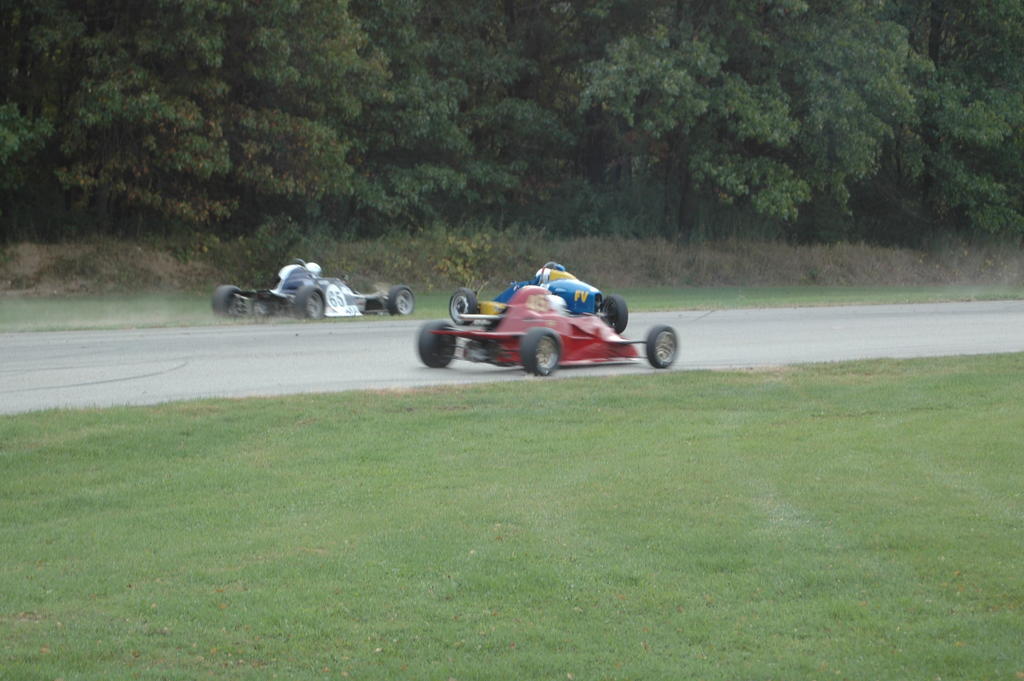
The shot of the weekend. As I entered corner 3, the corner station was waving the yellow flag, which usually means a car spun on track. As I came around the corner, I saw the blue FV stalled sideways on the track and I thought he was closer to the inside of the track. I committed to a path going around the front of his car and then discovered that there was no track there. Brad caught the moment in all of its lawnmowing glory. Alex Murray (#45) can be seen learning from my mistake.


It took some minutes of head-scratching for me to realize that this shot was taken a fraction of a second before the photo above. My hand was in the air as a signal to the drivers behind me that I was slowing down, there was real danger ahead, and they should look for a way through it.

Look at where the car is on the track and the direction it's pointed. Now look back at the other photo and compare where the car went. The difference is called drifting. As the car goes through the corner, it's pointed farther around the corner than its actual path of travel. If I had been travelling in the same direction the car was pointing (instead of drifting to the outside of the corner), I'd have speared the FV in the side.

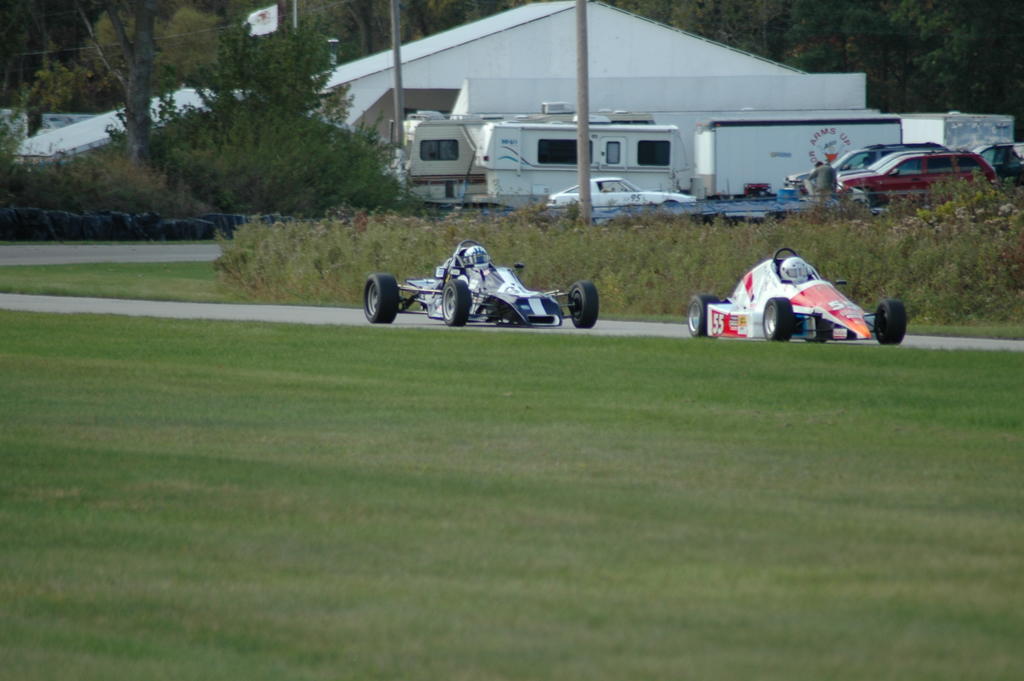
I like the contrast in this one. Car #55 is a Formula 500 (once known as F440). These cars have snowmobile engines and the original snowmobile primary drive belt system. They use tiny little tires, but they weigh less than a Formula Ford and put out close to the same power through a CVT (Constantly Variable Transmission) -- sort of a cross between a go-kart clutch and an automatic transmission. They don't have to shift gears, and their engines are always in the peak power band, so they accellerate quickly and have a very high top speed. They're fast, but I just can't consider them real race cars because they don't have a gearbox.

I hate to end on an insult to another class of racecar, so I'll mention that I will be pulling the engine this week, and I have a line on a gearbox for sale down south. I'll keep you posted on both as things progress.

Thursday, October 20, 2005

Thanks

Now that the season is over, I want to take some space here to thank some people who made it possible. The short list is "everyone who has ever talked with me about racing," but that's short-changing the people who really made this season happen. In random order:

Bruce Lindstrand, Cindy Lindstrand, Nicole Temple, and the rest of the Lindstrand Motorsports crew. It's rare to find people so willing to take you under their wing. I can't even begin to list the things they have done to help me. Just one example: At the bitter cold National race in May, I was walking back to my paddock space from the concession stand, and just as it began to drizzle a bit, I saw the LMI crew pushing my car from my spot to a spot under their already crowded tent to keep it dry. I truly cannot thank you enough.

Mom & Dad. I'm proud to say that my parents are my two biggest fans. Without my father's help, the car never would have hit the track this year. Without his expertise in engine building and his meticulous attention to detail, it never would have gone as fast or as far as it did. And without my mother's support and encouragement, the season would have been a lot shorter and much less enjoyable. I'll always have crew passes for you two.

Pete Wood. Speedy Petey is a multiple-time champion in Club Formula Ford -- once in my car! To paraphrase Fernando Alonso, this championship means everything because I had to beat him to win it. It was never easy, and you pushed me to drive like I never knew I could. And let's not forget that he sold me the car in the first place, and he helped me to restore it before I even paid it off!

Jack Bowling. JB Machine has made several vital parts on the car, and they've all been beautifully crafted, quickly done, and exactly what I needed. Add to that the fact that Jack has some great stories about racing back when people raced just to have fun.

Corky Jahn. Another person without whom I would not be the proud owner of a Tiga, much less a Tiga with four wheels on the ground. Corky helped finance the initial purchase by letting me sell him many of the spares -- and then letting me borrow them back when I needed them!

Chris & Carla Heitman and Pegasus Auto Racing Supplies. Chris is still a racer, even if he hasn't put on a helmet in a while. He and Carla understand what it takes to run a Formula Ford, and they have been an invaluable source of support, information, and helping hands. And they have yet to deny me a day off to go racing... Congratulations again on 25 years of Pegasus. I mean it when I say that this is the company I plan to retire from someday.

Lynn Serra, who told me about the Tiga when Pete wanted to sell it, and who never lets me think of quitting. Even if she has to smack me in the back of the head to get her point across. I still have a few more championships to win before I can break your record. Just watch me.

The Girl Who Wants to Remain Anonymous. You kept me sane (relatively), you made me laugh every day, you carried me to the med shack when I was ready to pass out. Despite having no interest in racing, you put up with me almost all summer. You really deserve a trophy for that.

There are hundreds more who have loaned me tools, parts, food, places to sleep, advice, and encouragement. Thank you all!