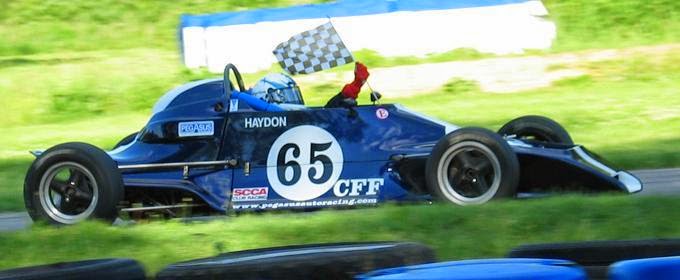
Fuel cells – not the hydrogen-oxygen electricity generating things that the EPA is excited about, but the impact-absorbing fuel tanks in racecars – are an important safety item. Unfortunately, they’re expensive and have a finite life span. Foam baffling inside keeps the fuel from sloshing and reduces the possibility of explosion in case the cell is ruptured, but the foam deteriorates after a few years and turns into a fuel pump-clogging sludge that causes racecars to choke to a stop. The bladder that actually holds the fuel typically lasts about ten years before it begins to crack and fall apart. Owners of older cars with older fuel cells dread the day when they find a puddle of fuel under the car.
The cheap and easy part of fuel cell maintenance is the replacement of the foam baffling. The foam only costs between $50 and $200 (depending on the fuel cell size). Having old foam break up can cost fuel filters, fuel pumps, and lost races. In the last two seasons, two of my friends lost a combined 6 races due to fuel cell foam clogging.
I found some interesting information from Eagle Fuel Cells (Eagle River, Wisconsin) about extending the life of fuel cells. Storing the cell empty is bad (oops), because that allows the rubber in the bladder to dry out. Regular pump gasoline is also bad, because it is not as stable as aviation gas, and the formulation is particularly harsh on the rubber ("gasohol" is even worse). I don’t know if race gas counts as pump gas, but AvGas is cheap enough that five gallons for winter storage will be worth the investment if it delays the replacement of the cell for another year.
Someone (sorry, I don’t remember who) recently pointed out that the rubber in the cell bladder doesn’t get along with water either. Cars where the cell sits on the floorpan often trap rainwater between the floor and the cell if there is no provision for drainage. Tiga were clever enough to sit the cell on top of some frame tubes, which minimizes contact with water. That’s what we call “good news.” The bad news is that resting the weight of the cell (and the fuel inside) on such a small area causes a major strain on the bladder. Fixing this should also be inexpensive and easy. A “floor” of heavy wire mesh between the cell and the tubes will at least spread the load a bit without trapping any water against the bladder. A basic frame around the mesh should make it rigid enough that the load will be much more evenly distributed.
All three projects should total about $150 and maybe a weekend. That’s a bargain if it keeps the cell alive through another season.
Friday, October 28, 2005


Wednesday, October 26, 2005
What a Mess!
Yecch.
The minute you bolt a car together, dirt seems to fly in from all over the world to make a new home in the crevices juuuust out of your reach. Equally amazing is the phenomenon whereby oil apparently flows uphill to join the dirt, drawn as if by magnetism. The resulting sludge will stay in place forever, or until the car is taken apart again.
Add to the mix a season of very hard running and three minor off-course excursions (two of them at the last two events), and you've got the recipe for one heck of a mess. This car can scoop up a lot of dirt, grass, and other debris because it sits so low to the ground. The configuration of the bellhousing (the front is open at the bottom) means that a LOT of debris can be stuffed in around the flywheel and starter, and it isn't inclined to come out on its own.
Until you pull the engine from the car, of course. You have to tilt the engine to clear the frame rails, so the dirt falls right out. Most of it lands smack in the middle of the oil that dripped out of the engine when you rocked it the other way. That weird magnetism again.
I could literally start a small garden with all the dirt that's caught up in this engine. That's not such a bad idea, cosmically. Maybe potting a couple of plants with this dirt could go some way towards balancing the bad karma from spilling so much oil...
Ah yes, the oil. How can something so slippery be so sticky? A fine layer of oil acts like flypaper, attracting and holding every available speck of dirt for miles around. For some reason, I keep thinking about putting "lifetime supply of paper towels" on my wishlist. (Before you run out and buy some for me, let me tell you a secret: I've gone through a roll and a half in two evenings so far, and the engine isn't even clean enough to go in the back of the pickup truck yet.)
The rear suspension teardown revealed a couple of surprises. One outer CV joint bolt on the right side had broken (usually they just loosen). The inner rod end on the lower right rear wishbone failed in a perplexing way: the race (the part holding the inner ball in place) actually "walked" out of the housing! I've never seen anything like it, and the confusing thing is that there was (theoretically) no load in the direction that the race travelled. The left rear hub also loosened up again -- time for some stronger hubs! And two of the ball bearings from the transmission layshaft rear bearing were found wedged in between two ribs in the bearing carrier.
Tonight is my night off, but I'll get back to the cleanup work on Thursday. Still planning to begin engine teardown this weekend!
(Leslie, that link is just for you.)
The minute you bolt a car together, dirt seems to fly in from all over the world to make a new home in the crevices juuuust out of your reach. Equally amazing is the phenomenon whereby oil apparently flows uphill to join the dirt, drawn as if by magnetism. The resulting sludge will stay in place forever, or until the car is taken apart again.
Add to the mix a season of very hard running and three minor off-course excursions (two of them at the last two events), and you've got the recipe for one heck of a mess. This car can scoop up a lot of dirt, grass, and other debris because it sits so low to the ground. The configuration of the bellhousing (the front is open at the bottom) means that a LOT of debris can be stuffed in around the flywheel and starter, and it isn't inclined to come out on its own.
Until you pull the engine from the car, of course. You have to tilt the engine to clear the frame rails, so the dirt falls right out. Most of it lands smack in the middle of the oil that dripped out of the engine when you rocked it the other way. That weird magnetism again.
I could literally start a small garden with all the dirt that's caught up in this engine. That's not such a bad idea, cosmically. Maybe potting a couple of plants with this dirt could go some way towards balancing the bad karma from spilling so much oil...
Ah yes, the oil. How can something so slippery be so sticky? A fine layer of oil acts like flypaper, attracting and holding every available speck of dirt for miles around. For some reason, I keep thinking about putting "lifetime supply of paper towels" on my wishlist. (Before you run out and buy some for me, let me tell you a secret: I've gone through a roll and a half in two evenings so far, and the engine isn't even clean enough to go in the back of the pickup truck yet.)
The rear suspension teardown revealed a couple of surprises. One outer CV joint bolt on the right side had broken (usually they just loosen). The inner rod end on the lower right rear wishbone failed in a perplexing way: the race (the part holding the inner ball in place) actually "walked" out of the housing! I've never seen anything like it, and the confusing thing is that there was (theoretically) no load in the direction that the race travelled. The left rear hub also loosened up again -- time for some stronger hubs! And two of the ball bearings from the transmission layshaft rear bearing were found wedged in between two ribs in the bearing carrier.
Tonight is my night off, but I'll get back to the cleanup work on Thursday. Still planning to begin engine teardown this weekend!
(Leslie, that link is just for you.)
Tuesday, October 25, 2005
Photos from The Loooong Race
In this morning's email were several great photos from Brian Lindstrand -- D Sports Racer driver, nephew of Bruce Lindstrand, and general all-around great guy.
 Ahh, the good memories. Getting ready to get in the car for the first practice session. My father seems to be trying to tell me something terribly important, but in fact he's probably asking me if the tire pressures are set, or if there's fuel in the car. Yes to both questions... and yes, I have forgotten both before.
 Aaaand... the not-so-good. This is us in our mad dash to try to repair the gearbox before the race. We cleaned the parts and then bathed them in oil and tired to flush the maincase with fresh oil to try to make the parts happy again. It was a very unhappy gearbox.
 Here's Brian next to his racecar. Sitting in the car is Nicole Temple, Lindstrand Motorsports' transmission specialist. (Did I mention that Nicole also helped with the paint on my car?) They co-drove this race, and won their class. Bravo!
The car was originally a Formula Ford built by Titan, but it was converted to a sports racer with a Fiat engine some years ago -- before I started my own driving career. Brian was finally convinced to replace the Fiat with something a little more reliable a couple of years ago, so a Yamaha R1 engine now powers the car to some very impressive speeds.
Back in my garage, the transmission is off, as is the rear suspension and most of the engine "extras." The engine should be out of the car tonight. We may be able to start tearing it down this weekend.
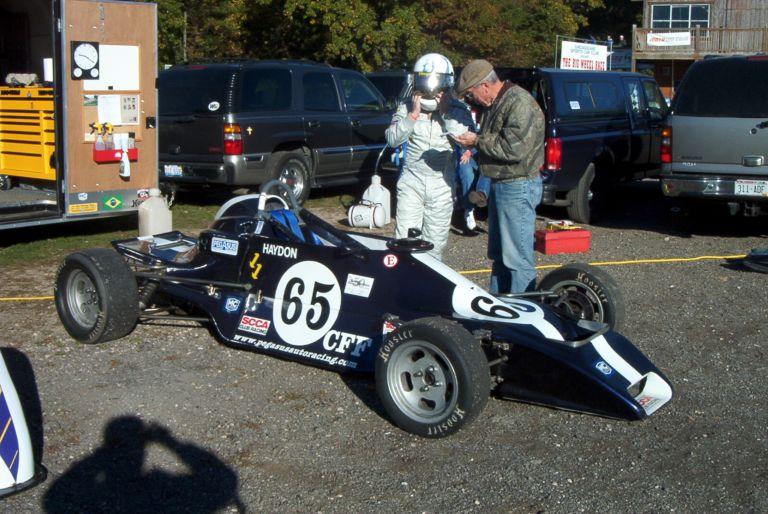 Ahh, the good memories. Getting ready to get in the car for the first practice session. My father seems to be trying to tell me something terribly important, but in fact he's probably asking me if the tire pressures are set, or if there's fuel in the car. Yes to both questions... and yes, I have forgotten both before.
 Aaaand... the not-so-good. This is us in our mad dash to try to repair the gearbox before the race. We cleaned the parts and then bathed them in oil and tired to flush the maincase with fresh oil to try to make the parts happy again. It was a very unhappy gearbox.
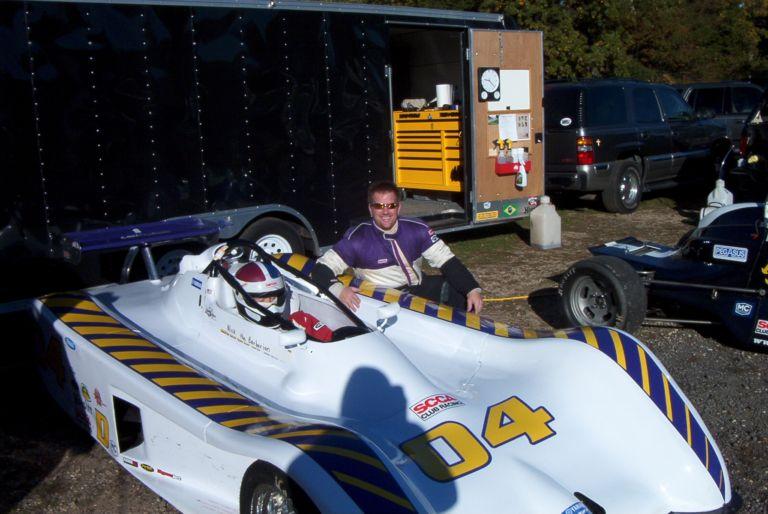 Here's Brian next to his racecar. Sitting in the car is Nicole Temple, Lindstrand Motorsports' transmission specialist. (Did I mention that Nicole also helped with the paint on my car?) They co-drove this race, and won their class. Bravo!
The car was originally a Formula Ford built by Titan, but it was converted to a sports racer with a Fiat engine some years ago -- before I started my own driving career. Brian was finally convinced to replace the Fiat with something a little more reliable a couple of years ago, so a Yamaha R1 engine now powers the car to some very impressive speeds.
Back in my garage, the transmission is off, as is the rear suspension and most of the engine "extras." The engine should be out of the car tonight. We may be able to start tearing it down this weekend.
Friday, October 21, 2005
Photos from October 8
I just got a CD of photos from Brad Ellingson, who attended the Fall Sprints with his digital camera instead of his racecar. Brad, I'm now torn between hoping you get your car back out next year and hoping you keep snapping away with the camera. Thanks!
 The shot of the weekend. As I entered corner 3, the corner station was waving the yellow flag, which usually means a car spun on track. As I came around the corner, I saw the blue FV stalled sideways on the track and I thought he was closer to the inside of the track. I committed to a path going around the front of his car and then discovered that there was no track there. Brad caught the moment in all of its lawnmowing glory. Alex Murray (#45) can be seen learning from my mistake.
 It took some minutes of head-scratching for me to realize that this shot was taken a fraction of a second before the photo above. My hand was in the air as a signal to the drivers behind me that I was slowing down, there was real danger ahead, and they should look for a way through it.
Look at where the car is on the track and the direction it's pointed. Now look back at the other photo and compare where the car went. The difference is called drifting. As the car goes through the corner, it's pointed farther around the corner than its actual path of travel. If I had been travelling in the same direction the car was pointing (instead of drifting to the outside of the corner), I'd have speared the FV in the side.
 I like the contrast in this one. Car #55 is a Formula 500 (once known as F440). These cars have snowmobile engines and the original snowmobile primary drive belt system. They use tiny little tires, but they weigh less than a Formula Ford and put out close to the same power through a CVT (Constantly Variable Transmission) -- sort of a cross between a go-kart clutch and an automatic transmission. They don't have to shift gears, and their engines are always in the peak power band, so they accellerate quickly and have a very high top speed. They're fast, but I just can't consider them real race cars because they don't have a gearbox.
I hate to end on an insult to another class of racecar, so I'll mention that I will be pulling the engine this week, and I have a line on a gearbox for sale down south. I'll keep you posted on both as things progress.
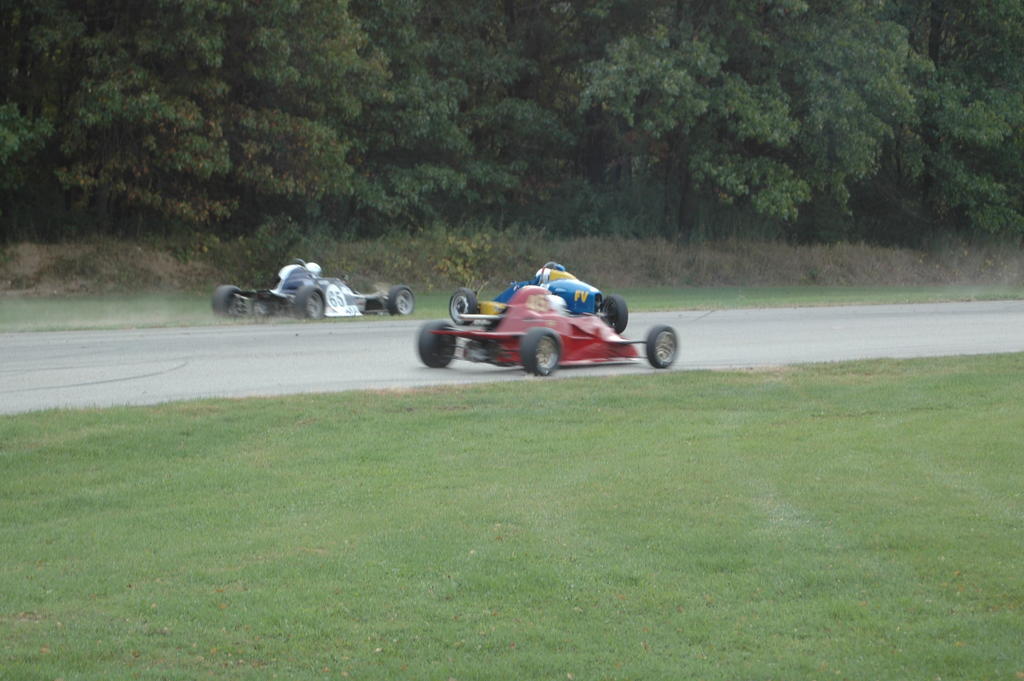 The shot of the weekend. As I entered corner 3, the corner station was waving the yellow flag, which usually means a car spun on track. As I came around the corner, I saw the blue FV stalled sideways on the track and I thought he was closer to the inside of the track. I committed to a path going around the front of his car and then discovered that there was no track there. Brad caught the moment in all of its lawnmowing glory. Alex Murray (#45) can be seen learning from my mistake.
 It took some minutes of head-scratching for me to realize that this shot was taken a fraction of a second before the photo above. My hand was in the air as a signal to the drivers behind me that I was slowing down, there was real danger ahead, and they should look for a way through it.
Look at where the car is on the track and the direction it's pointed. Now look back at the other photo and compare where the car went. The difference is called drifting. As the car goes through the corner, it's pointed farther around the corner than its actual path of travel. If I had been travelling in the same direction the car was pointing (instead of drifting to the outside of the corner), I'd have speared the FV in the side.
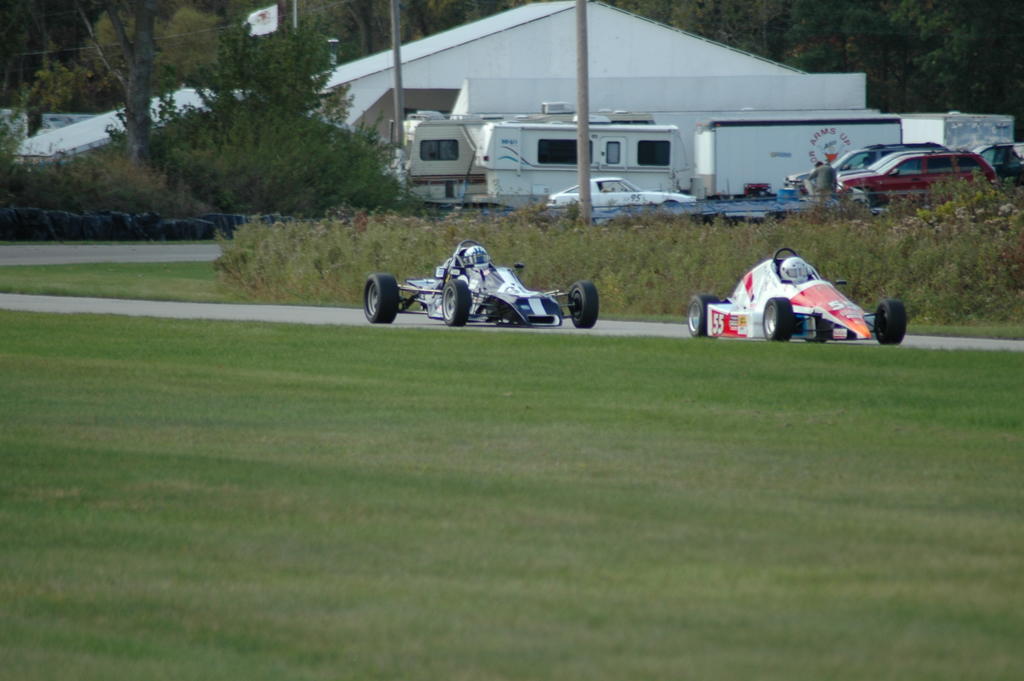 I like the contrast in this one. Car #55 is a Formula 500 (once known as F440). These cars have snowmobile engines and the original snowmobile primary drive belt system. They use tiny little tires, but they weigh less than a Formula Ford and put out close to the same power through a CVT (Constantly Variable Transmission) -- sort of a cross between a go-kart clutch and an automatic transmission. They don't have to shift gears, and their engines are always in the peak power band, so they accellerate quickly and have a very high top speed. They're fast, but I just can't consider them real race cars because they don't have a gearbox.
I hate to end on an insult to another class of racecar, so I'll mention that I will be pulling the engine this week, and I have a line on a gearbox for sale down south. I'll keep you posted on both as things progress.
Thursday, October 20, 2005
Thanks
Now that the season is over, I want to take some space here to thank some people who made it possible. The short list is "everyone who has ever talked with me about racing," but that's short-changing the people who really made this season happen. In random order:
Bruce Lindstrand, Cindy Lindstrand, Nicole Temple, and the rest of the Lindstrand Motorsports crew. It's rare to find people so willing to take you under their wing. I can't even begin to list the things they have done to help me. Just one example: At the bitter cold National race in May, I was walking back to my paddock space from the concession stand, and just as it began to drizzle a bit, I saw the LMI crew pushing my car from my spot to a spot under their already crowded tent to keep it dry. I truly cannot thank you enough.
Mom & Dad. I'm proud to say that my parents are my two biggest fans. Without my father's help, the car never would have hit the track this year. Without his expertise in engine building and his meticulous attention to detail, it never would have gone as fast or as far as it did. And without my mother's support and encouragement, the season would have been a lot shorter and much less enjoyable. I'll always have crew passes for you two.
Pete Wood. Speedy Petey is a multiple-time champion in Club Formula Ford -- once in my car! To paraphrase Fernando Alonso, this championship means everything because I had to beat him to win it. It was never easy, and you pushed me to drive like I never knew I could. And let's not forget that he sold me the car in the first place, and he helped me to restore it before I even paid it off!
Jack Bowling. JB Machine has made several vital parts on the car, and they've all been beautifully crafted, quickly done, and exactly what I needed. Add to that the fact that Jack has some great stories about racing back when people raced just to have fun.
Corky Jahn. Another person without whom I would not be the proud owner of a Tiga, much less a Tiga with four wheels on the ground. Corky helped finance the initial purchase by letting me sell him many of the spares -- and then letting me borrow them back when I needed them!
Chris & Carla Heitman and Pegasus Auto Racing Supplies. Chris is still a racer, even if he hasn't put on a helmet in a while. He and Carla understand what it takes to run a Formula Ford, and they have been an invaluable source of support, information, and helping hands. And they have yet to deny me a day off to go racing... Congratulations again on 25 years of Pegasus. I mean it when I say that this is the company I plan to retire from someday.
Lynn Serra, who told me about the Tiga when Pete wanted to sell it, and who never lets me think of quitting. Even if she has to smack me in the back of the head to get her point across. I still have a few more championships to win before I can break your record. Just watch me.
The Girl Who Wants to Remain Anonymous. You kept me sane (relatively), you made me laugh every day, you carried me to the med shack when I was ready to pass out. Despite having no interest in racing, you put up with me almost all summer. You really deserve a trophy for that.
There are hundreds more who have loaned me tools, parts, food, places to sleep, advice, and encouragement. Thank you all!
Bruce Lindstrand, Cindy Lindstrand, Nicole Temple, and the rest of the Lindstrand Motorsports crew. It's rare to find people so willing to take you under their wing. I can't even begin to list the things they have done to help me. Just one example: At the bitter cold National race in May, I was walking back to my paddock space from the concession stand, and just as it began to drizzle a bit, I saw the LMI crew pushing my car from my spot to a spot under their already crowded tent to keep it dry. I truly cannot thank you enough.
Mom & Dad. I'm proud to say that my parents are my two biggest fans. Without my father's help, the car never would have hit the track this year. Without his expertise in engine building and his meticulous attention to detail, it never would have gone as fast or as far as it did. And without my mother's support and encouragement, the season would have been a lot shorter and much less enjoyable. I'll always have crew passes for you two.
Pete Wood. Speedy Petey is a multiple-time champion in Club Formula Ford -- once in my car! To paraphrase Fernando Alonso, this championship means everything because I had to beat him to win it. It was never easy, and you pushed me to drive like I never knew I could. And let's not forget that he sold me the car in the first place, and he helped me to restore it before I even paid it off!
Jack Bowling. JB Machine has made several vital parts on the car, and they've all been beautifully crafted, quickly done, and exactly what I needed. Add to that the fact that Jack has some great stories about racing back when people raced just to have fun.
Corky Jahn. Another person without whom I would not be the proud owner of a Tiga, much less a Tiga with four wheels on the ground. Corky helped finance the initial purchase by letting me sell him many of the spares -- and then letting me borrow them back when I needed them!
Chris & Carla Heitman and Pegasus Auto Racing Supplies. Chris is still a racer, even if he hasn't put on a helmet in a while. He and Carla understand what it takes to run a Formula Ford, and they have been an invaluable source of support, information, and helping hands. And they have yet to deny me a day off to go racing... Congratulations again on 25 years of Pegasus. I mean it when I say that this is the company I plan to retire from someday.
Lynn Serra, who told me about the Tiga when Pete wanted to sell it, and who never lets me think of quitting. Even if she has to smack me in the back of the head to get her point across. I still have a few more championships to win before I can break your record. Just watch me.
The Girl Who Wants to Remain Anonymous. You kept me sane (relatively), you made me laugh every day, you carried me to the med shack when I was ready to pass out. Despite having no interest in racing, you put up with me almost all summer. You really deserve a trophy for that.
There are hundreds more who have loaned me tools, parts, food, places to sleep, advice, and encouragement. Thank you all!
Wednesday, October 19, 2005
That Loooong Race
As I mentioned last time, the final race of the season in this area is "That Loooong Race" at Blackhawk, put on (this year for the 35th time!) by the Chicagoland Sports Car Club. I had invited Bruce Lindstrand to co-drive the 100 mile race with me waaay back when I didn't know what kind of season I'd have and what condition the car would be in by now. I was eager to see him drive the car again, and he was excited to drive his old car again.
The car seemed to need little preparation after the Regional the week before, so I loaded it up and headed to the track. Our group was scheduled to run only on Sunday (20 minute practice, 25 minute qualifying, and 100 lap race), which was a VERY tough schedule. There was very little time between sessions to deal with the inevitable things that crop up on a race day. When you're running a race more than twice as long as you're used to, small problems become big problems.
I ran the practice session because Bruce ran that session in the other car he was co-driving: Allen Wheatcroft's 1998 Van Diemen FF. Bruce was going to have a very busy day. We determined that he would start the race in Allen's car and I would start in my car. Bruce would pull into the pits around lap 25, Allen would get in his car, I would come in on lap 30, and Bruce would take over in my car. The practice session went well, and I turned a few 1:22 laps.
The qualifying session was a little surreal. Seeing my own car being driven by someone else gave me an odd feeling of pride mixed with jealousy -- the car looked and sounded great, but someone else was driving my car! Bruce was kind to me and to the car. He immediately cranked out a string of 1:23.7 laps. He was so consistent that we thought there was something wrong with our timing equipment, because the numbers never changed. Then the worry set in. The second-last lap, as he was passing the pit lane, the car popped out of gear. That was very strange, because that had never happened to me with that car. The next lap, he pulled in and explained that the car wouldn't stay in 4th gear and was getting generally hard to shift. Smoke was coming off the gearbox -- never a good sign.
We let the gearbox cool a bit, to the point where our gloves wouldn't burst into flames as soon as we touched it. We took the rear cover off, expecting some gear lube to come out. All that came out was a little smoke. Bad sign.
We took the bearing carrier off and pulled the gear stacks out. Again, no oil -- only smoke. Very bad sign. There should have been at least a quart of gear lube inside. All of the internal parts were a disgusting shade of brown, evidence that the residual oil had been baked onto them. A couple of parts (the 4th gear set) had turned blue from the abuse.
We cleaned and re-oiled everything and replaced the 4th gear set with a new set. When I went to reassemble the gear stacks, something clearly didn't line up. Nicole Temple, Lindstrand Motorsports' gearbox specialist, spotted the problem immediately. The extreme heat had allowed a bearing to back out of the bearing carrier, changing all of the clearances. Fortunately, it was a thirty-seconds-with-a-mallet job for Bruce, and we went back to reassembling -- and refilling -- the gearbox. But where had the gear lube gone? That was a question that we should have asked and answered before the race, but we were pretty much fried from thrashing to get it back together. We had no idea how long it would last or if it would even work to begin with.
I started the race behind Paul Schindlbeck, the CFF polesitter. I managed to outbrake him going into corner 3 and set about building up a lead. Meanwhile, Pete Wood started from the pit lane. His strategy was to conserve fuel and try to run without stopping for fuel. I hoped he had miscalculated, but the season was basically over, so I wasn't hoping too hard. It was a gutsy strategy. It would be fun to see it work.
Somewhere around lap 20, I got the bad news. Coming down the front straight, the transmission popped out of 4th gear. I was completely unprepared for it, and immediately jammed it in 3rd gear, doing the engine no good at all. As soon as I recovered my wits, I realized that I would just have to hold the shift lever when the car was in 4th gear and drive with one hand. Sounds a lot easier than it is. The next lap, it popped out of 3rd. Yikes. Those are two important gears around Blackhawk, and 3rd gear is used in two sweeping turns. It's pretty tough to hold your line while sliding with only one hand on the wheel! A lap or two later, it popped out of 1st. Very very bad. At no time during the next few laps could I take my hand off the shift lever. I managed to pass Pete, but as I stumbled past, he could clearly smell blood, and he stuck behind me for the rest of that lap.
My left shoulder was getting really sore when I finally saw the relief: the pit board reading "L30 -- In"! I pulled in the pit lane just after Pete passed me. I coasted to a stop, hopped out, and yelled to Bruce, "It's bad! Popping out of all four now!" I turned my attention to refueling the car as my right leg began to cramp from the exertion of stomping on the throttle. The dull soreness in my shoulder began to focus into sharp pain, and my left calf began to cramp in protest. I threw the empty fuel jug down and turned to Bruce to make sure he had gotten the message about the gearbox.
"It's popping out of all four gears -- you have to hold the lever in gear all the time. The motor sounds pretty bad, too. I must have over-revved it at least a half a dozen times from it popping out!" Bruce nodded, looked at the lap counter, and said, "Okay, I think I know what I need to do to finish." He strapped into the car and headed out.
Because the pit stop took a fairly long time, we lost three laps to Pete. Bruce had re-entered the track just in front of Pete, and Pete knew we were having trouble. He knew that all he had to do was keep the car in sight and he'd have us. He was right. Bruce managed to keep a pretty consistent pace in the 1:24 range, but Pete was on his tail the whole time. Bruce couldn't hope to get the three laps back. I watched the lap counter anxiously: 10 laps to go... 5... 3... then it happened.
Pete came down the front straight alone. As he disappeared into corner 1, we became aware of a blue Tiga proceeding slowly down the front straight, hunting for a gear, any gear. The transmission had given out completely, and Bruce was just coasting towards corner 1. Two laps to go.
Pete took the checkered flag and a victory lap as we watched smoke pour out of the back of my car. Talk about a conflict of emotions. Pete was the underdog, he gambled on a longshot strategy and came from behind to win. He beat me for the first time this year. That was great to see, even from my shoes. But my car sat, mortally wounded and unable to continue. I had let Bruce down -- not just in the immediate sense of not being able to win the race, but in the broader sense of not putting into practice all that he had taught me about car preparation.
In hindsight, it all makes sense. The car was popping out of gear because of the extreme heat. The gearbox is held in gear by spring-loaded plungers that fit into detents in the shift rails. (Stick with me here, it's not really that technical.) Springs do not spring anymore if they get too hot. They just give up and relax. I have a theory about where the oil went. When I replaced the input shaft in August, I had to remove the left side cover to do it. Reinstallation required a certain sealant (which I used) to prevent leaks. But I haven't used that type of sealant before, and I didn't know that the nuts that hold the sideplate on need to be retightened after every session until the sealant is fully cured. That was the critical step. The sealant continues to shrink a bit for weeks. I knew the sideplate leaked a bit -- they all do! -- but I didn't realize it was steadily getting worse. Before October, I was changing gears almost every weekend, so checking the oil level in the gearbox was unneccessary. I just refilled it after each gear change. After Labor Day, I ran Blackhawk three times without opening up the gearbox. There was probably some oil in the gearbox, but when the level got too low, the heat increased and simply burned the remaining oil away.
A post-mortem of the gearbox shows pretty much total damage. The rear bearing that supports the layshaft fell apart, allowing the shaft (and its gears) to fall about 1/2" -- enough so that the gears no longer meshed. The shaft flailed around a bit at first, causing an as-yet undetermined amount of damage to the gears and bearing carrier. At this point, replacement of the entire transmission looks like the most economical solution.
But it looks like I may get off cheap compared to Allen. He said he heard a pop coming through corner 5 about 10 laps into his stint (some 15 laps from the end of the race). Everything seemed fine, so he continued. Nothing changed, and he won the Formula Ford race! When he pulled in, the Lindstrand crew noticed a hole in the engine cover. Something had exited the car through the bodywork. They took off the engine cover and saw that part of the transmission bellhousing had been broken out, and the lower frame rails and floorpan had been sheared in two! Apparently the ring gear had broken off the flywheel and done all that damage. But Allen was still able to turn his fastest race laps to date. Well done!
The car seemed to need little preparation after the Regional the week before, so I loaded it up and headed to the track. Our group was scheduled to run only on Sunday (20 minute practice, 25 minute qualifying, and 100 lap race), which was a VERY tough schedule. There was very little time between sessions to deal with the inevitable things that crop up on a race day. When you're running a race more than twice as long as you're used to, small problems become big problems.
I ran the practice session because Bruce ran that session in the other car he was co-driving: Allen Wheatcroft's 1998 Van Diemen FF. Bruce was going to have a very busy day. We determined that he would start the race in Allen's car and I would start in my car. Bruce would pull into the pits around lap 25, Allen would get in his car, I would come in on lap 30, and Bruce would take over in my car. The practice session went well, and I turned a few 1:22 laps.
The qualifying session was a little surreal. Seeing my own car being driven by someone else gave me an odd feeling of pride mixed with jealousy -- the car looked and sounded great, but someone else was driving my car! Bruce was kind to me and to the car. He immediately cranked out a string of 1:23.7 laps. He was so consistent that we thought there was something wrong with our timing equipment, because the numbers never changed. Then the worry set in. The second-last lap, as he was passing the pit lane, the car popped out of gear. That was very strange, because that had never happened to me with that car. The next lap, he pulled in and explained that the car wouldn't stay in 4th gear and was getting generally hard to shift. Smoke was coming off the gearbox -- never a good sign.
We let the gearbox cool a bit, to the point where our gloves wouldn't burst into flames as soon as we touched it. We took the rear cover off, expecting some gear lube to come out. All that came out was a little smoke. Bad sign.
We took the bearing carrier off and pulled the gear stacks out. Again, no oil -- only smoke. Very bad sign. There should have been at least a quart of gear lube inside. All of the internal parts were a disgusting shade of brown, evidence that the residual oil had been baked onto them. A couple of parts (the 4th gear set) had turned blue from the abuse.
We cleaned and re-oiled everything and replaced the 4th gear set with a new set. When I went to reassemble the gear stacks, something clearly didn't line up. Nicole Temple, Lindstrand Motorsports' gearbox specialist, spotted the problem immediately. The extreme heat had allowed a bearing to back out of the bearing carrier, changing all of the clearances. Fortunately, it was a thirty-seconds-with-a-mallet job for Bruce, and we went back to reassembling -- and refilling -- the gearbox. But where had the gear lube gone? That was a question that we should have asked and answered before the race, but we were pretty much fried from thrashing to get it back together. We had no idea how long it would last or if it would even work to begin with.
I started the race behind Paul Schindlbeck, the CFF polesitter. I managed to outbrake him going into corner 3 and set about building up a lead. Meanwhile, Pete Wood started from the pit lane. His strategy was to conserve fuel and try to run without stopping for fuel. I hoped he had miscalculated, but the season was basically over, so I wasn't hoping too hard. It was a gutsy strategy. It would be fun to see it work.
Somewhere around lap 20, I got the bad news. Coming down the front straight, the transmission popped out of 4th gear. I was completely unprepared for it, and immediately jammed it in 3rd gear, doing the engine no good at all. As soon as I recovered my wits, I realized that I would just have to hold the shift lever when the car was in 4th gear and drive with one hand. Sounds a lot easier than it is. The next lap, it popped out of 3rd. Yikes. Those are two important gears around Blackhawk, and 3rd gear is used in two sweeping turns. It's pretty tough to hold your line while sliding with only one hand on the wheel! A lap or two later, it popped out of 1st. Very very bad. At no time during the next few laps could I take my hand off the shift lever. I managed to pass Pete, but as I stumbled past, he could clearly smell blood, and he stuck behind me for the rest of that lap.
My left shoulder was getting really sore when I finally saw the relief: the pit board reading "L30 -- In"! I pulled in the pit lane just after Pete passed me. I coasted to a stop, hopped out, and yelled to Bruce, "It's bad! Popping out of all four now!" I turned my attention to refueling the car as my right leg began to cramp from the exertion of stomping on the throttle. The dull soreness in my shoulder began to focus into sharp pain, and my left calf began to cramp in protest. I threw the empty fuel jug down and turned to Bruce to make sure he had gotten the message about the gearbox.
"It's popping out of all four gears -- you have to hold the lever in gear all the time. The motor sounds pretty bad, too. I must have over-revved it at least a half a dozen times from it popping out!" Bruce nodded, looked at the lap counter, and said, "Okay, I think I know what I need to do to finish." He strapped into the car and headed out.
Because the pit stop took a fairly long time, we lost three laps to Pete. Bruce had re-entered the track just in front of Pete, and Pete knew we were having trouble. He knew that all he had to do was keep the car in sight and he'd have us. He was right. Bruce managed to keep a pretty consistent pace in the 1:24 range, but Pete was on his tail the whole time. Bruce couldn't hope to get the three laps back. I watched the lap counter anxiously: 10 laps to go... 5... 3... then it happened.
Pete came down the front straight alone. As he disappeared into corner 1, we became aware of a blue Tiga proceeding slowly down the front straight, hunting for a gear, any gear. The transmission had given out completely, and Bruce was just coasting towards corner 1. Two laps to go.
Pete took the checkered flag and a victory lap as we watched smoke pour out of the back of my car. Talk about a conflict of emotions. Pete was the underdog, he gambled on a longshot strategy and came from behind to win. He beat me for the first time this year. That was great to see, even from my shoes. But my car sat, mortally wounded and unable to continue. I had let Bruce down -- not just in the immediate sense of not being able to win the race, but in the broader sense of not putting into practice all that he had taught me about car preparation.
In hindsight, it all makes sense. The car was popping out of gear because of the extreme heat. The gearbox is held in gear by spring-loaded plungers that fit into detents in the shift rails. (Stick with me here, it's not really that technical.) Springs do not spring anymore if they get too hot. They just give up and relax. I have a theory about where the oil went. When I replaced the input shaft in August, I had to remove the left side cover to do it. Reinstallation required a certain sealant (which I used) to prevent leaks. But I haven't used that type of sealant before, and I didn't know that the nuts that hold the sideplate on need to be retightened after every session until the sealant is fully cured. That was the critical step. The sealant continues to shrink a bit for weeks. I knew the sideplate leaked a bit -- they all do! -- but I didn't realize it was steadily getting worse. Before October, I was changing gears almost every weekend, so checking the oil level in the gearbox was unneccessary. I just refilled it after each gear change. After Labor Day, I ran Blackhawk three times without opening up the gearbox. There was probably some oil in the gearbox, but when the level got too low, the heat increased and simply burned the remaining oil away.
A post-mortem of the gearbox shows pretty much total damage. The rear bearing that supports the layshaft fell apart, allowing the shaft (and its gears) to fall about 1/2" -- enough so that the gears no longer meshed. The shaft flailed around a bit at first, causing an as-yet undetermined amount of damage to the gears and bearing carrier. At this point, replacement of the entire transmission looks like the most economical solution.
But it looks like I may get off cheap compared to Allen. He said he heard a pop coming through corner 5 about 10 laps into his stint (some 15 laps from the end of the race). Everything seemed fine, so he continued. Nothing changed, and he won the Formula Ford race! When he pulled in, the Lindstrand crew noticed a hole in the engine cover. Something had exited the car through the bodywork. They took off the engine cover and saw that part of the transmission bellhousing had been broken out, and the lower frame rails and floorpan had been sheared in two! Apparently the ring gear had broken off the flywheel and done all that damage. But Allen was still able to turn his fastest race laps to date. Well done!
Tuesday, October 18, 2005
Fall Sprints
With the championship locked and the engine oil pressure too low for comfort, I was prepared to skip the rest of the season and begin the winter overhaul on the race car. But I needed to run one more SCCA-sanctioned race to renew my SCCA license, and the car was ready, so I was persuaded to run the next Blackhawk race, this one run by the Chicago Region of SCCA.
This was a Regional race taking place over the course of two days (Saturday and Sunday). My group would qualify early on Saturday and race before lunch on Sunday. This was quite a contrast to most of the events I've run so far. All but a few have been either one-day races with three sessions crammed into one day, or double race weekends with two or three sessions each on Saturday and Sunday. I'm not used to having a lot of time on my hands during a race weekend.
The track was cold and slippery for the first qualifying session early Saturday morning, so I didn't accomplish much except to avoid a Formula Vee that had spun across track in corner 3. I had to take to the grass on the outside of the corner, and I learned that the track did in fact have a bit more traction than the damp grass.* No harm done, I got back on the track and finished the session.
The second qualifying session started off pretty poorly. I couldn't get settled down, I couldn't get a rhythm, and I was all over the track. After posting about a half a dozen laps in the high 1:25 range, I decided to quit pushing so hard and to try to follow a Formula Ve e. Many people will tell you how much a season in an FV can teach you about driving fast. I don't think they realize how much a single session behind an FV can teach you about driving fast! Those cars have half the horsepower of a Formula Ford, half the tire, drum brakes, and suspension that just shouldn't work at all, but they can out-corner any Formula Ford. The drivers learn to conserve momentum rather than relying on horsepower for fast lap times, so their cornering speed is not much lower than their straightline speed. Following that car got me settled down and really focused my concentration on the task at hand. I passed him after a few good laps and immediately turned a 1:20.38.
That was good enough for the CFF pole position... but there were no CFFs behind me. I had been told that this event would be crowded, that "everybody" comes out to have the one last bash before the winter. But I was the only CFF entrant. All I had to do was finish the race to get a win.
Sunday morning was a little warmer than Saturday morning, but still colder than Saturday afternoon. We left everything as it was for Saturday and headed to the grid. I was directly behind Todd Rhoades in a Swift DB-1 Formula Ford, between some F500s, and in front of all of the FVs. The start went well, and I even managed to keep Todd in sight for the first several laps despite the Swift's more advanced suspension, more aerodynamic body, and stickier tires. Once his tires warmed up, he pulled away and I didn't push the issue. I finished the race, which was enough for a win. I took a victory lap with another huge checkered flag slapping against my helmet.
The real drama of this race was at the front of the pack in the Formula Ford race. Bruce Lindstrand ran his '92 Van Diemen (his first time in that car this year) against Mark Kolell's very fast '85 Van Diemen. Bruce started in front of Mark and held him off for 24 laps. Well, almost 24 laps. Mark passed him coming out of the last turn and crossed the finish line just 0.077 seconds in front of Bruce! As someone said later to Bruce, "You held him off for 47 miles... and you couldn't find one more foot?"
I found out the next day that this win put me in the lead in the "TRO Manufacturing Area 5 Central Division CFF Championship" -- but because I did not run the minimum 6 races in the Area 5 series, I was ineligible for the championship! Thrilling, because I had no idea I was even a contender for the title. And yet a little heartbreaking.
The car was still running strong at the end of the race, so I decided to go for broke and run "The Looong Race" the next weekend at Blackhawk. This year-end race is 100 miles, more than twice the typical race distance. Because so many championships are decided before then, people often invite friends to co-drive the event with them. I invited Bruce Lindstrand to drive his old car again.
*Despite what TV racing commentators (and armchair commentators) will claim, hitting wet grass will NOT make the car go faster. If it did, we'd be racing on wet grass, not asphalt! Here's what really happens: Almost any time a car leaves the track, it's skidding or sliding along the asphalt, either trying to stop or trying to make a turn. Skidding and sliding against the asphalt slows the car dramatically. Sliding on grass slows the car only a little bit -- much less than sliding on asphalt. There's a lot of friction between tires and asphalt. There's not much between tires and wet grass. It's the contrast between the deceleration rates that makes it look and feel like the car sped up. In actual fact, all that happened is that the car lost a lot of deceleration. Its true speed will not be any faster after it hits the grass than it was when it left the asphalt. It will continue to slow down, but much less dramatically.
TV cameras perpetuate the myth because the camera operators pan (rotate) the camera to follow the car's motion. The operator compensates for the deceleration rate. When the deceleration rate suddenly changes, the camera operator is caught off-guard, still slowing the camera, and the car appears to "shoot" out of the picture.
And if anyone still believes that cars accelerate when they hit the grass, maybe you can answer this. It takes energy to accelerate. Where does that extra energy come from? Do the individual blades of grass band together to push the car along?
This was a Regional race taking place over the course of two days (Saturday and Sunday). My group would qualify early on Saturday and race before lunch on Sunday. This was quite a contrast to most of the events I've run so far. All but a few have been either one-day races with three sessions crammed into one day, or double race weekends with two or three sessions each on Saturday and Sunday. I'm not used to having a lot of time on my hands during a race weekend.
The track was cold and slippery for the first qualifying session early Saturday morning, so I didn't accomplish much except to avoid a Formula Vee that had spun across track in corner 3. I had to take to the grass on the outside of the corner, and I learned that the track did in fact have a bit more traction than the damp grass.* No harm done, I got back on the track and finished the session.
The second qualifying session started off pretty poorly. I couldn't get settled down, I couldn't get a rhythm, and I was all over the track. After posting about a half a dozen laps in the high 1:25 range, I decided to quit pushing so hard and to try to follow a Formula Ve
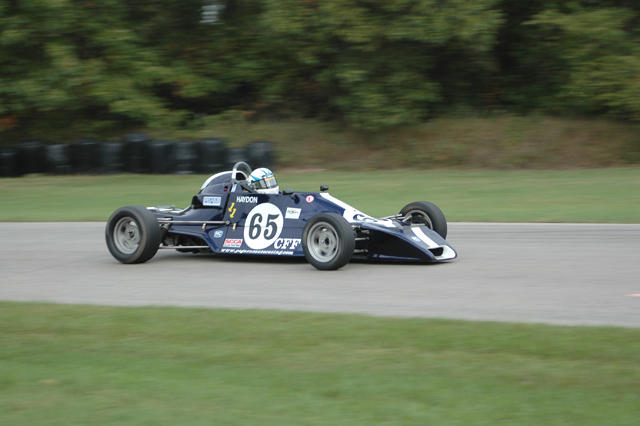 e. Many people will tell you how much a season in an FV can teach you about driving fast. I don't think they realize how much a single session behind an FV can teach you about driving fast! Those cars have half the horsepower of a Formula Ford, half the tire, drum brakes, and suspension that just shouldn't work at all, but they can out-corner any Formula Ford. The drivers learn to conserve momentum rather than relying on horsepower for fast lap times, so their cornering speed is not much lower than their straightline speed. Following that car got me settled down and really focused my concentration on the task at hand. I passed him after a few good laps and immediately turned a 1:20.38.
That was good enough for the CFF pole position... but there were no CFFs behind me. I had been told that this event would be crowded, that "everybody" comes out to have the one last bash before the winter. But I was the only CFF entrant. All I had to do was finish the race to get a win.
Sunday morning was a little warmer than Saturday morning, but still colder than Saturday afternoon. We left everything as it was for Saturday and headed to the grid. I was directly behind Todd Rhoades in a Swift DB-1 Formula Ford, between some F500s, and in front of all of the FVs. The start went well, and I even managed to keep Todd in sight for the first several laps despite the Swift's more advanced suspension, more aerodynamic body, and stickier tires. Once his tires warmed up, he pulled away and I didn't push the issue. I finished the race, which was enough for a win. I took a victory lap with another huge checkered flag slapping against my helmet.
The real drama of this race was at the front of the pack in the Formula Ford race. Bruce Lindstrand ran his '92 Van Diemen (his first time in that car this year) against Mark Kolell's very fast '85 Van Diemen. Bruce started in front of Mark and held him off for 24 laps. Well, almost 24 laps. Mark passed him coming out of the last turn and crossed the finish line just 0.077 seconds in front of Bruce! As someone said later to Bruce, "You held him off for 47 miles... and you couldn't find one more foot?"
I found out the next day that this win put me in the lead in the "TRO Manufacturing Area 5 Central Division CFF Championship" -- but because I did not run the minimum 6 races in the Area 5 series, I was ineligible for the championship! Thrilling, because I had no idea I was even a contender for the title. And yet a little heartbreaking.
The car was still running strong at the end of the race, so I decided to go for broke and run "The Looong Race" the next weekend at Blackhawk. This year-end race is 100 miles, more than twice the typical race distance. Because so many championships are decided before then, people often invite friends to co-drive the event with them. I invited Bruce Lindstrand to drive his old car again.
*Despite what TV racing commentators (and armchair commentators) will claim, hitting wet grass will NOT make the car go faster. If it did, we'd be racing on wet grass, not asphalt! Here's what really happens: Almost any time a car leaves the track, it's skidding or sliding along the asphalt, either trying to stop or trying to make a turn. Skidding and sliding against the asphalt slows the car dramatically. Sliding on grass slows the car only a little bit -- much less than sliding on asphalt. There's a lot of friction between tires and asphalt. There's not much between tires and wet grass. It's the contrast between the deceleration rates that makes it look and feel like the car sped up. In actual fact, all that happened is that the car lost a lot of deceleration. Its true speed will not be any faster after it hits the grass than it was when it left the asphalt. It will continue to slow down, but much less dramatically.
TV cameras perpetuate the myth because the camera operators pan (rotate) the camera to follow the car's motion. The operator compensates for the deceleration rate. When the deceleration rate suddenly changes, the camera operator is caught off-guard, still slowing the camera, and the car appears to "shoot" out of the picture.
And if anyone still believes that cars accelerate when they hit the grass, maybe you can answer this. It takes energy to accelerate. Where does that extra energy come from? Do the individual blades of grass band together to push the car along?
Monday, October 17, 2005
Catch-Up
I have been scolded by my fans for not posting an update in too long. "Time just got away from me" is the absolute truth -- September 7 was the most recent post?? How did that happen? Well, time to play catch-up again. Step with me now into the WayBack machine...
September 17-18 was a Midwestern Council driver's school / race weekend at Blackhawk Farms Raceway. Since the Tiga's oil pressure was solidly in the "iffy" range, I decided against running as a chase car for the school on Saturday. The MC points chase was almost decided. All I needed was to finish in front of Pete Wood to clinch the CFF championship. Pete was looking strong, so I relied again on strategy.
I had my crew monitor Pete's qualifying times while I watched my own times on my in-car timer. Such an invention! Back in the day (last year), your crew had to use a stopwatch and put numbers on a pit board, which they showed you as you raced past them. But they couldn't show you the time for the lap you just completed -- it was always the lap before. By then, it was old news! Now I can see my lap time right on the steering wheel, as well as lap number, total time in the session, and whether that lap was faster or slower than my best. When Pete did a 1:22, I turned up the wick and did a 1:21. When Pete recorded a 1:20.8, I pulled out all the stops and scraped out a 1:20.2. As I rounded corner 1, I saw Pete's car sitting in the grass next to the corner station.
After the session, Pete explained that he downshifted for corner 1, but when he got back on the throttle, the car didn't accelerate. The engine revved happily, but it wasn't connected to the transmission. He suspected a broken input shaft, like I had at Road America in August, but it sounded to me like a stripped clutch disc. I tried to persuade him to fix it for the race, but his Crossle chassis is a different design than the Tiga. He would have to support the engine with a hoist to get the clutch out. His day was done.
At that point, I could have also packed up and I still would have clinched the championship. (If Pete could win the last two events, and if I didn't show to either one, we would have tied for points, but I had more wins.) But I didn't come out just to pack up when it got too easy. I decided to try to have a race with Scott Reif, the third place CFF qualifier.
I looked for Scott in my mirrors on the first lap, expecting to just race leisurely with him. But as we came out of corner 5, a sports racer spun in corner 6, blocking the right side of the track. Scott was trying to pass the sports racer gridded between us, but he had gone to the right side and almost had to come to a full stop to avoid the stalled car. I think Scott lost about four or five positions and at least 15 seconds because of it. I was too far ahead to catch, so I ran alone for the rest of the race. Scott finished second (in a '76 Tiga), Mike Schindlbeck finished third, Bob Fleming was fourth, and Larry Noble rounded out the CFF field in a third Tiga.
The CFF points after this race:

September 17-18 was a Midwestern Council driver's school / race weekend at Blackhawk Farms Raceway. Since the Tiga's oil pressure was solidly in the "iffy" range, I decided against running as a chase car for the school on Saturday. The MC points chase was almost decided. All I needed was to finish in front of Pete Wood to clinch the CFF championship. Pete was looking strong, so I relied again on strategy.
I had my crew monitor Pete's qualifying times while I watched my own times on my in-car timer. Such an invention! Back in the day (last year), your crew had to use a stopwatch and put numbers on a pit board, which they showed you as you raced past them. But they couldn't show you the time for the lap you just completed -- it was always the lap before. By then, it was old news! Now I can see my lap time right on the steering wheel, as well as lap number, total time in the session, and whether that lap was faster or slower than my best. When Pete did a 1:22, I turned up the wick and did a 1:21. When Pete recorded a 1:20.8, I pulled out all the stops and scraped out a 1:20.2. As I rounded corner 1, I saw Pete's car sitting in the grass next to the corner station.
After the session, Pete explained that he downshifted for corner 1, but when he got back on the throttle, the car didn't accelerate. The engine revved happily, but it wasn't connected to the transmission. He suspected a broken input shaft, like I had at Road America in August, but it sounded to me like a stripped clutch disc. I tried to persuade him to fix it for the race, but his Crossle chassis is a different design than the Tiga. He would have to support the engine with a hoist to get the clutch out. His day was done.
At that point, I could have also packed up and I still would have clinched the championship. (If Pete could win the last two events, and if I didn't show to either one, we would have tied for points, but I had more wins.) But I didn't come out just to pack up when it got too easy. I decided to try to have a race with Scott Reif, the third place CFF qualifier.
I looked for Scott in my mirrors on the first lap, expecting to just race leisurely with him. But as we came out of corner 5, a sports racer spun in corner 6, blocking the right side of the track. Scott was trying to pass the sports racer gridded between us, but he had gone to the right side and almost had to come to a full stop to avoid the stalled car. I think Scott lost about four or five positions and at least 15 seconds because of it. I was too far ahead to catch, so I ran alone for the rest of the race. Scott finished second (in a '76 Tiga), Mike Schindlbeck finished third, Bob Fleming was fourth, and Larry Noble rounded out the CFF field in a third Tiga.
The CFF points after this race:
- John Haydon - 200
- Pete Wood - 126
- Michael Schindlbeck - 85
- Scott Reif - 53
- Denis Downs - 33
- Larry Noble - 27
- Bob Fleming - 21
- Jon Borkowski - 16
- Paul Schindlbeck - 16
- Dick Plank - 13
With only two races remaining and only 50 points up for grabs, my lead was solid. Time to pop the champagne!
Next time: SCCA Fall Sprints at BFR. I promise this one will take me less than a month to write!
Wednesday, September 07, 2005
There has been plenty of action since the last update. August 28 was "The Masterpiece: Style & Speed Showcase" car show at Veteran's Park in Milwaukee. It was the first car show of its type in the area, with some spectacular cars (1931 Cadillac V-16 Coupe Road ster, 1937 Rolls Royce PIII Aero Coupe, and my father's 1932 Packard Coupe Roadster), some great early cars (1902 Curved Dash Oldsmobile, 1926 Stanley "steamer", and a 1905 one-cylinder Cadillac), and competition cars, including my car. The show was carefully planned and staged so that the cars were displayed in groups emphasizing their similarities: finned cars were in a circle with the fins pointing outwards; roadsters were in a circle with the tops down; and competition cars were in a row from oldest (1927 Bugatti Grand Prix car) to newest (1979 Tiga Formula Ford). Proceeds from the show benefitted Jewish Family Services, who are eager to team up for a repeat next year.
Labor Day weekend was unusual for me, to say the least. Races were being held at two tracks in Michigan: Midwestern Council ran at GingerMan in South Haven on Saturday, and SCCA ran two Regional races (Saturday and Sunday) at Grattan near Grand Rapids. I decided that going all the way to Michigan would make more sense if I ran both days. I wanted to get the points for Midwestern Council, and I needed to run more SCCA races to keep that license current. Since the tracks are roughly an hour or two apart, getting a hotel midway between them made sense. The Best Western in Holland turned out to be a great choice. Clean and quiet, with a jaccuzzi tub in the room! Very swank.
Saturday looked like it was going to be uneventful, but looks can deceive. I was the only Club Formula Ford entered, so all I needed to do was finish the race to get a win. I qualified in the thick of the usual group: Dave Knaack's D Sports Racer qualified in front of me, Frank Riemann's FF would be next to me, and Chuck Cassaro's Sports 2000 qualified behind me. When I checked over the car after qualifying, I found that the rear wheel hubs were loose again. I wasn't too concerned, since I know it's due to the relatively soft Brazilian hubs compressing and mushrooming due to the cornering forces that they were never designed for. All I'd have to do would be to retorque the axle nuts and I'd be ready to cruise to an easy win.
Someone once said, "Nothing easy is ever worthwhile." Maybe this was proof that what I'm doing is worthwhile, but when I tried to tighten the right rear axle nut, the threads stripped out of the nut. Bad timing. I don't carry a spare nut (but I will now), and I had about an hour and a half to get the car fixed for the race. I went through the paddock looking for anyone likely to have something to fit. It's an old VW Beetle part, so I checked with some VW Rabbit racers, Porsche drivers, and even the FV brigade, but no luck. As I returned to the Lindstrand Motorsports tent, Nicole Temple told me that a friend of theirs knew a local guy... He had one, but he was 45 minutes away, and the race was in an hour.
A couple of phone calls later, Patrick Ohmann arranged to meet Rob Ritt of Epicenter Design halfway between the track and his shop in Holland. As he sped off, I finished preparing the car and began arranging the details to get the car together and on the track as quickly as possible. Pat would install the new nut as I belted in the car, Nicole Temple from LMI would install the wheel, my roommate David Cox would lower the jack while Amy would take care of the jumpstart battery. All we needed now was the nut. While I waited for Pat and watched the minutes tick away, I mentally prepared myself to start from the pit lane after the other cars had taken the green flag, then just get the required number of laps to be considered a finisher. That was all I needed to do.
As the announcement came over the PA system that the grid for our race was closed*, Pat came running up to me with the new nut in his hand. I jumped in the car and held the brake pedal down as he tightened the nut as much as he dared. As I belted myself in, Nicole got the wheel on quicker than I've ever been able to do, and as I felt the car being lowered off the jack I hit the starter. The engine eagerly barked to life. I got the thumbs-up from Amy and drove toward the grid.
The grid configuration at GingerMan is a little odd. Due to a one-way lane, we had to drive the wrong way down the grid between the lines of cars, turn around, and then join the lineup. When I turned the corner to drive down between the cars, the crews for all the other cars pointed at me in disbelief and began applauding and cheering as though I had already won the race. It's amazing how much the other racers pull for you, even if they're trying to beat you on the track.
Since I was late to the grid, I started from the back. My plan was to just get the required laps, take it easy, get my finish, and pull in. But I don't know a racer who is able to keep his foot off the throttle when the green flag flies. Seeing a slower car disappear in your mirror is just too inspiring. When I got past the first car, I couldn't help trying to pass the next... then the next... I think I passed a car each lap for the first half of the race. I chased down all the cars gridded behind me and actually improved my finishing position by one spot.
We packed up the truck and loaded the trailer after the race to get back to the hotel for the night. I soaked in the jaccuzzi for a while until my throat started to burn a little, which I figured was due to breathing in all of the hot chlorinated water vaporizing all around me. When I woke up Sunday morning, I realized that it was really the start of a cold. There wasn't much I could do about it then except get some hot cider and oatmeal at the hotel's continental breakfast and hit the road to Grattan.
We got to Grattan right on time, got through Registration and Tech without any delays or difficulties, and found a great paddock spot without even looking. After we got the car unloaded I realized that I would have plenty of time to change the gears to suit the longer track. I got the gear change done in record time with Amy's help -- despite a boneheaded error on my part that cost me about 15 extra minutes -- and waited for the morning qualifying session.
Qualifying went well enough, but I didn't set the world on fire. I only needed to finish the race to fulfill the renewal requirements for my SCCA license, but I enjoy Grattan too much not to drive hard. Once I managed to match my best time from May, I cut my session short by a few minutes and pulled in, hoping to save the engine and tires a bit. I was sent to Impound for a spot-check, and I rolled across the scales at 1191 pounds. I had a few more gallons of fuel than I would at the end of a race, so it sounded accurate to me. I returned to my paddock space and began the nut-and-bolt check for the afternoon's race.
I finished two items on the list and started to feel dizzy and exhausted. I realized that the cold was catching up to me, and it was not going down without a fight. I wrapped up in a blanket and a fleece sweatshirt and sat in the sun, shivering for about an hour. I actually felt much better after that little rest, so I set about finishing the preparations for the race. Everything was in order... except the exhaust header pipe from the #1 cylinder had a big crack in the tubing.
The exhaust header's primary job is to direct hot exhaust gasses out of the engine, away from things that need to be kept cool, and eventually out the back of the car via the tailpipe. It also plays a rather significant role in the performance of the engine. The correct length header tubes can work together, harmonizing the exhaust pulses and increasing the power output of the engine. A less appreciated duty of the exhaust header is to prevent cold outside air from coming in contact with the hot exhaust valves. If the header breaks, cold air can suddenly rush in, potentially cracking or bending the exhaust valve. If you've ever dunked a cold glass in steaming hot wash water, you have experienced this same kind of thermal shock: the glass breaks because of the extremely quick change of temperature.
I really like this cylinder head, and I don't want anything to happen to it. Pushing the car hard, especially on the undulating Grattan circuit, would almost certainly cause the cracked header to break. I had to drive as easily as possible, minimizing the bumps and jumps that make Grattan so much fun. I also had to go easy on the throttle, since pushing the engine too hard could also make the crack develop into a full fracture.
We watched the start of the first race group, and I noticed that they were taking a pace lap and a half. The false grid at Grattan enters the track at corner 3. The pace lap would take the field out onto the track at corner 3, make the rest of that lap, cross the start/finish line, then make another full lap before the green flag. I realized that was 4 miles of driving I didn't need to put on the car, so I spoke to the starters about starting from the pit lane after the green flag. I explained that the header was cracked and that I was feeling under the weather, and they were very nice and supportive -- "No problem, we'll take care of it," "Remember, you only need 8 laps to get a finish," "Good luck, hope it holds together," "Feel better!" I already felt better after talking to them.
While puttering around at 4000 rpm, I learned a few things. First, I learned that if I drive down the front straight at 4000 rpm instead of 7000 rpm, I can brake at my usual turn-in point and still make it through corner 1. I learned that there is so much used rubber off the racing line that if you drive down the front straight off the line and then try to carry some speed through corner 1, you get the feeling that you're driving through some kind of weird rubber storm with all the bits of rubber being thrown up by your tires. I also learned that if you drive ten laps at Grattan off the normal line, you gain about 5 pounds of used rubber.
I pulled in after 10 laps and went to Impound. Since there was only one other CFF there, I would get credit for a second place finish. The Impound workers gave me a cold washcloth and two bottles of water and insisted that I stay on the scales in the shade until the other cars were done racing.
The scoreboard for MC looks the same as it did before, but add 25 more points to my total. And it only cost one knee (Amy's -- injured on the trailer before we had gone one block), one nasty wasp sting (Amy again), one 1" strip of skin off my pinky finger (another boneheaded move during the gearchange), and one nasty head cold.
Next up: Showing off the car again, this time at a British car show in Palos Hills, IL on Sunday.
*The grid "closes" five minutes before the start of the race. If a car gets to the grid after the grid is closed, that car must start at the back of the pack.
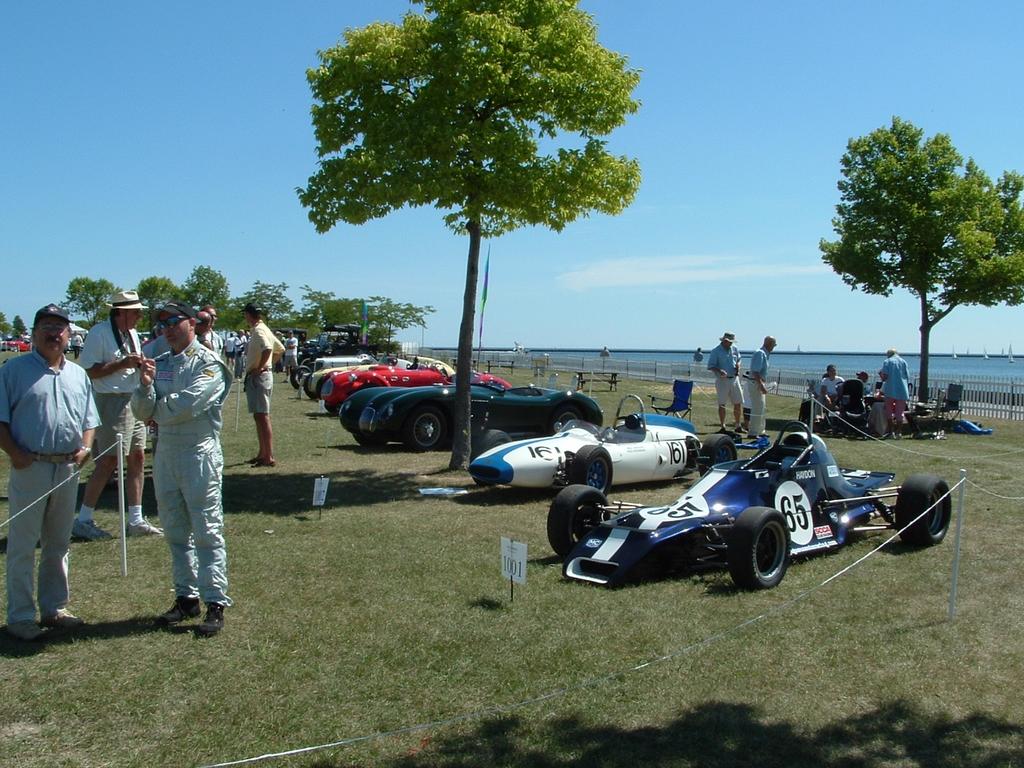 ster, 1937 Rolls Royce PIII Aero Coupe, and my father's 1932 Packard Coupe Roadster), some great early cars (1902 Curved Dash Oldsmobile, 1926 Stanley "steamer", and a 1905 one-cylinder Cadillac), and competition cars, including my car. The show was carefully planned and staged so that the cars were displayed in groups emphasizing their similarities: finned cars were in a circle with the fins pointing outwards; roadsters were in a circle with the tops down; and competition cars were in a row from oldest (1927 Bugatti Grand Prix car) to newest (1979 Tiga Formula Ford). Proceeds from the show benefitted Jewish Family Services, who are eager to team up for a repeat next year.
Labor Day weekend was unusual for me, to say the least. Races were being held at two tracks in Michigan: Midwestern Council ran at GingerMan in South Haven on Saturday, and SCCA ran two Regional races (Saturday and Sunday) at Grattan near Grand Rapids. I decided that going all the way to Michigan would make more sense if I ran both days. I wanted to get the points for Midwestern Council, and I needed to run more SCCA races to keep that license current. Since the tracks are roughly an hour or two apart, getting a hotel midway between them made sense. The Best Western in Holland turned out to be a great choice. Clean and quiet, with a jaccuzzi tub in the room! Very swank.
Saturday looked like it was going to be uneventful, but looks can deceive. I was the only Club Formula Ford entered, so all I needed to do was finish the race to get a win. I qualified in the thick of the usual group: Dave Knaack's D Sports Racer qualified in front of me, Frank Riemann's FF would be next to me, and Chuck Cassaro's Sports 2000 qualified behind me. When I checked over the car after qualifying, I found that the rear wheel hubs were loose again. I wasn't too concerned, since I know it's due to the relatively soft Brazilian hubs compressing and mushrooming due to the cornering forces that they were never designed for. All I'd have to do would be to retorque the axle nuts and I'd be ready to cruise to an easy win.
Someone once said, "Nothing easy is ever worthwhile." Maybe this was proof that what I'm doing is worthwhile, but when I tried to tighten the right rear axle nut, the threads stripped out of the nut. Bad timing. I don't carry a spare nut (but I will now), and I had about an hour and a half to get the car fixed for the race. I went through the paddock looking for anyone likely to have something to fit. It's an old VW Beetle part, so I checked with some VW Rabbit racers, Porsche drivers, and even the FV brigade, but no luck. As I returned to the Lindstrand Motorsports tent, Nicole Temple told me that a friend of theirs knew a local guy... He had one, but he was 45 minutes away, and the race was in an hour.
A couple of phone calls later, Patrick Ohmann arranged to meet Rob Ritt of Epicenter Design halfway between the track and his shop in Holland. As he sped off, I finished preparing the car and began arranging the details to get the car together and on the track as quickly as possible. Pat would install the new nut as I belted in the car, Nicole Temple from LMI would install the wheel, my roommate David Cox would lower the jack while Amy would take care of the jumpstart battery. All we needed now was the nut. While I waited for Pat and watched the minutes tick away, I mentally prepared myself to start from the pit lane after the other cars had taken the green flag, then just get the required number of laps to be considered a finisher. That was all I needed to do.
As the announcement came over the PA system that the grid for our race was closed*, Pat came running up to me with the new nut in his hand. I jumped in the car and held the brake pedal down as he tightened the nut as much as he dared. As I belted myself in, Nicole got the wheel on quicker than I've ever been able to do, and as I felt the car being lowered off the jack I hit the starter. The engine eagerly barked to life. I got the thumbs-up from Amy and drove toward the grid.
The grid configuration at GingerMan is a little odd. Due to a one-way lane, we had to drive the wrong way down the grid between the lines of cars, turn around, and then join the lineup. When I turned the corner to drive down between the cars, the crews for all the other cars pointed at me in disbelief and began applauding and cheering as though I had already won the race. It's amazing how much the other racers pull for you, even if they're trying to beat you on the track.
Since I was late to the grid, I started from the back. My plan was to just get the required laps, take it easy, get my finish, and pull in. But I don't know a racer who is able to keep his foot off the throttle when the green flag flies. Seeing a slower car disappear in your mirror is just too inspiring. When I got past the first car, I couldn't help trying to pass the next... then the next... I think I passed a car each lap for the first half of the race. I chased down all the cars gridded behind me and actually improved my finishing position by one spot.
We packed up the truck and loaded the trailer after the race to get back to the hotel for the night. I soaked in the jaccuzzi for a while until my throat started to burn a little, which I figured was due to breathing in all of the hot chlorinated water vaporizing all around me. When I woke up Sunday morning, I realized that it was really the start of a cold. There wasn't much I could do about it then except get some hot cider and oatmeal at the hotel's continental breakfast and hit the road to Grattan.
We got to Grattan right on time, got through Registration and Tech without any delays or difficulties, and found a great paddock spot without even looking. After we got the car unloaded I realized that I would have plenty of time to change the gears to suit the longer track. I got the gear change done in record time with Amy's help -- despite a boneheaded error on my part that cost me about 15 extra minutes -- and waited for the morning qualifying session.
Qualifying went well enough, but I didn't set the world on fire. I only needed to finish the race to fulfill the renewal requirements for my SCCA license, but I enjoy Grattan too much not to drive hard. Once I managed to match my best time from May, I cut my session short by a few minutes and pulled in, hoping to save the engine and tires a bit. I was sent to Impound for a spot-check, and I rolled across the scales at 1191 pounds. I had a few more gallons of fuel than I would at the end of a race, so it sounded accurate to me. I returned to my paddock space and began the nut-and-bolt check for the afternoon's race.
I finished two items on the list and started to feel dizzy and exhausted. I realized that the cold was catching up to me, and it was not going down without a fight. I wrapped up in a blanket and a fleece sweatshirt and sat in the sun, shivering for about an hour. I actually felt much better after that little rest, so I set about finishing the preparations for the race. Everything was in order... except the exhaust header pipe from the #1 cylinder had a big crack in the tubing.
The exhaust header's primary job is to direct hot exhaust gasses out of the engine, away from things that need to be kept cool, and eventually out the back of the car via the tailpipe. It also plays a rather significant role in the performance of the engine. The correct length header tubes can work together, harmonizing the exhaust pulses and increasing the power output of the engine. A less appreciated duty of the exhaust header is to prevent cold outside air from coming in contact with the hot exhaust valves. If the header breaks, cold air can suddenly rush in, potentially cracking or bending the exhaust valve. If you've ever dunked a cold glass in steaming hot wash water, you have experienced this same kind of thermal shock: the glass breaks because of the extremely quick change of temperature.
I really like this cylinder head, and I don't want anything to happen to it. Pushing the car hard, especially on the undulating Grattan circuit, would almost certainly cause the cracked header to break. I had to drive as easily as possible, minimizing the bumps and jumps that make Grattan so much fun. I also had to go easy on the throttle, since pushing the engine too hard could also make the crack develop into a full fracture.
We watched the start of the first race group, and I noticed that they were taking a pace lap and a half. The false grid at Grattan enters the track at corner 3. The pace lap would take the field out onto the track at corner 3, make the rest of that lap, cross the start/finish line, then make another full lap before the green flag. I realized that was 4 miles of driving I didn't need to put on the car, so I spoke to the starters about starting from the pit lane after the green flag. I explained that the header was cracked and that I was feeling under the weather, and they were very nice and supportive -- "No problem, we'll take care of it," "Remember, you only need 8 laps to get a finish," "Good luck, hope it holds together," "Feel better!" I already felt better after talking to them.
While puttering around at 4000 rpm, I learned a few things. First, I learned that if I drive down the front straight at 4000 rpm instead of 7000 rpm, I can brake at my usual turn-in point and still make it through corner 1. I learned that there is so much used rubber off the racing line that if you drive down the front straight off the line and then try to carry some speed through corner 1, you get the feeling that you're driving through some kind of weird rubber storm with all the bits of rubber being thrown up by your tires. I also learned that if you drive ten laps at Grattan off the normal line, you gain about 5 pounds of used rubber.
I pulled in after 10 laps and went to Impound. Since there was only one other CFF there, I would get credit for a second place finish. The Impound workers gave me a cold washcloth and two bottles of water and insisted that I stay on the scales in the shade until the other cars were done racing.
The scoreboard for MC looks the same as it did before, but add 25 more points to my total. And it only cost one knee (Amy's -- injured on the trailer before we had gone one block), one nasty wasp sting (Amy again), one 1" strip of skin off my pinky finger (another boneheaded move during the gearchange), and one nasty head cold.
Next up: Showing off the car again, this time at a British car show in Palos Hills, IL on Sunday.
*The grid "closes" five minutes before the start of the race. If a car gets to the grid after the grid is closed, that car must start at the back of the pack.
Monday, August 22, 2005
The Racetrack at the End of the Universe
I confess, I didn't get the joke until I saw the graphics on Pete Wood's car: "Arthur Dent" and "Ford Prefect" on the sides... and then he wore a bathrobe to the drivers' meeting. Too bad nobody else got the joke even after that. The title of the race was a play on the title of a book in a series that enjoyed a cult following in the '80s. The central character, Arthur Dent, is a normal Englishman who finds himself a passenger on a spaceship with his new friend Ford Prefect while wearing his bathrobe. Or something like that. I've only read the first book in the series, and it's been a long time since I read that one. (Pete has even run car number 42 for years, which will mean something to those who have read the book.)
We were the fifth group to hit the track, which left plenty of time for worrying and second-guessing about the repairs we had just completed. I did my best to stay calm and rational while I waited for our group to be called to the grid. The car was ready, and I had to trust that we had done everything correctly.
Practice went very well despite some oil on the track in a couple of corners. I managed to keep up with a yellow and blue Sports 2000 -- a much faster car* -- for several laps, which shocked me... until I found out that it was being driven by a racer who had never driven a mid-engined, right-hand-drive car. He is used to the front-engine V8 sedans that he's raced for years, and he was busy learning that the techniques are very different.
Debbie Campbell, a co-worker at Pegasus Auto Racing Supplies, arrived after practice with her parents, who had never been to Blackhawk before. Her father and I chatted about racing while she and her mother chatted with my mother about dogs. Debbie used to show dogs all over the country, and my mother is a dog training instructor, so they had plenty to talk about.
For qualifying I asked my parents to once again time Pete while I monitored my own times on my on-board lap timer. The best number I saw on the pit board was 1:20, while my fastest qualifying time was a 1:18.89. I knew I had turned a few laps in the :19s, so I was confident that I had the pole. The grid sheet confirmed it: I turned a 1:18.89, and Pete's best was a 1:20.26.
Between the qualifying session and the race, there is generally enough time to give the car a thorough inspection and repair most problems that may show up. The between-session checklist includes such things as bleeding the brakes, checking the wheel bearings and rod ends, and retightening any fasteners that may have worked loose. Everything was pretty much normal, with the same old bolts working themselves loose, everything else staying tight as usual, but the right rear hub was suddenly loose. The hub I've been using is a modified VW piece that just doesn't seem to be holding up too well to the stresses of racing. Oh well... take off the wheel, remove the cotter pin, have Dad hold the brakes, torque the axle nut down again, new cotter pin, wheel back on... wow, that's a lot easier and quicker with two people! When it's a one-person operation, you jack up the car, remove the wheel, remove the cotter pin, put the wheel back on, lower the car, somehow stop the wheel from turning -- usually by locking the transmission in two gears at once (a big job on its own) -- tighten the nut, unlock the transmission, jack up the car, take off the wheel, put in a fresh pin, wheel back on, car back down...
The car was ready in plenty of time for the race. I had enough time to watch a couple of other groups race, including the Formula Vee / Spec Racer group, where I used to run. The polesitting Vee, driven by Hal Adkins, spun or got hit on the first lap. By the time the pack went through corner 4, he was at least 15 seconds behind the back of the pack. He drove like a madman, gaining huge chunks of time every lap. Within about 10 laps, he had regained the lead. I confess that Hal is one reason I got out of FV. I realized that I would probably never be able to beat him, at least not with the car I had. I still joke with him that I had to move up a class to have any chance to keep up with him.
We gridded for our race and waited in the cars for ten or fifteen minutes while the safety crews cleaned up after the group before ours. I don't know what it was about this weekend, but every single group -- including ours -- had an incident (or multiple incidents), stranded cars, or blown engines that needed to be cleaned up and cleared away before the next group could hit the track. It was unusual to say the least, and it got us so far off schedule that the last three races had to be shortened by five minutes each and victory laps were cancelled.
I gridded directly behind the yellow and blue Sports 2000 I had followed in practice, and Pete lined up next to me. I was a little concerned that the driver in front of me still wouldn't be familiar enough with the gearbox and might miss a shift on the start. That would give Pete a clear advantage of several car lengths at best -- a good reason for Pete to hope for it. I got lucky, and everyone in front of us got away cleanly. I got a slight edge on Pete and crowded him just a little bit exiting corner 1 to try to keep him behind me. As the race progressed, some cars fell off the track here and there. On the second lap, corner 6 was waving their yellow flag, indicating that there was something dangerous or someone vulnerable on the track or near the track. I slowed and tiptoed around the corner, looking for the incident that caused the flag... but I couldn't see anything out of the ordinary. The next lap, corner 6 still had their yellow flag out, but this time I saw a driver standing next to the track. Apparently he had spun exiting the corner and his car went into the weeds about 50 feet off the track. The car was completely hidden by the foliage, and it stayed there for the rest of the race.
My father was showing me the gap times between Pete and me on the pit board -- :03, :04, :06. About halfway through the race, the board showed :13... and my oil pressure gauge suddenly dropped! The rule of thumb for oil pressure is to have 10psi per 1000rpm. Since we spin the Formula Ford engines to 6000rpm, 60psi would be ideal, but most of us settle for 40psi. My car had 40psi all day, but suddenly it dropped to 20psi. Better than nothing, but it seemed to me that if it started dropping, it was likely to drop the rest of the way to zero. I tried everything I could to nurse the engine, keeping the revs as low as I could while still conserving speed. I don't know which would have been a more disappointing sight in my mirrors: Blue-white smoke indicating a blown motor, or the purple nose of Pete's car!
The car held together and the oil pressure didn't drop any farther. I finished about 10 seconds ahead of Pete and shut the car off as soon as I could. Now to diagnose just what happened and what we need to do about it...
The points now look like this:
* A Sports 2000 is a little hard to describe. Imagine a formula car, with a 2.0-liter Ford engine in the back, but with two seats and fiberglass fenders. The design of the fenders can make the car handle better than a Formula Ford, and the larger engine gives it better acceleration and top speed.
We were the fifth group to hit the track, which left plenty of time for worrying and second-guessing about the repairs we had just completed. I did my best to stay calm and rational while I waited for our group to be called to the grid. The car was ready, and I had to trust that we had done everything correctly.
Practice went very well despite some oil on the track in a couple of corners. I managed to keep up with a yellow and blue Sports 2000 -- a much faster car* -- for several laps, which shocked me... until I found out that it was being driven by a racer who had never driven a mid-engined, right-hand-drive car. He is used to the front-engine V8 sedans that he's raced for years, and he was busy learning that the techniques are very different.
Debbie Campbell, a co-worker at Pegasus Auto Racing Supplies, arrived after practice with her parents, who had never been to Blackhawk before. Her father and I chatted about racing while she and her mother chatted with my mother about dogs. Debbie used to show dogs all over the country, and my mother is a dog training instructor, so they had plenty to talk about.
For qualifying I asked my parents to once again time Pete while I monitored my own times on my on-board lap timer. The best number I saw on the pit board was 1:20, while my fastest qualifying time was a 1:18.89. I knew I had turned a few laps in the :19s, so I was confident that I had the pole. The grid sheet confirmed it: I turned a 1:18.89, and Pete's best was a 1:20.26.
Between the qualifying session and the race, there is generally enough time to give the car a thorough inspection and repair most problems that may show up. The between-session checklist includes such things as bleeding the brakes, checking the wheel bearings and rod ends, and retightening any fasteners that may have worked loose. Everything was pretty much normal, with the same old bolts working themselves loose, everything else staying tight as usual, but the right rear hub was suddenly loose. The hub I've been using is a modified VW piece that just doesn't seem to be holding up too well to the stresses of racing. Oh well... take off the wheel, remove the cotter pin, have Dad hold the brakes, torque the axle nut down again, new cotter pin, wheel back on... wow, that's a lot easier and quicker with two people! When it's a one-person operation, you jack up the car, remove the wheel, remove the cotter pin, put the wheel back on, lower the car, somehow stop the wheel from turning -- usually by locking the transmission in two gears at once (a big job on its own) -- tighten the nut, unlock the transmission, jack up the car, take off the wheel, put in a fresh pin, wheel back on, car back down...
The car was ready in plenty of time for the race. I had enough time to watch a couple of other groups race, including the Formula Vee / Spec Racer group, where I used to run. The polesitting Vee, driven by Hal Adkins, spun or got hit on the first lap. By the time the pack went through corner 4, he was at least 15 seconds behind the back of the pack. He drove like a madman, gaining huge chunks of time every lap. Within about 10 laps, he had regained the lead. I confess that Hal is one reason I got out of FV. I realized that I would probably never be able to beat him, at least not with the car I had. I still joke with him that I had to move up a class to have any chance to keep up with him.
We gridded for our race and waited in the cars for ten or fifteen minutes while the safety crews cleaned up after the group before ours. I don't know what it was about this weekend, but every single group -- including ours -- had an incident (or multiple incidents), stranded cars, or blown engines that needed to be cleaned up and cleared away before the next group could hit the track. It was unusual to say the least, and it got us so far off schedule that the last three races had to be shortened by five minutes each and victory laps were cancelled.
I gridded directly behind the yellow and blue Sports 2000 I had followed in practice, and Pete lined up next to me. I was a little concerned that the driver in front of me still wouldn't be familiar enough with the gearbox and might miss a shift on the start. That would give Pete a clear advantage of several car lengths at best -- a good reason for Pete to hope for it. I got lucky, and everyone in front of us got away cleanly. I got a slight edge on Pete and crowded him just a little bit exiting corner 1 to try to keep him behind me. As the race progressed, some cars fell off the track here and there. On the second lap, corner 6 was waving their yellow flag, indicating that there was something dangerous or someone vulnerable on the track or near the track. I slowed and tiptoed around the corner, looking for the incident that caused the flag... but I couldn't see anything out of the ordinary. The next lap, corner 6 still had their yellow flag out, but this time I saw a driver standing next to the track. Apparently he had spun exiting the corner and his car went into the weeds about 50 feet off the track. The car was completely hidden by the foliage, and it stayed there for the rest of the race.
My father was showing me the gap times between Pete and me on the pit board -- :03, :04, :06. About halfway through the race, the board showed :13... and my oil pressure gauge suddenly dropped! The rule of thumb for oil pressure is to have 10psi per 1000rpm. Since we spin the Formula Ford engines to 6000rpm, 60psi would be ideal, but most of us settle for 40psi. My car had 40psi all day, but suddenly it dropped to 20psi. Better than nothing, but it seemed to me that if it started dropping, it was likely to drop the rest of the way to zero. I tried everything I could to nurse the engine, keeping the revs as low as I could while still conserving speed. I don't know which would have been a more disappointing sight in my mirrors: Blue-white smoke indicating a blown motor, or the purple nose of Pete's car!
The car held together and the oil pressure didn't drop any farther. I finished about 10 seconds ahead of Pete and shut the car off as soon as I could. Now to diagnose just what happened and what we need to do about it...

The points now look like this:
- John Haydon: 150
- Pete Wood: 125
- Michael Schindlbeck: 69
- Denis Downs: 33
- Scott Reif: 33
- Larry Noble: 17
- Jon Borkowski: 16
- Paul Schindlbeck: 16
- Dick Plank: 13
- Bob Fleming: 8
Next stop: Milwaukee's lakefront, Veteran's Park, for the "Masterpiece Style & Speed Showcase" car show.
* A Sports 2000 is a little hard to describe. Imagine a formula car, with a 2.0-liter Ford engine in the back, but with two seats and fiberglass fenders. The design of the fenders can make the car handle better than a Formula Ford, and the larger engine gives it better acceleration and top speed.
Friday, August 19, 2005
Friday
The car is on the trailer and ready to run! Sunday is the 7th Midwestern Council race of the season, once again at Blackhawk. I'm looking forward to being back at my "home" track with the crowd I've known for years.
Not to imply that the crowd I've run with lately is any less than a great bunch, but I know the MC regulars well enough to anticipate what they will do in a lot of situations, and they know me as well. There have been a few situations at the last couple of races where I just wasn't sure how a driver would react to being passed on the outside of the Carousel, for example. Or just how early I'd have to brake to get him to take the line going into corner 5 so we could both carry some speed through instead of tiptoeing through side-by-side. Or whether he would try that optimistic pass going into corner 3...
Not to imply that the crowd I've run with lately is any less than a great bunch, but I know the MC regulars well enough to anticipate what they will do in a lot of situations, and they know me as well. There have been a few situations at the last couple of races where I just wasn't sure how a driver would react to being passed on the outside of the Carousel, for example. Or just how early I'd have to brake to get him to take the line going into corner 5 so we could both carry some speed through instead of tiptoeing through side-by-side. Or whether he would try that optimistic pass going into corner 3...
Thursday, August 18, 2005
Transmission Externals
I'm still not an engineer, but the Internet can be a wonderful tool -- and there's nothing more dangerous than a tool in the hands of someone who thinks he knows what he's doing.
According to a fascinating article on the Key to Steel website, the breakage of the input shaft shows some characteristics of a "brittle fracture":
According to a fascinating article on the Key to Steel website, the breakage of the input shaft shows some characteristics of a "brittle fracture":
"Brittle fracture is characterised by the very small amount of work absorbed and
by a crystalline appearance of the surfaces of fracture, often with a chevron
pattern pointing to the origin of fracture, due to the formation of
discontinuous cleavage cracks which join up. It can occur at a low stress of
75-120 MPa with great suddenness; the velocity of crack propagation is probably
not far from that of sound in the material. In this type of fracture plastic
deformation is very small, and the crack need not open up considerably in order
to propagate, as is necessary with a ductile failure."
I'll just repeat the bit that really struck me: This thing broke apart at close
to the speed of sound. No, the fragments didn't necessarily go that fast (and
neither did I), but that's how suddenly the shaft broke, and that explains why
it looks like a grenade went off inside it.
On very close inspection, I can see several cracks at seemingly random angles to the breakage. It does show some signs of "ductile failure," where metal stretches as it is pulled, bent, or twisted apart. Some of the splines are bent, stretched, or twisted, although the surfaces between the fragments show no such signs. That makes some sense. As part of the shaft broke, neighboring areas were stretching to accomodate the change of shape. This same thing happens when you break a glass -- the definition of brittle -- the glass actually deforms a little before it breaks, which is why the pieces never fit together quite right again.
The good news is that the car is nearly together again. The two big pieces of car were reunited last night, and all that remains is a quick alignment check, gear change, and brake and clutch bleeding.
Wednesday, August 17, 2005
Transmission Internals
There's a strange phenomenon that affects people who do repair work. Some call it a philosophy of "as long as"-ism, while others call it an illness, "might as well"-itis. It always begins with a necessary repair which requires disassembly of the item needing repair. The next step -- or several steps -- are characterized by repeated cries of, "As long as it's apart..." and "We might as well replace..." The final step is either a good-as-new item that will not need maintenance for a long time, or else a never-ending money pit.
I try to avoid falling victim to "might as well"-itis while at the same time keeping a healthy amount of "as long as"-ism. In this case, the "as long as"-ism involves having the transmission off the car -- a big project that we hope not to have to do again until the off-season. "As long as" we have the transmission off, we "might as well" replace these parts we now have easy access to... and we "might as well" repair that part that we couldn't reach before... and we "might as well" clean up inside this hidden area...
Opening the transmisssion to replace the input shaft gives us acces to such things as the clutch, the input shaft oil seal, several crevices which collect dirt and oil, the differential and final drive, and the inside of the transmission case. It makes sense to replace the clutch now, since it is a consumable item and mine has outlived the clutches in several competitors' cars. The input shaft oil seal has been seeping a little more oil every weekend, making a bigger and bigger mess to clean up after each race. The differential and final drive deserve to be inspected for any signs of damage or stress -- especially after having bits of the input shaft thrown around inside the gearbox.
There are plenty of other projects we could add on now, but none of them are important enough to risk missing the next race if they don't go as planned. For example, the filler plug in the top of the transmission case had been jammed in and stripped by a previous owner. Since we have access to the inside of the case, we could drill out the plug, catching any shavings that fall into the case, and replace the plug. But having access through that plug is not critical, and if the project doesn't go well, we could end up needing a new transmission case. We wouldn't be able to get a new one before the weekend, and setting up a new case is an expensive, time-consuming operation. Maybe we'll try that plug during the winter.
Everything else looks to be in good shape, so as soon as we can get all the RTV sealant cleaned off the sideplate, we should be ready to begin reassembly tonight. The new oil seal is in, the rest of the new parts are on the bench, and the fragments have been cleaned out of the transmission.
I try to avoid falling victim to "might as well"-itis while at the same time keeping a healthy amount of "as long as"-ism. In this case, the "as long as"-ism involves having the transmission off the car -- a big project that we hope not to have to do again until the off-season. "As long as" we have the transmission off, we "might as well" replace these parts we now have easy access to... and we "might as well" repair that part that we couldn't reach before... and we "might as well" clean up inside this hidden area...
Opening the transmisssion to replace the input shaft gives us acces to such things as the clutch, the input shaft oil seal, several crevices which collect dirt and oil, the differential and final drive, and the inside of the transmission case. It makes sense to replace the clutch now, since it is a consumable item and mine has outlived the clutches in several competitors' cars. The input shaft oil seal has been seeping a little more oil every weekend, making a bigger and bigger mess to clean up after each race. The differential and final drive deserve to be inspected for any signs of damage or stress -- especially after having bits of the input shaft thrown around inside the gearbox.
There are plenty of other projects we could add on now, but none of them are important enough to risk missing the next race if they don't go as planned. For example, the filler plug in the top of the transmission case had been jammed in and stripped by a previous owner. Since we have access to the inside of the case, we could drill out the plug, catching any shavings that fall into the case, and replace the plug. But having access through that plug is not critical, and if the project doesn't go well, we could end up needing a new transmission case. We wouldn't be able to get a new one before the weekend, and setting up a new case is an expensive, time-consuming operation. Maybe we'll try that plug during the winter.
Everything else looks to be in good shape, so as soon as we can get all the RTV sealant cleaned off the sideplate, we should be ready to begin reassembly tonight. The new oil seal is in, the rest of the new parts are on the bench, and the fragments have been cleaned out of the transmission.
Tuesday, August 16, 2005
Bad News
When we pulled the gearbox last night, we found that the clutch disc is actually just fine. The input shaft had broken.
I have no experience with metallurgy or stress analysis, so I have no idea if this is a sudden catastrophic failure or a gradual breakage. The books I've read have described gradual fatigue fractures as having a visible progression to them; you can see where the initial crack started and how it progressed across the part, until there wasn't enough intact material to take the stress, leaving the last bit to break suddenly with a jagged edge. On the other hand, the sudden catastrophic failures they illustrate show a clean break, with no clear beginning, middle, or end.
The shaft looks almost like a piece of clay that was torn from another piece. There are jagged valleys and sharp ridges radiating from the center, suggesting that the shaft was pulled apart rather than twisted apart. Perhaps the twisting apart is what raised the ridges; I don't know. The transmission is coming apart tonight. With a little luck, the new input shaft will be in and the gearbox will at least be ready to reinstall by the end of the evening.
I have no experience with metallurgy or stress analysis, so I have no idea if this is a sudden catastrophic failure or a gradual breakage. The books I've read have described gradual fatigue fractures as having a visible progression to them; you can see where the initial crack started and how it progressed across the part, until there wasn't enough intact material to take the stress, leaving the last bit to break suddenly with a jagged edge. On the other hand, the sudden catastrophic failures they illustrate show a clean break, with no clear beginning, middle, or end.
The shaft looks almost like a piece of clay that was torn from another piece. There are jagged valleys and sharp ridges radiating from the center, suggesting that the shaft was pulled apart rather than twisted apart. Perhaps the twisting apart is what raised the ridges; I don't know. The transmission is coming apart tonight. With a little luck, the new input shaft will be in and the gearbox will at least be ready to reinstall by the end of the evening.
Monday, August 15, 2005
Kettle Moraine Double: Sunday
Information from the weekend is still filtering in from various sources. Two cars who I thought had tangled in The Kink on the first lap of Saturday's race actually had a very different story. One car had a wheel come loose and lock up in The Kink, sending him spinning. The second car came through at full speed and saw the disabled car in the middle of the track. He barely had time to avoid him at all, and unfortunately avoiding him meant sending himself into the wall, destroying his own car for the sake of the other driver.
Sunday began warmer than Saturday by a few degrees, but it was still not hot. My mother came up to watch and help out. I went out for the morning qualifying session and tried to stay with a group of fast cars. I was able to hang with them during the first lap, but as we approached corner 13, when I shifted to 3rd gear, the car didn't go any faster. I tried to select 3rd gear again, just to make sure I hadn't missed, but no difference. I tried 4th gear with the same results. The linkage could have come undone, or something in the transmission could have broken. I tried 2nd gear just to be sure. I could feel that the transmission did in fact select 2nd gear, but the car still wouldn't accelerate. Some connection between the engine and the transmission (or between the transmission and the rear wheels) must have broken.
My theory is that the clutch disc splines have probably stripped. This clutch disc has seen at least two seasons of use, maybe more. So I learned something: Replace the clutch disc every season, and don't worry about it again! Replacing the disc should be a relatively inexpensive repair, fairly easy to do, but it wouldn't be a good job to do at the track. Several people offered to help change the clutch, and we could have done it before lunch, but I decided that it was time to sit back and just watch the race.
I think I was better off sitting in the bleachers than I would have been in the driver's seat. Of 45 cars entered, 38 started the race and only 27 were still running at the finish. Between what I saw and what I was told, about 5 or 6 cars were damaged or destroyed. Add that to Saturday's toll, and almost a dozen cars will need major repairs before they can race again. A few of those may never see the track again. I have been told that all the drivers are uninjured.
Speedy Petey grabbed 4th in CFF on Sunday. He could have had 3rd, but he got stuck in a battle for 4th while 1st through 3rd pulled away. Allen Wheatcroft got 9th in FF, and I think he turned his best-ever lap time in the process. Good job guys!
Sunday began warmer than Saturday by a few degrees, but it was still not hot. My mother came up to watch and help out. I went out for the morning qualifying session and tried to stay with a group of fast cars. I was able to hang with them during the first lap, but as we approached corner 13, when I shifted to 3rd gear, the car didn't go any faster. I tried to select 3rd gear again, just to make sure I hadn't missed, but no difference. I tried 4th gear with the same results. The linkage could have come undone, or something in the transmission could have broken. I tried 2nd gear just to be sure. I could feel that the transmission did in fact select 2nd gear, but the car still wouldn't accelerate. Some connection between the engine and the transmission (or between the transmission and the rear wheels) must have broken.
My theory is that the clutch disc splines have probably stripped. This clutch disc has seen at least two seasons of use, maybe more. So I learned something: Replace the clutch disc every season, and don't worry about it again! Replacing the disc should be a relatively inexpensive repair, fairly easy to do, but it wouldn't be a good job to do at the track. Several people offered to help change the clutch, and we could have done it before lunch, but I decided that it was time to sit back and just watch the race.
I think I was better off sitting in the bleachers than I would have been in the driver's seat. Of 45 cars entered, 38 started the race and only 27 were still running at the finish. Between what I saw and what I was told, about 5 or 6 cars were damaged or destroyed. Add that to Saturday's toll, and almost a dozen cars will need major repairs before they can race again. A few of those may never see the track again. I have been told that all the drivers are uninjured.
Speedy Petey grabbed 4th in CFF on Sunday. He could have had 3rd, but he got stuck in a battle for 4th while 1st through 3rd pulled away. Allen Wheatcroft got 9th in FF, and I think he turned his best-ever lap time in the process. Good job guys!
Kettle Moraine Double Regional: Saturday
Win or learn something. I didn't win on Saturday, but I learned something important on Sunday.
The Saturday morning qualifying session at Road America started poorly. The track was very slippery and had a visible line of oil all the way around. We spent the first two laps sliding around, trying not to spin. The track was scrubbed off pretty well by the third lap, but then cars started going off everywhere. I'm not quite sure how that works. No traction, everyone stays on the track. Get traction back, people start spinning off. There were so many yellow flags, it was basically impossible to pass the slower cars or get into a rhythm. I had to settle for 5th on the CFF grid with a 2:44, six seconds slower than my time in July. But this weekend was about relaxing and having fun racing, so my starting position wasn't that important.
My father and I began working on the car to get ready for the race, and we were just starting to think about lunch when Cindy Lindstrand came buzzing up on a scooter and handed us a plate with two Italian beef sandwiches, leftovers from the big Lindstrand Motorsports lunch. They go all out for their drivers, and they're willing to share the leftovers with people like me. Thanks, Cindy, they were great!
As we ate, the sky got darker and the breeze suddenly got much cooler. The temperature dipped from about 75 to below 70 in just a few minutes. The rain started during the race for big GT cars (Corvettes, Camaros, Mustangs, Cobras -- the big fire-breathing V8s). The huge horsepower and wide, slick tires made the slightly slippery conditions downright treacherous, and cars were sliding everywhere. Formula Ford tires are much narrower and we have much less horsepower, but racing any car with slick tires on a wet track is an adventure. I asked my father for advice, and he pointed out that there were no puddles. Rain tires generally work only if there is standing water on the track. If the pavement is only damp, the rain tires will overheat and come apart. As we were discussing it, the rain stopped. The sun came out and the track dried completely before we went out.
I gridded next to Allen Wheatcroft's red Van Diemen FF, in front of Pete Wood's Crossle CFF, pretty much in the middle of the pack. The pace lap was a little slow, but not at all bad. The pack seemed to be well grouped, but when we slowed and just about stopped for corner 5, Allen's car stalled. He got it going again eventually, but he wasn't able to get back to his grid position before the start.
The car in front of me seemed to be much too slow, but I couldn't get around him. I lost three positions in class on the first lap while following him. Every corner, I felt I could have gone faster than he did, but he would just pull away from me on the straights. Two other cars were stuck behind him with me, and we were all looking for a way around him. Finally we passed him, and then the other two cars passed me (no problem, they were in a different class). The first lap we were clear of him, I turned a 2:38. Within a couple of laps, I caught up to and passed Bill Ehrlinger and Michael Neylon, both in CFFs, which got me back up to 5th place.
As the race progressed, cars began to accumulate at the corner stations and along the walls. Two cars nearly tangled in The Kink, a very high-speed corner where going off track usually means hitting the concrete wall, hard -- and one of them did just that. A third car joined them about halfway through the race. Another car got hit in corner 3. A car pulled off in corner 12, smoke still rising from the engine. Fiberglass bodywork littered the track at corner 14. A car spun in corner 5 and couldn't get off the damp grass without spinning again. Corner 12 was yellow for several laps while they pulled a car out of the gravel trap. I could see that several cars would not be back out for Sunday.
The car ran well and handled great. Almost every time I followed a car around the Carousel turn or through The Kink, I felt like I could have just driven right around them. In fact, most of the passes I made were driving around cars in the Carousel. The car is so stable and forgiving and solid!
Next update: The Kettle Moraine Double Regional, Sunday...
The Saturday morning qualifying session at Road America started poorly. The track was very slippery and had a visible line of oil all the way around. We spent the first two laps sliding around, trying not to spin. The track was scrubbed off pretty well by the third lap, but then cars started going off everywhere. I'm not quite sure how that works. No traction, everyone stays on the track. Get traction back, people start spinning off. There were so many yellow flags, it was basically impossible to pass the slower cars or get into a rhythm. I had to settle for 5th on the CFF grid with a 2:44, six seconds slower than my time in July. But this weekend was about relaxing and having fun racing, so my starting position wasn't that important.
My father and I began working on the car to get ready for the race, and we were just starting to think about lunch when Cindy Lindstrand came buzzing up on a scooter and handed us a plate with two Italian beef sandwiches, leftovers from the big Lindstrand Motorsports lunch. They go all out for their drivers, and they're willing to share the leftovers with people like me. Thanks, Cindy, they were great!
As we ate, the sky got darker and the breeze suddenly got much cooler. The temperature dipped from about 75 to below 70 in just a few minutes. The rain started during the race for big GT cars (Corvettes, Camaros, Mustangs, Cobras -- the big fire-breathing V8s). The huge horsepower and wide, slick tires made the slightly slippery conditions downright treacherous, and cars were sliding everywhere. Formula Ford tires are much narrower and we have much less horsepower, but racing any car with slick tires on a wet track is an adventure. I asked my father for advice, and he pointed out that there were no puddles. Rain tires generally work only if there is standing water on the track. If the pavement is only damp, the rain tires will overheat and come apart. As we were discussing it, the rain stopped. The sun came out and the track dried completely before we went out.
I gridded next to Allen Wheatcroft's red Van Diemen FF, in front of Pete Wood's Crossle CFF, pretty much in the middle of the pack. The pace lap was a little slow, but not at all bad. The pack seemed to be well grouped, but when we slowed and just about stopped for corner 5, Allen's car stalled. He got it going again eventually, but he wasn't able to get back to his grid position before the start.
The car in front of me seemed to be much too slow, but I couldn't get around him. I lost three positions in class on the first lap while following him. Every corner, I felt I could have gone faster than he did, but he would just pull away from me on the straights. Two other cars were stuck behind him with me, and we were all looking for a way around him. Finally we passed him, and then the other two cars passed me (no problem, they were in a different class). The first lap we were clear of him, I turned a 2:38. Within a couple of laps, I caught up to and passed Bill Ehrlinger and Michael Neylon, both in CFFs, which got me back up to 5th place.
As the race progressed, cars began to accumulate at the corner stations and along the walls. Two cars nearly tangled in The Kink, a very high-speed corner where going off track usually means hitting the concrete wall, hard -- and one of them did just that. A third car joined them about halfway through the race. Another car got hit in corner 3. A car pulled off in corner 12, smoke still rising from the engine. Fiberglass bodywork littered the track at corner 14. A car spun in corner 5 and couldn't get off the damp grass without spinning again. Corner 12 was yellow for several laps while they pulled a car out of the gravel trap. I could see that several cars would not be back out for Sunday.
The car ran well and handled great. Almost every time I followed a car around the Carousel turn or through The Kink, I felt like I could have just driven right around them. In fact, most of the passes I made were driving around cars in the Carousel. The car is so stable and forgiving and solid!
Next update: The Kettle Moraine Double Regional, Sunday...
Monday, August 08, 2005
East-West Challenge
In recent years, one question has been asked over and over at road races across the country: “Where have all the cars gone?” In the ‘70s and ‘80s, so many cars would show up to a race that some classes (Formula Ford among them) would have to be run as two separate groups because all the cars couldn’t fit on the track at once.
Something happened in the ‘80s and ‘90s, and nobody can pin down what it was. Maybe it was the “me” era, maybe it was the rising cost of racing, maybe it was the advent of VCRs and video games. Whatever the reason, race attendance dropped. Classes which once enjoyed 80-car fields now saw 10-car fields. Where were all the cars?
Steve Beeler, a Club Formula Ford racer from Michigan, realized several years ago that the cars still existed, but the owners just weren’t racing them. He asked around, and most people agreed that the reason they didn’t race was because there were so few cars racing. A depressing catch-22.
Steve began a concerted effort to promote several specific races within the SCCA Central Division. Since CenDiv is roughly divided by Lake Michigan, all drivers were either on the “East” team or the “West” team based on each driver’s hometown. Continuing the east/west theme, two of the four race weekends would take place east of the lake, and the other two would be on tracks west of the lake.
The “East-West Challenge” was an instant success. Companies pitched in with contingency awards, which attracted more drivers. Car counts were back up in the 20s and 30s, which was enough to convince most Regions to give the FF/CFF race its own group instead of mixing them with other classes. Over 70 drivers have raced in the series, with more joining every race.
My initial plan for the season was to run the East-West Challenge again this year with only a few Midwestern Council races mixed in. But as I said once before, a racing schedule is at best flexible, a mere suggestion of what may happen. After winning the first two MC races and breaking the car at the first EWC race, I decided to concentrate on the MC season. I still want to run at least one or two EWC weekends, including this weekend’s races at Road America. Since I have missed the first four rounds of the series, I won’t be trying quite so hard to finish in the points. I plan to hook up with someone – maybe Speedy Petey – and just race for the fun of it. It is impressive to see a pack of 30 Formula Fords, even from the back!
Something happened in the ‘80s and ‘90s, and nobody can pin down what it was. Maybe it was the “me” era, maybe it was the rising cost of racing, maybe it was the advent of VCRs and video games. Whatever the reason, race attendance dropped. Classes which once enjoyed 80-car fields now saw 10-car fields. Where were all the cars?
Steve Beeler, a Club Formula Ford racer from Michigan, realized several years ago that the cars still existed, but the owners just weren’t racing them. He asked around, and most people agreed that the reason they didn’t race was because there were so few cars racing. A depressing catch-22.
Steve began a concerted effort to promote several specific races within the SCCA Central Division. Since CenDiv is roughly divided by Lake Michigan, all drivers were either on the “East” team or the “West” team based on each driver’s hometown. Continuing the east/west theme, two of the four race weekends would take place east of the lake, and the other two would be on tracks west of the lake.
The “East-West Challenge” was an instant success. Companies pitched in with contingency awards, which attracted more drivers. Car counts were back up in the 20s and 30s, which was enough to convince most Regions to give the FF/CFF race its own group instead of mixing them with other classes. Over 70 drivers have raced in the series, with more joining every race.
My initial plan for the season was to run the East-West Challenge again this year with only a few Midwestern Council races mixed in. But as I said once before, a racing schedule is at best flexible, a mere suggestion of what may happen. After winning the first two MC races and breaking the car at the first EWC race, I decided to concentrate on the MC season. I still want to run at least one or two EWC weekends, including this weekend’s races at Road America. Since I have missed the first four rounds of the series, I won’t be trying quite so hard to finish in the points. I plan to hook up with someone – maybe Speedy Petey – and just race for the fun of it. It is impressive to see a pack of 30 Formula Fords, even from the back!
Thursday, August 04, 2005
Driver's Suits
Of all the possible injuries a driver could suffer in an auto racing incident, burn injuries probably scare me the most. Niki Lauda will tell you how bad burns can be. (He looked quite a bit better when he had ears.) Because of that, my safety equipment -- especially my driver's suit -- has always been a high priority for me.
My first driver's suit was a hand-me-down from my father. Obviously, this suit means a lot to me. My mother gave it to him for Christmas back in the '70s, when it was cutting-edge and the best that money could buy. It was custom-tailored in bright yellow to match his car, and his name was embroidered above the chest pocket. It was constructed of a single layer of Nomex, which was common for firesuits back then. Drivers generally wore Nomex long underwear under their suits to get adequate protection. At the time, more protection meant more layers, which meant bulky, heavy suits. Drag racers wore multi-layer firesuits that looked like quilted snowmobile suits.
In 2002, my co-worker Michael Marmurowicz told me he wanted to sell his old driver's suit, a modern 3-layer suit by Italian manufacturer OMP. He never had a chance to wear it before he retired from racing some 10 years ago. I talked him out of listing it on eBay, and he sold it to me for less than it was worth. This suit has acquired some special meaning for me as well. One sleeve bears a patch of quilting fabric in memory of my friend Carol Nappi, and the other sleeve still has some of my friend Frank Nelson's ashes. Unfortunately, this suit is mostly black. It looks great and sleek and fashionable, but it is awful on sunny days. It sucks up sunlight like a sponge, and oddly enough, the medical crews aren't very sympathetic when you overheat while wearing it. Especially if you still wear a layer of Nomex long underwear under it.
After my last visit to the Med Shed, I was persuaded to get a lighter suit. OMP has been supplying safety equipment to Formula 1 teams for years, and they have done a lot of research and development on driver's suits. They recently introduced a new suit called the "Tecnica Light" which they claim is lighter and cooler than the previous generation of 3-layer suits. They only offer it in two colors, shiny silver and shiny red with a shiny silver chest -- the McLaren-Mercedes and Marlboro Ferarri F1 team colors. I chose silver, since red wouldn't go so well with a blue car.
The suit arrived this week, and it's more than a half a pound lighter than a standard OMP three-layer suit. I tried it on this morning, and right out of the box it feels softer, less stiff and less bulky than my old suit. It has knit panels on the knees and around the arms to allow sweat to evaporate instead of boiling the driver. Another nice feature about this suit is that it is not second-hand, so it's actually my size! I'm looking forward to trying it next weekend at Road America. Sorry everyone, I'll be crossing my fingers for 100 degrees and sunny!
My first driver's suit was a hand-me-down from my father. Obviously, this suit means a lot to me. My mother gave it to him for Christmas back in the '70s, when it was cutting-edge and the best that money could buy. It was custom-tailored in bright yellow to match his car, and his name was embroidered above the chest pocket. It was constructed of a single layer of Nomex, which was common for firesuits back then. Drivers generally wore Nomex long underwear under their suits to get adequate protection. At the time, more protection meant more layers, which meant bulky, heavy suits. Drag racers wore multi-layer firesuits that looked like quilted snowmobile suits.
In 2002, my co-worker Michael Marmurowicz told me he wanted to sell his old driver's suit, a modern 3-layer suit by Italian manufacturer OMP. He never had a chance to wear it before he retired from racing some 10 years ago. I talked him out of listing it on eBay, and he sold it to me for less than it was worth. This suit has acquired some special meaning for me as well. One sleeve bears a patch of quilting fabric in memory of my friend Carol Nappi, and the other sleeve still has some of my friend Frank Nelson's ashes. Unfortunately, this suit is mostly black. It looks great and sleek and fashionable, but it is awful on sunny days. It sucks up sunlight like a sponge, and oddly enough, the medical crews aren't very sympathetic when you overheat while wearing it. Especially if you still wear a layer of Nomex long underwear under it.
After my last visit to the Med Shed, I was persuaded to get a lighter suit. OMP has been supplying safety equipment to Formula 1 teams for years, and they have done a lot of research and development on driver's suits. They recently introduced a new suit called the "Tecnica Light" which they claim is lighter and cooler than the previous generation of 3-layer suits. They only offer it in two colors, shiny silver and shiny red with a shiny silver chest -- the McLaren-Mercedes and Marlboro Ferarri F1 team colors. I chose silver, since red wouldn't go so well with a blue car.
The suit arrived this week, and it's more than a half a pound lighter than a standard OMP three-layer suit. I tried it on this morning, and right out of the box it feels softer, less stiff and less bulky than my old suit. It has knit panels on the knees and around the arms to allow sweat to evaporate instead of boiling the driver. Another nice feature about this suit is that it is not second-hand, so it's actually my size! I'm looking forward to trying it next weekend at Road America. Sorry everyone, I'll be crossing my fingers for 100 degrees and sunny!
Monday, August 01, 2005
Drive the Autobahn
Meet the newest Club Formula Ford track record holder.
Sunday was the first SCCA race at the Autobahn Country Club in Joliet, Illinois. Because it is a new facility, one driver in each class would finish the weekend as a track record holder. Despite that draw, the turnout was surprisingly light. Pete Wood and I were the only two Club Formula Fords entered.
The schedule for the day was very calm, with only two track sessions. We would have a 25-minute qualifying session in the morning, and a 26-lap race after lunch. On the 1.4-mile "North" track, a 26-lap race should take just over half an hour.
I had the luxury of doing some low-speed laps on this track in April, in a borrowed Dodge Durango and then in Lynn Serra's Formula Ford. Although I kept both vehicles at touring speeds, I was able to get a very good education in which way the track went, and in how it would look from a low formula car perspective. Still, Pete had raced here in May with Midwestern Council, so he had three high-speed sessions in his own race car. He certainly knew the track better than I did, so I concentrated on doing my best to keep up with him during qualifying.
Fortunately for me, Pete took it fairly easy for the first part of the session, maybe letting me keep up with him while he showed me the line. Within ten laps, we were already turning faster times than he had turned in May. Several laps from the end, he moved over to let me pass. I found a little more speed in a couple of corners and got the pole position (and the qualifying track record) with a 1:10.523 to Pete's 1:11.089. Once again, a car in another class (Formula First, "FST") had gridded between us.
The race got off to a very bad start. We were all clean through the first few corners, but coming out of corner 5 I saw a large cloud of dust in my mirrors. When we came up the front straight, we saw that all corner stations were showing the black flag, which is a signal for all drivers to report to the pit lane. In other words, something big had happened, and the officials needed us to clear the track so they could deal with it. We slowed down to come back to the pit lane, and as we came to corner 5, we found out what the big deal was. Two Formula Vees had come together (kicking up the cloud of dust), and were now in the middle of the track, a pair of conjoined twins joined at the bellypan. One car was upside down, facing traffic, with the driver's helmet touching the track, and the other car was upright, on top of the other car, facing the correct direction. Don't ask me how they got that way.
We all proceeded to the pit lane (without the two FVs which were otherwise engaged) to wait for the restart. Before we had come to a full stop, the crew from Lindstrand Motorsports had set about distributing umbrellas and cold water to the drivers. Although they were only responsible for one car in our group, they checked on every driver to make sure that everyone would be able to continue. A grid worker began to lug a big water jug down the line of cars, but Zach (one of the Linstrand crew) stopped her and carried the jug for her on their ATV. They are a great group of people, and I'm not just saying that because they've saved me more times than I can count.
We lined up for a single-file restart and set off behind the pace car. The two Vees had left some gouges in the asphalt at corner 5, but the corner and safety crews had cleaned up all of the scattered dirt and spilled fluids. We took the green flag again and expected a much cleaner start. That was our second mistake.
The FST gridded between Pete and me was pressing me in the corners, but I was not interested in racing him. Meanwhile, Pete had a horsepower advantage over him and wanted to pass him on the straight. I didn't want to tangle with the third car -- I just wanted to settle down for a fun race with Pete. Unfortunately, the FST tried to pass me at the same time that Pete tried to set up to pass him... Pete got the short end of that deal and was forced to do a little off-road driving in a particularly rough spot. He was lucky to continue with only minor damage to the fiberglass bodywork. I decided to slow a bit to let Pete catch up, but the next time I saw him I was behind him, about to put him a lap down. As I passed, I noticed that his nosecone was missing. That has two problems: the car was less aerodynamic without it (not such a big deal on a short course like this), and the air that the nose would have directed through the radiator to keep the car cool was free to flow around the radiator instead. That could have been a big problem on a 90 degree day, and is the more likely reason that he slowed down.
For the victory lap, the pit marshall handed me the largest checkered flag I have ever seen in my life. This thing had to be 3 feet by 3 feet. I held it as far in front of me as I could, and it still flapped against my helmet. It was a pretty good feeling!
Since this was an SCCA Regional race, the MC points have not changed. I am now much more familiar and comfortable with the track than I was, so I should be ready when MC returns in October.
Next up: The SCCA Central Division East-West Challenge Double Regional Race at Road America on August 13 & 14. We will race on Saturday and again on Sunday. MC will run at Blackhawk the week after, and the week after that, the Wisconsin Region of the Classic Car Club of America will host "The Masterpiece Style & Speed Showcase" car show at Veteran's Park in Milwaukee. See you there!
Sunday was the first SCCA race at the Autobahn Country Club in Joliet, Illinois. Because it is a new facility, one driver in each class would finish the weekend as a track record holder. Despite that draw, the turnout was surprisingly light. Pete Wood and I were the only two Club Formula Fords entered.
The schedule for the day was very calm, with only two track sessions. We would have a 25-minute qualifying session in the morning, and a 26-lap race after lunch. On the 1.4-mile "North" track, a 26-lap race should take just over half an hour.
I had the luxury of doing some low-speed laps on this track in April, in a borrowed Dodge Durango and then in Lynn Serra's Formula Ford. Although I kept both vehicles at touring speeds, I was able to get a very good education in which way the track went, and in how it would look from a low formula car perspective. Still, Pete had raced here in May with Midwestern Council, so he had three high-speed sessions in his own race car. He certainly knew the track better than I did, so I concentrated on doing my best to keep up with him during qualifying.
Fortunately for me, Pete took it fairly easy for the first part of the session, maybe letting me keep up with him while he showed me the line. Within ten laps, we were already turning faster times than he had turned in May. Several laps from the end, he moved over to let me pass. I found a little more speed in a couple of corners and got the pole position (and the qualifying track record) with a 1:10.523 to Pete's 1:11.089. Once again, a car in another class (Formula First, "FST") had gridded between us.
The race got off to a very bad start. We were all clean through the first few corners, but coming out of corner 5 I saw a large cloud of dust in my mirrors. When we came up the front straight, we saw that all corner stations were showing the black flag, which is a signal for all drivers to report to the pit lane. In other words, something big had happened, and the officials needed us to clear the track so they could deal with it. We slowed down to come back to the pit lane, and as we came to corner 5, we found out what the big deal was. Two Formula Vees had come together (kicking up the cloud of dust), and were now in the middle of the track, a pair of conjoined twins joined at the bellypan. One car was upside down, facing traffic, with the driver's helmet touching the track, and the other car was upright, on top of the other car, facing the correct direction. Don't ask me how they got that way.
We all proceeded to the pit lane (without the two FVs which were otherwise engaged) to wait for the restart. Before we had come to a full stop, the crew from Lindstrand Motorsports had set about distributing umbrellas and cold water to the drivers. Although they were only responsible for one car in our group, they checked on every driver to make sure that everyone would be able to continue. A grid worker began to lug a big water jug down the line of cars, but Zach (one of the Linstrand crew) stopped her and carried the jug for her on their ATV. They are a great group of people, and I'm not just saying that because they've saved me more times than I can count.
We lined up for a single-file restart and set off behind the pace car. The two Vees had left some gouges in the asphalt at corner 5, but the corner and safety crews had cleaned up all of the scattered dirt and spilled fluids. We took the green flag again and expected a much cleaner start. That was our second mistake.
The FST gridded between Pete and me was pressing me in the corners, but I was not interested in racing him. Meanwhile, Pete had a horsepower advantage over him and wanted to pass him on the straight. I didn't want to tangle with the third car -- I just wanted to settle down for a fun race with Pete. Unfortunately, the FST tried to pass me at the same time that Pete tried to set up to pass him... Pete got the short end of that deal and was forced to do a little off-road driving in a particularly rough spot. He was lucky to continue with only minor damage to the fiberglass bodywork. I decided to slow a bit to let Pete catch up, but the next time I saw him I was behind him, about to put him a lap down. As I passed, I noticed that his nosecone was missing. That has two problems: the car was less aerodynamic without it (not such a big deal on a short course like this), and the air that the nose would have directed through the radiator to keep the car cool was free to flow around the radiator instead. That could have been a big problem on a 90 degree day, and is the more likely reason that he slowed down.
For the victory lap, the pit marshall handed me the largest checkered flag I have ever seen in my life. This thing had to be 3 feet by 3 feet. I held it as far in front of me as I could, and it still flapped against my helmet. It was a pretty good feeling!
Since this was an SCCA Regional race, the MC points have not changed. I am now much more familiar and comfortable with the track than I was, so I should be ready when MC returns in October.
Next up: The SCCA Central Division East-West Challenge Double Regional Race at Road America on August 13 & 14. We will race on Saturday and again on Sunday. MC will run at Blackhawk the week after, and the week after that, the Wisconsin Region of the Classic Car Club of America will host "The Masterpiece Style & Speed Showcase" car show at Veteran's Park in Milwaukee. See you there!
Thursday, July 28, 2005
Last Sunday's race at Blackhawk was sponsored by Botham Vinyards in Wisconsin. The trophy (for those of us over 21, of course) included a bottle of Botham wine. My personal trainer Amy Stecker and I tried it last night -- "Go Racing Red" -- and it was delicious. If you want a red wine that doesn't burn your throat or taste like purple grape juice, you should really consider this wine.
I couldn't pick out any flavors of spices or wood or flowers or anything silly like that, and even if I could I probably wouldn't waste my energy on it. Botham uses words like "bold fruit character" and describes the "finish" as "long, smooth, and slightly tart." I think we used words like "sweet but not overpowering" and "mmmm" (as opposed to the typical *kawf kawff*).
Botham proclaims that it works well with sandwiches, grills, and picnic food. Peter, add pizza to the list.
And put in my order for a case.
I couldn't pick out any flavors of spices or wood or flowers or anything silly like that, and even if I could I probably wouldn't waste my energy on it. Botham uses words like "bold fruit character" and describes the "finish" as "long, smooth, and slightly tart." I think we used words like "sweet but not overpowering" and "mmmm" (as opposed to the typical *kawf kawff*).
Botham proclaims that it works well with sandwiches, grills, and picnic food. Peter, add pizza to the list.
And put in my order for a case.
Subscribe to:
Posts (Atom)