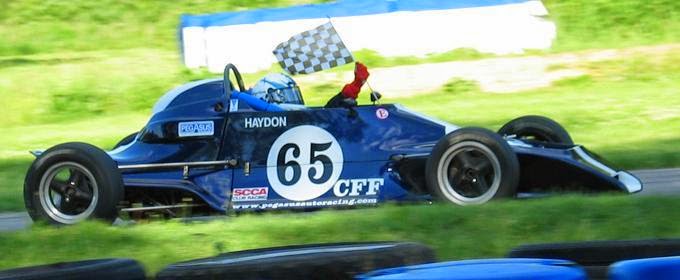
"It was the best of times, it was the worst of times."
-- Charles Dickens, A Tale of Two Cities
Well, no, it wasn't the worst of times by a long shot. More like, "it was the best of times, it was the wettest of times." It wasn't raining when I got to Blackhawk on Sunday morning, but a big storm had rolled through Saturday night, dumping enough water to break several canopies around the paddock (including one of mine) and to flood my paddock area. Everything I owned was wet, and before I could get anything sorted out, it started raining again.
It continued to rain -- hard -- during the first practice session. The track was underwater in a few spots, creating a new racing line that was less about finding traction and more about not drowning. I was happy to bring the car back in one piece, delighted that it was once again running perfectly, and surprised that I managed to get below a 2 minute lap time.
The rain eased up a bit for qualifying, so I was able to take a couple of seconds off of my practice time (still a 1:50, 11th on the grid). The car was running strong, but at one point when I opened the throttle, the exhaust note suddenly changed dramatically. It sounded a little like a blown exhaust header gasket, so I stayed out just long enough to ensure that I got enough laps to start the race.
When I pulled the engine cover, the gasket was still in one piece. The 4-year-old crack in the header looked worse, but there was still no evidence that it had cracked through. I started the engine again to try to find the leak, but there was nothing -- no visible smoke and no gas escaping anywhere -- just that weird noise that didn't sound so much like a header gasket after all. Luckily, Nicole Temple walked over from the Lindstrand Motorsports trailer just in time. She listened for just a few seconds, looked it over for a moment, and spotted the problem. One of the tabs which holds the exhaust collector to the header primary tubes had broken. The collector slipped off just enough to allow the #2 pipe to pop out, creating the bizarre, lumpy-cam-V8 racket. (Yes, she's better at this stuff than I am, but to be fair, she was standing on the other side of the car, so she could see the collector.)
The rain stopped soon after qualifying, and the sun came out. It was like a Christmas miracle. The flood waters began to recede, and we all changed from rain tires to dry tires, from clear and amber face shields to smoked and mirrored shields. Of course, just before the first call to grid, the sky clouded over again, and we all began to wonder if we had made a terrible miscalculation.
We hadn't. The rain held off, and the sun even peeked out a few more times during the afternoon. The track had drained somewhat before the start of our race, but it was still wet everywhere, and there were still puddles on the front straight. I got a great start, passing a CFF and an FC going into corner 1. Someone spun in either corner 2 or 5 (or both??), and cars went off both sides of the track. I picked my way through the group and found myself 4th overall! One of the cars still in front of me was Matt Lagessie (usually a big V8 sedan driver) in Jack Bartelt's Lola CFF. I caught up to him a few laps later, just in time for a front-row seat when he spun in corner 2. We narrowly missed each other as I passed, taking over the CFF lead. I tried to get some distance on him before he could recover.
The track conditions were tricky to say the least. It started out wet, but within 10 laps some of the corners were visibly drying. I worked on increasing my cornering speed in those corners, trying to take advantage of the increase in traction. The hard part was trying to keep from turning on "full dry" mode. Corners 2 and 5 and the dogleg between 3A and 4 are the last sections of the track to dry. Even when all of the other corners dry completely, you still have to take it easy through those areas. You're not driving a rain race, but you can't drive like it's a dry race either. It's hard to build a rhythm that way, and a lot of very fast drivers struggled with having to switch back and forth from corner to corner.
I ran as hard as I dared, trying a little harder each lap until I was at full dry speed in almost every corner. I managed to get down to a 1:19.14, just a second off of my best dry time. Soon I recognized the white Hawke of Mike Green in the distance ahead of me. Putting him a lap down would take a lot of pressure off of my pit stop. I turned up the heat a bit to catch up to him. Braking for corner 7, he briefly locked a wheel, and like a fool I started thinking that I had pressured him into a mistake... until I felt my own tires sliding, and I realized he had snookered me into a mistake! Fortunately I recovered from it -- and from the same mistake entering corner 1, and from another mistake in corner 2 (boy, was I getting greedy). The next time down the back straight, I was almost ready to set up for a pass, but he stayed to the right exiting the kink... and ducked into the pits. He later told me they had planned it that way. Clever, but he might have done better to drive defensively for another lap or two. He could have easily kept me behind him, maybe drawing me into a bigger mistake that I couldn't recover from.
"That Loooong Race" (yes, officially 4 "o"s) is a 100-mile race. Back in the day, the Formula Ford rules (at least in England, or someplace) actually specified that the fuel cell could be no larger than 5 gallons. Making some assumptions about fuel consumption, that means a Formula Ford has an expected range of about 30 minutes, which is about 50 miles at Blackhawk. In reality, I have had about 1 1/2 to 2 gallons left after a 30 minute race. The TLR rules allow auxilliary fuel tanks, but I've never come up with a design that I'd be proud of. I would need to stop for fuel too.
Of course, this isn't NASCAR or Formula 1 or CART. Our pit stops take a little longer. We don't have the high-dollar quick-refuelling rigs. We also don't have safety crews stationed up and down pit lane, so we have to be more cautious when it comes to refuelling. Our rules require the driver to be out of the car with the engine off, with a crew member standing by with a fire extinguisher. The person doing the fuelling is also required to wear so much safety equipment that it makes sense for the driver to do the actual fuelling.
With Mike in the pits, I drove as hard as I could to try to maximize the number of laps between us. I had told my crew to expect me around lap 30, so I waited for the right combination of traffic, lap number, and... something else, which I hadn't quite decided on yet. Soon enough, I got a sign. My water temperature gauge had reached 210 and was edging towards 220. I wasn't hot outside by any means (maybe high 60s), but I knew right away what the problem was. It's late fall in Illinois at a track with a thick canopy of trees. I noticed on the pace lap that corner 2 was covered in leaves, and of course I had scooped some huge amount of them into the radiator intake. It was only strange that it had taken 30 laps for it to run this hot.
I pulled into the pits for my fuel stop. Before I could get out of the car, Jack Bartelt had already cleaned the leaves out of the radiator intake for me. I dumped in the 2 gallons we had left in the fuel jug and got back in the car. I saw Matt and Mike both pass while I was buckling in, but were they already lapping me or just unlapping themselves? I asked my dad how long Mike had been in the pits, and I think he said that our stop was faster.
With the leaves out of the radiator, the track drying off, and fewer than 20 laps to go, I tried to drive like it was a sprint race. I tried to keep the lap times in the :19s, which was tough with so much traffic, both slower and faster. I have a new empathy for the drivers at LeMans, and the wide mix of cars and speeds they deal with. The fastest 5 cars in our group had fast lap times between 1:10 and 1:16; the slowest were between 1:29 and 1:35. The fastest car must have been passing the slowest car every 3 laps! And there I was in the middle, alternately lapping slower traffic and being lapped by faster cars.
I passed Matt in the Lola once more after my stop, getting back a lap I had lost during my pit stop. But how many laps he had already done was a mystery to me. Was he now behind me or still ahead of me? Were we on the same lap now?
As it turned out, we weren't. I forgot that Jack had constructed an auxiliary fuel tank for that car long ago, which meant that Matt didn't need to pit for fuel. I was only unlapping myself, but I still had another lap to make up before we would be on the same lap! He won CFF with 47 laps (finishing 5th overall), and I took second (9th overall) with 46 laps. I was catching him at a rate of about 4 seconds a lap, and at the end I was only about 20 seconds from getting back on the same lap as he was. But then I would have needed another 20 laps to make up the rest of that lap, which would have required another pit stop.
I am very proud of how I did, not just the finishing position and lap times, but I really felt like I drove better than I ever have. I was more confident under braking, I carried more speed through the corners, and my line took advantage of every bit of traction I could find.
Now if I could just start the 2011 season with a drive like that, we might really have something.
Showing posts with label Midwestern Council. Show all posts
Showing posts with label Midwestern Council. Show all posts
Monday, October 25, 2010


Wednesday, October 22, 2008
Catching Up Part 2: All Tired Out
Although my 2008 season has been all about SCCA, it was easy to talk me into running the Midwestern Council 50th anniversary race at Blackhawk on September 21. Unfortunately, I had committed to that event long before running the Double Regional at Road America the week before. I came down with a cold after spending the weekend outside in the cold and the rain (did I mention I was wet?), and I was seriously considering sleeping in when Sunday came around.
The title of the event was “All Tired Out,” so it was fitting that I had to drag myself out of bed at oh-dark-thirty and spend two hours trying to pick my way through a pea soup fog to get to the track. The fog lifted by the time I got to the track, but it was still cool and humid when we hit the track. I got out of the car after the practice session and realized that I was blowing a lot of fog around. I was breathing heavy, and the cool air turned my breath into quite a cloud every time I exhaled. I tried to calm my breathing a bit, but I was still engulfed in steam. Finally I realized that the steam was coming off my body! My slight fever combined with the exertion raised my body temperature, and the perspiration was all but sizzling off of me. Yes, I was hot.
I couldn’t hook up with anyone during qualifying. I was balked by sports racers nearly every lap, and it seemed that nobody was turning the same lap times that I was. I settled for a 1:22 and 3rd in CFF. Several DSRs had come to test for the Runoffs, so the field was large and fast. Third in CFF was 21st overall on the grid.
The race started off very badly. On lap 2, a Runoffs-bound DSR broke and stopped at the side of the track. On lap 3, an S2000 hit the wall, and an FC broke and stopped. On lap 7, another FC and another DSR both stopped. There were not enough wreckers available to get all of the broken cars to safety, so the officials had no choice but to stop the race until the track could be cleared.
When we lined up for the restart, I was directly behind Scott Reif, who was running 2nd in CFF. I thought I could get a jump on him at the start, and I was right. By the next lap, he was almost a straightaway behind me, balked by a sports racer. I did my best to deal with increasing understeer, but I could only manage a 1:21. Meanwhile Scott had passed the sports racer and was turning 1:19s in pursuit of me. He passed me with only a few laps to go, and I finished 3rd, just 5 seconds behind him.
After the race it became clear why the car had been understeering. The left front tire had just about shredded, losing a significant portion of its tread. But this wasn’t an entirely bad thing. While it was happening, I felt as though I learned (or re-learned) a lot about driving the car. I tried to compensate for the loss of traction by turning in to the corner a little earlier, so I could turn the wheel a little less abruptly. That not only made the car turn better, it also made the car handle much more neutrally than it had been doing. The back end was finally sliding as much as the front, which is what I had been struggling to make happen since 2006. I was probably as spent as that tire, but I felt so much better about everything that nothing really seemed to matter.
That would have been a terrifically high note to end the season, but there was still one more race to go.
The title of the event was “All Tired Out,” so it was fitting that I had to drag myself out of bed at oh-dark-thirty and spend two hours trying to pick my way through a pea soup fog to get to the track. The fog lifted by the time I got to the track, but it was still cool and humid when we hit the track. I got out of the car after the practice session and realized that I was blowing a lot of fog around. I was breathing heavy, and the cool air turned my breath into quite a cloud every time I exhaled. I tried to calm my breathing a bit, but I was still engulfed in steam. Finally I realized that the steam was coming off my body! My slight fever combined with the exertion raised my body temperature, and the perspiration was all but sizzling off of me. Yes, I was hot.
I couldn’t hook up with anyone during qualifying. I was balked by sports racers nearly every lap, and it seemed that nobody was turning the same lap times that I was. I settled for a 1:22 and 3rd in CFF. Several DSRs had come to test for the Runoffs, so the field was large and fast. Third in CFF was 21st overall on the grid.
The race started off very badly. On lap 2, a Runoffs-bound DSR broke and stopped at the side of the track. On lap 3, an S2000 hit the wall, and an FC broke and stopped. On lap 7, another FC and another DSR both stopped. There were not enough wreckers available to get all of the broken cars to safety, so the officials had no choice but to stop the race until the track could be cleared.
When we lined up for the restart, I was directly behind Scott Reif, who was running 2nd in CFF. I thought I could get a jump on him at the start, and I was right. By the next lap, he was almost a straightaway behind me, balked by a sports racer. I did my best to deal with increasing understeer, but I could only manage a 1:21. Meanwhile Scott had passed the sports racer and
 was turning 1:19s in pursuit of me. He passed me with only a few laps to go, and I finished 3rd, just 5 seconds behind him.
After the race it became clear why the car had been understeering. The left front tire had just about shredded, losing a significant portion of its tread. But this wasn’t an entirely bad thing. While it was happening, I felt as though I learned (or re-learned) a lot about driving the car. I tried to compensate for the loss of traction by turning in to the corner a little earlier, so I could turn the wheel a little less abruptly. That not only made
 the car turn better, it also made the car handle much more neutrally than it had been doing. The back end was finally sliding as much as the front, which is what I had been struggling to make happen since 2006. I was probably as spent as that tire, but I felt so much better about everything that nothing really seemed to matter.
That would have been a terrifically high note to end the season, but there was still one more race to go.
Tuesday, October 23, 2007
That Loooong Race '07
"Couldn't ask for better weather" was the most often heard phrase last weekend. The late October weather in northern Illinois has not been the best for outdoor activities in the past. Rain, cold, wind, bitter cold, snow, and cold are typical conditions for "The Looong Race," but cloudless skies and temperatures in the 70s made the stiff breeze tolerable all weekend.
This was my first race at Blackhawk since losing the oil pump in the rain last May, and I was looking forward to it. Blackhawk is a fun track with a welcoming atmosphere. Pro teams test there, but the track doesn't host any pro events. Unlike other tracks that cater to the pro racer (and to the spectators), Blackhawk hasn't clearcut groves of trees to set up grandstands or paved everything in sight. The creek where I used to catch tadpoles and snails and grasshoppers as a kid is still a creek. The track is still shaded by trees in many areas. Yes, the bathrooms are far from glamorous and we all paddock on grass or gravel, but the place feels more like a park or a picnic area than a business.
Most of the races we run are short sprint races, somewhere around 30 minutes or 50 miles. The Looong Race is a 100 mile race (technically, it's 97 1/2 -- 50 laps around a 1.95 mile track). Many cars stop to refuel (as I would have to do), and many people co-drive the event (as my competition, Mike and Paul Schindlbeck, would do). Most of our races don't involve pit stops, so this race can see some real entertainment in the pits. Unless the race is going to decide a championship, many of us take a fairly laid-back approach to setting up a pit crew. I hadn't actually arranged for a crew to help me refuel, but the great thing about club racing is that I knew could count on someone to help me. My parents were there, and my father agreed to hand me the fuel jug and hold the fire extinguisher ready while I poured in the fuel. That was all I needed, and I only needed enough fuel to make it to the finish.
Practice was relatively uneventful as I got reacquainted with the track. It was amazing how quickly some of the reference points came back, and equally amazing how baffling some of the corners seemed, even at the end of the session. Still, I turned a 1:20.655, which is only a few seconds off my best time. The car ran flawlessly, and I was even able to buckle the belts without holding my breath this time.
Practice didn't go so well for everyone. For some reason, people in fast cars seemed content to follow slower cars for many laps. I caught up to a group of cars including FCs, FFs, a CSR, and a CS2000 (all faster) following a slower car. I was directly behind a Reynard FC, just watching and trying to copy his rhythm, when the CS2 spun entering corner 3A. A couple of cars went right, one car went left, a couple of cars stopped, and the Reynard went off the track to the left. He must have hit a curb on his way out, because the car went bounding over the grass like a huge metal puppy. He came back on the track in front of me, but he slowed and pulled off at corner 4 with a bent suspension.
I shouldn't have put so much emphasis on qualifying, since winning this race would not earn me any points. Only one other CFF was running (Schindlbecks), and I would still get a trophy for second place. They would probably beat me in the pits anyway, since they have co-driven this race in their car more times than I have in all the cars I've driven. But I didn't come to finish second. I worked hard during qualifying, turning a 1:19.7 to Paul Schindlbeck's 1:22.5.
Paul told me during lunch that they had found their two and a half seconds -- the ignition points were badly burned out, keeping the car from making any power above 5000rpm. With the new set of points, he predicted he'd be right on my tail. I didn't doubt him. But what he didn't tell me is that they wouldn't need to refuel. They would only change drivers. That would be a big advantage for them.
The pace lap was incredibly fast. I don't remember the last time I was in 4th gear during a pace lap. (That may have been my fastest lap of the race.) Once the green flag dropped, I tried to settle in to a conservative pace, turning 1:22 laps and driving as smoothly as I could. Traffic spread out almost immediately, which was surprising after the clumps in the morning practice session. Soon I was all alone. No faster cars in sight in front of me, but more surprising, no cars in my mirrors either. Where was Paul, and when would I see him flying past me? I started cursing my decision not to burden my mother with the stopwatch and pit board. I really wanted to know what was going on around me!
A peculiar thing happens when you're all alone with your thoughts in a noisy racecar. The noises seem to change, though it may only be your interpretation of the noises that changes. Every click, every buzz, every pop, and every rattle worries you. Is that clicking sound new? Was that pop the sound of something breaking? Is something wearing out? Is this car going to last the entire race? You can go crazy listening for new sounds, trying to picture just what the sound is, and trying to calculate how much longer you can afford to push it before the sound turns into an explosion.
I started to worry about the gearbox. This was the same race that cost me a transmission in 2005. I had checked the oil level before this race, though, and it was fine. I kept telling myself to concentrate on the track, on the steering, the throttle and brake. But I kept hearing a rattling, popping noise. I kept picturing a tooth broken off of a gear, bouncing around inside the transmission, waiting for just the right moment to jump between two meshed gears and jam everything solid. I actually stopped using first and second gears, thinking that shifting less often would be less strain on the gearbox. Not that it would have helped. If something had broken off and was rattling around, it could have jammed everything regardless of what gear I was in at the time.
I had a very loose plan in place to stop for fuel somewhere around the 25 lap mark. On my 22nd lap, I recognized my fuel jug being waved in the air at the pit wall. But the person waving it was wearing a helmet, and I couldn't figure out who it was! The next lap, the person had taken his helmet off, and I recognized that it was David Cox. I pulled in the next time around and hopped out of the car. I found out later that David had approached my father and offered to do the fueling so I could rest. I'm so thankful that he did. I had forgotten how tiring it is to race for that long.
I pulled out of the pit lane and saw that my lap timer showed a time of 5:49.5. I had lost 4 minutes in the pits -- most of it spent struggling to buckle myself back in the car. I found out later that the Schindlbecks had changed drivers in less than 30 seconds, and their total pit stop, including entering and exiting pit lane, cost them only about one minute. After both pit stops, I was one lap down. I would really have to turn some seriously fast laps to catch them.
Or I could rely on luck. The next thing I knew (which was about 15 laps later), I passed Mike on the track. He was going very slow, and the car didn't sound right. Even with a helmet on, I could see he wasn't happy. Shortly after they had changed drivers, Mike spent about 5 minutes in the pits because the car was overheating. Several laps later -- probably shortly after I passed him -- he pulled back in with a blown head gasket. Their race was done after 35 laps.
I nursed the car to the finish, turning a best lap of 1:21.5. This was my first time ever winning The Looong Race (and only my third time making it to the checkered flag) in 9 tries. I was so worn out at the end, I know the car was in better shape than I was. I could barely hold the checkered flag because my hand was so sore from gripping the steering wheel. I couldn't push the clutch pedal because my foot hurt so badly from bracing myself against the footrest. My eyes were as dry as the Sahara and I could barely hold my head upright. But it felt great.
Now I need to open the gearbox and find out what is going on in there before the last SCCA Regional race of the season at Blackhawk this weekend. Wish me luck.
This was my first race at Blackhawk since losing the oil pump in the rain last May, and I was looking forward to it. Blackhawk is a fun track with a welcoming atmosphere. Pro teams test there, but the track doesn't host any pro events. Unlike other tracks that cater to the pro racer (and to the spectators), Blackhawk hasn't clearcut groves of trees to set up grandstands or paved everything in sight. The creek where I used to catch tadpoles and snails and grasshoppers as a kid is still a creek. The track is still shaded by trees in many areas. Yes, the bathrooms are far from glamorous and we all paddock on grass or gravel, but the place feels more like a park or a picnic area than a business.
Most of the races we run are short sprint races, somewhere around 30 minutes or 50 miles. The Looong Race is a 100 mile race (technically, it's 97 1/2 -- 50 laps around a 1.95 mile track). Many cars stop to refuel (as I would have to do), and many people co-drive the event (as my competition, Mike and Paul Schindlbeck, would do). Most of our races don't involve pit stops, so this race can see some real entertainment in the pits. Unless the race is going to decide a championship, many of us take a fairly laid-back approach to setting up a pit crew. I hadn't actually arranged for a crew to help me refuel, but the great thing about club racing is that I knew could count on someone to help me. My parents were there, and my father agreed to hand me the fuel jug and hold the fire extinguisher ready while I poured in the fuel. That was all I needed, and I only needed enough fuel to make it to the finish.
Practice was relatively uneventful as I got reacquainted with the track. It was amazing how quickly some of the reference points came back, and equally amazing how baffling some of the corners seemed, even at the end of the session. Still, I turned a 1:20.655, which is only a few seconds off my best time. The car ran flawlessly, and I was even able to buckle the belts without holding my breath this time.
Practice didn't go so well for everyone. For some reason, people in fast cars seemed content to follow slower cars for many laps. I caught up to a group of cars including FCs, FFs, a CSR, and a CS2000 (all faster) following a slower car. I was directly behind a Reynard FC, just watching and trying to copy his rhythm, when the CS2 spun entering corner 3A. A couple of cars went right, one car went left, a couple of cars stopped, and the Reynard went off the track to the left. He must have hit a curb on his way out, because the car went bounding over the grass like a huge metal puppy. He came back on the track in front of me, but he slowed and pulled off at corner 4 with a bent suspension.
I shouldn't have put so much emphasis on qualifying, since winning this race would not earn me any points. Only one other CFF was running (Schindlbecks), and I would still get a trophy for second place. They would probably beat me in the pits anyway, since they have co-driven this race in their car more times than I have in all the cars I've driven. But I didn't come to finish second. I worked hard during qualifying, turning a 1:19.7 to Paul Schindlbeck's 1:22.5.
Paul told me during lunch that they had found their two and a half seconds -- the ignition points were badly burned out, keeping the car from making any power above 5000rpm. With the new set of points, he predicted he'd be right on my tail. I didn't doubt him. But what he didn't tell me is that they wouldn't need to refuel. They would only change drivers. That would be a big advantage for them.
The pace lap was incredibly fast. I don't remember the last time I was in 4th gear during a pace lap. (That may have been my fastest lap of the race.) Once the green flag dropped, I tried to settle in to a conservative pace, turning 1:22 laps and driving as smoothly as I could. Traffic spread out almost immediately, which was surprising after the clumps in the morning practice session. Soon I was all alone. No faster cars in sight in front of me, but more surprising, no cars in my mirrors either. Where was Paul, and when would I see him flying past me? I started cursing my decision not to burden my mother with the stopwatch and pit board. I really wanted to know what was going on around me!
A peculiar thing happens when you're all alone with your thoughts in a noisy racecar. The noises seem to change, though it may only be your interpretation of the noises that changes. Every click, every buzz, every pop, and every rattle worries you. Is that clicking sound new? Was that pop the sound of something breaking? Is something wearing out? Is this car going to last the entire race? You can go crazy listening for new sounds, trying to picture just what the sound is, and trying to calculate how much longer you can afford to push it before the sound turns into an explosion.
I started to worry about the gearbox. This was the same race that cost me a transmission in 2005. I had checked the oil level before this race, though, and it was fine. I kept telling myself to concentrate on the track, on the steering, the throttle and brake. But I kept hearing a rattling, popping noise. I kept picturing a tooth broken off of a gear, bouncing around inside the transmission, waiting for just the right moment to jump between two meshed gears and jam everything solid. I actually stopped using first and second gears, thinking that shifting less often would be less strain on the gearbox. Not that it would have helped. If something had broken off and was rattling around, it could have jammed everything regardless of what gear I was in at the time.
I had a very loose plan in place to stop for fuel somewhere around the 25 lap mark. On my 22nd lap, I recognized my fuel jug being waved in the air at the pit wall. But the person waving it was wearing a helmet, and I couldn't figure out who it was! The next lap, the person had taken his helmet off, and I recognized that it was David Cox. I pulled in the next time around and hopped out of the car. I found out later that David had approached my father and offered to do the fueling so I could rest. I'm so thankful that he did. I had forgotten how tiring it is to race for that long.
I pulled out of the pit lane and saw that my lap timer showed a time of 5:49.5. I had lost 4 minutes in the pits -- most of it spent struggling to buckle myself back in the car. I found out later that the Schindlbecks had changed drivers in less than 30 seconds, and their total pit stop, including entering and exiting pit lane, cost them only about one minute. After both pit stops, I was one lap down. I would really have to turn some seriously fast laps to catch them.
Or I could rely on luck. The next thing I knew (which was about 15 laps later), I passed Mike on the track. He was going very slow, and the car didn't sound right. Even with a helmet on, I could see he wasn't happy. Shortly after they had changed drivers, Mike spent about 5 minutes in the pits because the car was overheating. Several laps later -- probably shortly after I passed him -- he pulled back in with a blown head gasket. Their race was done after 35 laps.
I nursed the car to the finish, turning a best lap of 1:21.5. This was my first time ever winning The Looong Race (and only my third time making it to the checkered flag) in 9 tries. I was so worn out at the end, I know the car was in better shape than I was. I could barely hold the checkered flag because my hand was so sore from gripping the steering wheel. I couldn't push the clutch pedal because my foot hurt so badly from bracing myself against the footrest. My eyes were as dry as the Sahara and I could barely hold my head upright. But it felt great.
Now I need to open the gearbox and find out what is going on in there before the last SCCA Regional race of the season at Blackhawk this weekend. Wish me luck.
Wednesday, September 26, 2007
Back In It
 Since the car was already set up for Road America, I decided to run the Midwestern Council races there last weekend. I wouldn’t be able to earn points because I would be running on an SCCA license, but I figured the seat time would be worth it.
I wanted to drop the car off at the track on Friday night, but the forecast suddenly called for strong storms overnight with high winds and hail. I didn’t want to leave the car outside in weather like that, so I left the car in the garage for the night and drove up to register. The weather cooperated and rained on and off while I was there, with a few lightning strikes thrown in for good measure.
The trip to the track was much less interesting than last time (thankfully) and I found a spot on the paved area of the south paddock, very close to where I had parked last month. The only drawback was a stiff breeze which continued until the early afternoon, but spending a few minutes in the sun was enough to get rid of the chill.
The schedule was similar to last month (one morning qualifying session and one afternoon race each day), but my group was later in the day, which made the pace much more relaxing. Because the races are longer than the qualifying sessions, the later groups get more time to prepare for their races. That has always seemed to me to be much more important than being able to leave the track earlier in the day.
My goal for qualifying was to find Pete Wood (or another fast driver) and spend the session following him. That has worked very well for me at Road America, and I’m not exactly sure why. It could be because the draft is so important because of the high speeds on the long straights. It could be that I don’t run the track often enough to have good reference points for braking and turning. Or it could just be that I get a little bored on the long straights and lose concentration, which of course leads to mistakes.
I managed to find Pete a few laps into the session, and as soon as I began following him, my lap times (and his) started falling. Pete eventually got the pole with a 2:44.6, and I qualified right behind him with a 2:44.8. The session felt great, and the day was off to a good start.
The race, on the other hand, didn’t start so well for me. Somehow I lost five positions (two of them in my class) before corner 5. I was now behind Scott Reif in a 1976 Tiga with Scott Durbin in a 1975 Tiga challenging Pete for the lead. I decided to settle in and draft Scott Reif for at least a lap or two, figuring that our cooperation would get us closer to the two lead cars, who I expected to slow each other down a bit in their battle for the lead.
I passed Scott in the Carousel on lap 3 and worked on chasing down Pete and Scott Durbin. I managed to turn a 2:39.5 before I spotted them in the distance. Unfortunately, I got stuck behind another car and couldn’t quite catch them before the checkered flag came out. We finished within 4.2 seconds, and according to the lap times, if I hadn’t been held up by the other car (and IF I could have kept turning 2:39 laps), I could have caught the leaders (or at least I could have been right on their tails). I was happy to settle for third place out of 8 Club Fords.
 Sunday went much better for me, not so much better for the other Club Ford drivers. I couldn’t hook up with anyone for qualifying, but I still got the pole with a 2:39.4. Pete had pulled in after three laps with his transmission popping out of gear, and Scott Durbin pulled in one lap early. I had out-qualified Scott by 2 seconds, but we later found out that his gearbox had cracked, so his weekend was over.
I couldn’t relax just yet. I suggested that Pete’s gearbox problem sounded a lot like the problem that I had experienced in October of 2005, when my transmission had run itself dry. The heat generated by the dry gears and bearings made the shift detent springs relax, which left nothing holding the car in gear. He checked and found out that he was indeed very low on oil. He refilled the gearbox and test-drove it around the paddock to make sure everything still operated freely. He would be starting 11 spots behind me (make that 10, since Durbin was out).
 And speaking of gearbox issues… during the first few corners of the pace lap for Saturday’s race and the first few corners of Sunday’s qualifying session, I had missed third gear on a few downshifts and once on an upshift. It seemed to be better when the gearbox warmed up, but I couldn’t explain what was going on. I don’t like when I can’t explain why the car is doing something. Fortunately, I checked the valve lash during lunch on Sunday. Stick with me here, because it will make sense in a minute. To adjust the valve lash, I put the car in gear and push the car to turn the engine over very slowly, one valve at a time. The last step in the process is to put the car back in neutral. When I did that, I noticed the shift lever felt and looked very loose. Closer inspection revealed that one central bolt which holds the entire shift linkage in place had indeed loosened. That allowed just the right amount and type of slop into the linkage that it wouldn’t go into third gear unless I really slammed it home (which, apparently, I do when I’m driving hard). Simply tightening the bolt cured the problem. One more issue off my mind.
Sure enough, Pete passed me on the second lap of the race. I had gotten stuck behind a high-horsepower but ill-handling sports racer, and Pete took full advantage of it. I managed to pass the sports racer on the next lap and caught up to Pete. I decided to stay behind him for a while, since cooperating with him early would get us away from the sports racer and allow us to concentrate on racing each other later. I drafted him for several laps before finally deciding that it was time to make a move.
I tried passing Pete in the Carousel, but the track had become dirty enough that I didn’t have enough traction to pull it off. I tried drafting him between corners 3 and 5, but I didn’t time the move quite right and all I could do was draw even. I didn’t think I could outbrake him into corner 5, so I pulled back in behind him and tried to look for another option.
That same lap, I bobbled a little bit entering corner 14, which could have cost me a lot of time since that corner leads onto a very long front straight. But somehow I managed to salvage the corner and come away with good exit speed. Good enough to draft past Pete into corner 1. Well, almost. I timed the passing maneuver correctly so that the draft helped to “slingshot” me past him, but I could only get about halfway past. His front wheels were still ahead of my rear wheels, and I couldn’t pull away. But I knew that I could brake later and carry more speed through corner 1, so I held my position and waited for what seemed like hours. Finally I spotted his brake marker and heard him get off the throttle. I waited a half a beat later than I normally would have before hitting my brakes, just to avoid tangling or crowding him. I was off the proper line, so I should have slowed down even more than I normally would have, but I dropped one gear (I could hear Pete downshifting twice), got off the brakes, and made it through the corner at full throttle.
Pete wasn’t about to let me go without a fight. He was on my tail entering corner 3, but I managed to carry a bit more speed through that corner as well. He was a few car lengths behind me along the straight leading to corner 5, but I still expected him to try to pass me under braking. I knew I wouldn’t be able to keep him behind me if he tried it. I braked as late as I thought I possibly could, and he didn’t try to pass me. I finally felt like I could breathe again.
He was still on my tail on the hill from 5 to 6, but I gained a little ground coming through corner 7. He was back on my tail entering corner 8 though, but I knew I could get a better lead through the Carousel. The Tiga hooks up so well through that long sweeper that it’s actually hard to follow other cars through there. In fact, I think I passed more cars that weekend by driving around them in the Carousel than on any other corner.
When I set up for the Kink, I checked my mirrors and saw just a small purple spot behind me. I concentrated on building up a lead for a few laps before I couldn’t see Pete any more. Once my mirrors were clear, I relaxed a bit. As I exited corner 5 the next lap I realized what a mistake I had made. I could see the purple nose of Pete’s Crossle just a few car lengths behind me! But it was already the last lap of the race, and corner 7 and the Carousel were in front of us. I told myself I just had to do the rest of the lap correctly and I’d be home free. No banzai craziness or super speed. Just be smooth, don’t over-brake, and drive the correct line. I think I repeated that mantra about two dozen times over the next nine corners. But it got me to the finish line 0.945 second ahead of Pete.
I can’t count all the bruises and sore muscles from the unfamiliar exertion. Honestly I can’t tell where a bruise ends and a sore muscle begins. But even the aches and pains feel awfully good right now.
Monday, October 30, 2006
The Bartelt Belt
Soon I will need to say good-bye (maybe only temporarily) to the Bartelt Belt.
Informally known as the "Club Ford Federation World Heavyweight Championship Belt," it was designed by Jack Bartelt to honor the Midwestern Council Club Formula Ford class champions. It's an impressive piece of leather, with engraved metal plaques bearing the names of all the champions. The center logo is a larger plaque depicting Jack's Lola T-540 surrounded by the legend "Midwestern Council - Club Formula Ford Champion." On each side of the center logo is a Midwestern Council logo.
The "tongue" (not the buckle) end has one plaque:
Past CFF Champions:
1987 Mike Mudjer
1988 Steve Stadel
1989 Pete Wood
1990 Jeff Jagusch
1991 Mike Wood
1992 Pete Wood
The buckle side has individual plaques, added as each championship is won:
1st Annual Winner of the "Bartelt Belt": 1993Pete Mike Wood
1994 Marc Blanc
1995 Jack Bartelt
1996 Jack Bartelt
1997 Mike Schindlbeck
1998 Dean Elston
1999 and 2000 Millenium Champion Joe Christenbury
2001 Jack Bartelt
2002 Pete Wood
2003 Scott Reif
2004 Scott Reif
2005 John Haydon
In case anyone's counting, that's 2 championships for Scott Reif, 2 for Joe Christenbury, 3 for Jack Bartelt, and 4 for Pete Wood. Pete will get his name on the belt for afifth fourth time in 2006. (Three champions won their titles in my car -- Dean Elston in 1998, Pete Wood in 2002, and me in 2005.)
Speaking of my car, the engine block is being checked for cracks right now. I need to test the oil pressure gauge and tear open a few oil pumps to try to build one good pump. I'm hopeful that if I keep working through the winter, I may be able to get the car together in time to run a very early 2007 race somewhere in the south.
Wish me luck!
Informally known as the "Club Ford Federation World Heavyweight Championship Belt," it was designed by Jack Bartelt to honor the Midwestern Council Club Formula Ford class champions. It's an impressive piece of leather, with engraved metal plaques bearing the names of all the champions. The center logo is a larger plaque depicting Jack's Lola T-540 surrounded by the legend "Midwestern Council - Club Formula Ford Champion." On each side of the center logo is a Midwestern Council logo.
The "tongue" (not the buckle) end has one plaque:
Past CFF Champions:
1987 Mike Mudjer
1988 Steve Stadel
1989 Pete Wood
1990 Jeff Jagusch
1991 Mike Wood
1992 Pete Wood
The buckle side has individual plaques, added as each championship is won:
1st Annual Winner of the "Bartelt Belt": 1993
1994 Marc Blanc
1995 Jack Bartelt
1996 Jack Bartelt
1997 Mike Schindlbeck
1998 Dean Elston
1999 and 2000 Millenium Champion Joe Christenbury
2001 Jack Bartelt
2002 Pete Wood
2003 Scott Reif
2004 Scott Reif
2005 John Haydon
In case anyone's counting, that's 2 championships for Scott Reif, 2 for Joe Christenbury, 3 for Jack Bartelt, and 4 for Pete Wood. Pete will get his name on the belt for a
Speaking of my car, the engine block is being checked for cracks right now. I need to test the oil pressure gauge and tear open a few oil pumps to try to build one good pump. I'm hopeful that if I keep working through the winter, I may be able to get the car together in time to run a very early 2007 race somewhere in the south.
Wish me luck!
Tuesday, January 24, 2006
Driver of the Year
Last Saturday was the annual Midwestern Council of Sports Car Clubs awards banquet. We gather each year to honor the champions in each class and to present several special awards to members who have excelled in areas that aren’t scored. Sportsman of the Year is one of those awards, given to the competitor who is voted by the other members to have driven hard but always clean, helping others along the way, demonstrating the spirit of fair play, respecting others, and behaving well even in the face of defeat. Driver of the Year is awarded to the driver who has not only finished well in his class, but has also shown excellence in his driving skill (sort of a “champion of champions” award).
I was voted the Sportsman of the Year in 2004, primarily because of a long story involving an engine that I was told was legal, and a fantastic season (including a lap record) that I voluntarily forfeited when I found out that the engine I had been using wasn’t legal. I was glad that people appreciated my honesty, but I couldn’t help wishing that I could have been remembered for something other than that embarrassing episode.
This year, I was nominated again for Sportsman of the Year and also for Driver of the Year. The Sportsman nomination was partially because I helped to honor Frank Nelson, a Formula Vee driver who had passed away over the winter. He had asked to be buried in his racecar, but his family found that the cost was prohibitive. They mentioned that the next best might be to scatter his ashes around the racetrack from his racecar, and I jumped at the chance to be involved. I got his car ready to go, and I gave him his final ride just before the start of the first FV race of the season.
Lynn Serra won the Sportsman of the Year award, which I still enjoyed, since I was one of several people who nominated her. Lynn works on the Safety & Rescue team whenever she isn’t racing her Formula Ford. She frequently solicits help for other drivers who are in a pinch, but I honestly don’t remember her ever asking anyone to help her. I was thrilled to be voted the 2005 Driver of the Year. Even when I do well on the track, I sometimes find myself making excuses for my success (the other cars weren’t running very well, only three cars showed up, Pete must have had an off day), so it was a very pleasant surprise to have my peers give me such a vote of confidence.
I was also presented with a lovely plaque for the Club Formula Ford championship, but the real highlight of my evening was getting the Bartelt Belt.
Let’s back up a little. Despite what they show in movies (Le Mans and Driven being prime examples), racers are generally not a serious, dry, scowling bunch. Racing is a serious enough activity. We like to keep things in perspective by not taking anything else too seriously, even if it means poking fun at ourselves and what we do.
Jack Bartelt reminds us of the humorous side of racing better than anyone else I’ve met. When I first saw Jack race, I noticed that while all the other drivers would wave to the corner workers on their cool-down laps, Jack would instead shake a rubber chicken at them as he drove past. Jack decided to inject some humor into the Club Formula Ford championship while adding a little to the prestige and lure of the class at the same time.
In 1993, Jack made the Bartelt Belt, a pro wrestling-style championship belt with the names of all the past CFF champions on it. Every year since 1993, it has been presented to the CFF champion by “Action Jackson,” Jack’s WWF alter ego. The first Midwestern Council awards banquet I attended was for the 1993 season, and the hilarious presentation stuck with me. Ever since that night, I thought about how much fun it might be to be presented with the Belt. I confess that part of the reason I bought the Tiga was that I wanted a chance at the Belt.
Unfortunately, the people who organize the banquet have all gotten too old to see the humor and value in the belt presentation, so Jack was not given the stage or the microphone. We had to settle for an unofficial mini-presentation in one corner of the banquet hall after the official program was over. Several past CFF champions gathered to pass the belt to me in front of a small crowd of people who still appreciate lowbrow humor.
Here, Scott Reif (2003 & 2004 champ, in the glasses) prepares to hand over the Bartelt Belt while Jack “Action Jackson” Bartelt (1995, 96, 01 champ, in the mask) says some surprisingly nice things about me.

Speedy Petey (1989, 92, 2002 champ) was number 2 behind me this year. How do you like my Ford Cosworth tie??
The 2006 racing schedule is changing already. The June 24 Formula 1 support race has been officially cancelled. The National races at Nelson Ledges (July 29-30 and September 2-3) and Mid-Ohio (June 3-4) are sounding less appealing right now. Those tracks are a pretty long tow, and I’m not likely to gain enough points at those races to make the trip worthwhile. I may replace those races with some Midwestern Council events instead. And if I don’t get enough points early in the season to make the Runoffs, I may just finish the season running MC and SCCA Regional races.
I was voted the Sportsman of the Year in 2004, primarily because of a long story involving an engine that I was told was legal, and a fantastic season (including a lap record) that I voluntarily forfeited when I found out that the engine I had been using wasn’t legal. I was glad that people appreciated my honesty, but I couldn’t help wishing that I could have been remembered for something other than that embarrassing episode.
This year, I was nominated again for Sportsman of the Year and also for Driver of the Year. The Sportsman nomination was partially because I helped to honor Frank Nelson, a Formula Vee driver who had passed away over the winter. He had asked to be buried in his racecar, but his family found that the cost was prohibitive. They mentioned that the next best might be to scatter his ashes around the racetrack from his racecar, and I jumped at the chance to be involved. I got his car ready to go, and I gave him his final ride just before the start of the first FV race of the season.
Lynn Serra won the Sportsman of the Year award, which I still enjoyed, since I was one of several people who nominated her. Lynn works on the Safety & Rescue team whenever she isn’t racing her Formula Ford. She frequently solicits help for other drivers who are in a pinch, but I honestly don’t remember her ever asking anyone to help her. I was thrilled to be voted the 2005 Driver of the Year. Even when I do well on the track, I sometimes find myself making excuses for my success (the other cars weren’t running very well, only three cars showed up, Pete must have had an off day), so it was a very pleasant surprise to have my peers give me such a vote of confidence.
I was also presented with a lovely plaque for the Club Formula Ford championship, but the real highlight of my evening was getting the Bartelt Belt.
Let’s back up a little. Despite what they show in movies (Le Mans and Driven being prime examples), racers are generally not a serious, dry, scowling bunch. Racing is a serious enough activity. We like to keep things in perspective by not taking anything else too seriously, even if it means poking fun at ourselves and what we do.
Jack Bartelt reminds us of the humorous side of racing better than anyone else I’ve met. When I first saw Jack race, I noticed that while all the other drivers would wave to the corner workers on their cool-down laps, Jack would instead shake a rubber chicken at them as he drove past. Jack decided to inject some humor into the Club Formula Ford championship while adding a little to the prestige and lure of the class at the same time.
In 1993, Jack made the Bartelt Belt, a pro wrestling-style championship belt with the names of all the past CFF champions on it. Every year since 1993, it has been presented to the CFF champion by “Action Jackson,” Jack’s WWF alter ego. The first Midwestern Council awards banquet I attended was for the 1993 season, and the hilarious presentation stuck with me. Ever since that night, I thought about how much fun it might be to be presented with the Belt. I confess that part of the reason I bought the Tiga was that I wanted a chance at the Belt.
Unfortunately, the people who organize the banquet have all gotten too old to see the humor and value in the belt presentation, so Jack was not given the stage or the microphone. We had to settle for an unofficial mini-presentation in one corner of the banquet hall after the official program was over. Several past CFF champions
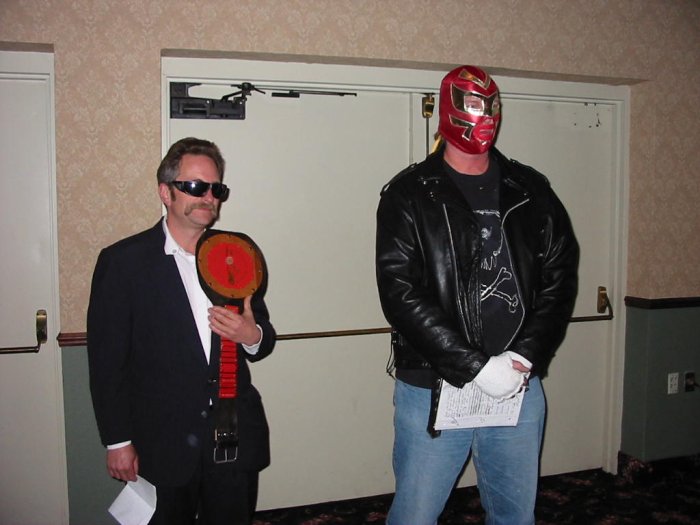 gathered to pass the belt to me in front of a small crowd of people who still appreciate lowbrow humor.
Here, Scott Reif (2003 & 2004 champ, in the glasses) prepares to hand over the Bartelt Belt while Jack “Action Jackson” Bartelt (1995, 96, 01 champ, in the mask) says some surprisingly nice things about me.
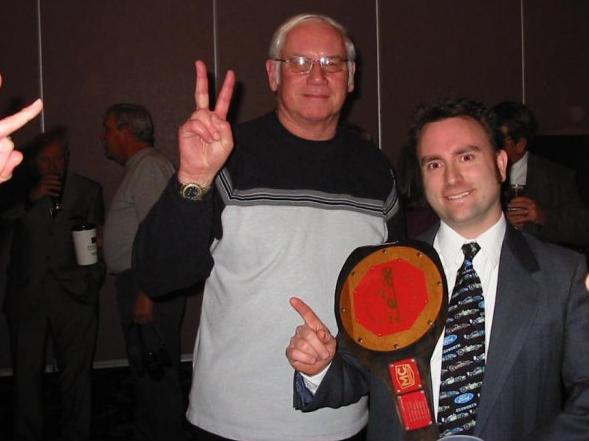
Speedy Petey (1989, 92, 2002 champ) was number 2 behind me this year. How do you like my Ford Cosworth tie??
The 2006 racing schedule is changing already. The June 24 Formula 1 support race has been officially cancelled. The National races at Nelson Ledges (July 29-30 and September 2-3) and Mid-Ohio (June 3-4) are sounding less appealing right now. Those tracks are a pretty long tow, and I’m not likely to gain enough points at those races to make the trip worthwhile. I may replace those races with some Midwestern Council events instead. And if I don’t get enough points early in the season to make the Runoffs, I may just finish the season running MC and SCCA Regional races.
Tuesday, October 25, 2005
Photos from The Loooong Race
In this morning's email were several great photos from Brian Lindstrand -- D Sports Racer driver, nephew of Bruce Lindstrand, and general all-around great guy.
 Ahh, the good memories. Getting ready to get in the car for the first practice session. My father seems to be trying to tell me something terribly important, but in fact he's probably asking me if the tire pressures are set, or if there's fuel in the car. Yes to both questions... and yes, I have forgotten both before.
 Aaaand... the not-so-good. This is us in our mad dash to try to repair the gearbox before the race. We cleaned the parts and then bathed them in oil and tired to flush the maincase with fresh oil to try to make the parts happy again. It was a very unhappy gearbox.
 Here's Brian next to his racecar. Sitting in the car is Nicole Temple, Lindstrand Motorsports' transmission specialist. (Did I mention that Nicole also helped with the paint on my car?) They co-drove this race, and won their class. Bravo!
The car was originally a Formula Ford built by Titan, but it was converted to a sports racer with a Fiat engine some years ago -- before I started my own driving career. Brian was finally convinced to replace the Fiat with something a little more reliable a couple of years ago, so a Yamaha R1 engine now powers the car to some very impressive speeds.
Back in my garage, the transmission is off, as is the rear suspension and most of the engine "extras." The engine should be out of the car tonight. We may be able to start tearing it down this weekend.
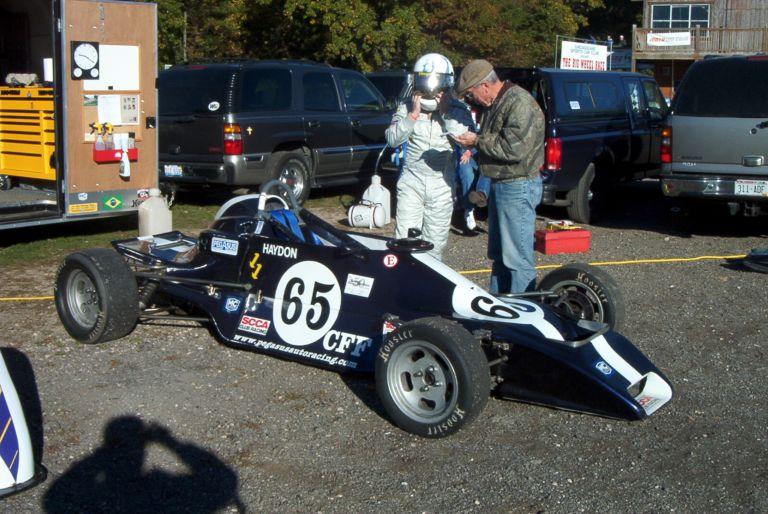 Ahh, the good memories. Getting ready to get in the car for the first practice session. My father seems to be trying to tell me something terribly important, but in fact he's probably asking me if the tire pressures are set, or if there's fuel in the car. Yes to both questions... and yes, I have forgotten both before.
 Aaaand... the not-so-good. This is us in our mad dash to try to repair the gearbox before the race. We cleaned the parts and then bathed them in oil and tired to flush the maincase with fresh oil to try to make the parts happy again. It was a very unhappy gearbox.
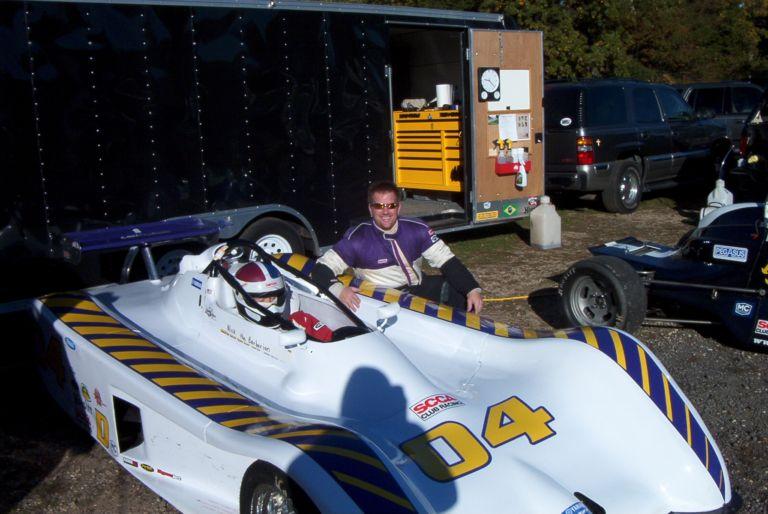 Here's Brian next to his racecar. Sitting in the car is Nicole Temple, Lindstrand Motorsports' transmission specialist. (Did I mention that Nicole also helped with the paint on my car?) They co-drove this race, and won their class. Bravo!
The car was originally a Formula Ford built by Titan, but it was converted to a sports racer with a Fiat engine some years ago -- before I started my own driving career. Brian was finally convinced to replace the Fiat with something a little more reliable a couple of years ago, so a Yamaha R1 engine now powers the car to some very impressive speeds.
Back in my garage, the transmission is off, as is the rear suspension and most of the engine "extras." The engine should be out of the car tonight. We may be able to start tearing it down this weekend.
Wednesday, October 19, 2005
That Loooong Race
As I mentioned last time, the final race of the season in this area is "That Loooong Race" at Blackhawk, put on (this year for the 35th time!) by the Chicagoland Sports Car Club. I had invited Bruce Lindstrand to co-drive the 100 mile race with me waaay back when I didn't know what kind of season I'd have and what condition the car would be in by now. I was eager to see him drive the car again, and he was excited to drive his old car again.
The car seemed to need little preparation after the Regional the week before, so I loaded it up and headed to the track. Our group was scheduled to run only on Sunday (20 minute practice, 25 minute qualifying, and 100 lap race), which was a VERY tough schedule. There was very little time between sessions to deal with the inevitable things that crop up on a race day. When you're running a race more than twice as long as you're used to, small problems become big problems.
I ran the practice session because Bruce ran that session in the other car he was co-driving: Allen Wheatcroft's 1998 Van Diemen FF. Bruce was going to have a very busy day. We determined that he would start the race in Allen's car and I would start in my car. Bruce would pull into the pits around lap 25, Allen would get in his car, I would come in on lap 30, and Bruce would take over in my car. The practice session went well, and I turned a few 1:22 laps.
The qualifying session was a little surreal. Seeing my own car being driven by someone else gave me an odd feeling of pride mixed with jealousy -- the car looked and sounded great, but someone else was driving my car! Bruce was kind to me and to the car. He immediately cranked out a string of 1:23.7 laps. He was so consistent that we thought there was something wrong with our timing equipment, because the numbers never changed. Then the worry set in. The second-last lap, as he was passing the pit lane, the car popped out of gear. That was very strange, because that had never happened to me with that car. The next lap, he pulled in and explained that the car wouldn't stay in 4th gear and was getting generally hard to shift. Smoke was coming off the gearbox -- never a good sign.
We let the gearbox cool a bit, to the point where our gloves wouldn't burst into flames as soon as we touched it. We took the rear cover off, expecting some gear lube to come out. All that came out was a little smoke. Bad sign.
We took the bearing carrier off and pulled the gear stacks out. Again, no oil -- only smoke. Very bad sign. There should have been at least a quart of gear lube inside. All of the internal parts were a disgusting shade of brown, evidence that the residual oil had been baked onto them. A couple of parts (the 4th gear set) had turned blue from the abuse.
We cleaned and re-oiled everything and replaced the 4th gear set with a new set. When I went to reassemble the gear stacks, something clearly didn't line up. Nicole Temple, Lindstrand Motorsports' gearbox specialist, spotted the problem immediately. The extreme heat had allowed a bearing to back out of the bearing carrier, changing all of the clearances. Fortunately, it was a thirty-seconds-with-a-mallet job for Bruce, and we went back to reassembling -- and refilling -- the gearbox. But where had the gear lube gone? That was a question that we should have asked and answered before the race, but we were pretty much fried from thrashing to get it back together. We had no idea how long it would last or if it would even work to begin with.
I started the race behind Paul Schindlbeck, the CFF polesitter. I managed to outbrake him going into corner 3 and set about building up a lead. Meanwhile, Pete Wood started from the pit lane. His strategy was to conserve fuel and try to run without stopping for fuel. I hoped he had miscalculated, but the season was basically over, so I wasn't hoping too hard. It was a gutsy strategy. It would be fun to see it work.
Somewhere around lap 20, I got the bad news. Coming down the front straight, the transmission popped out of 4th gear. I was completely unprepared for it, and immediately jammed it in 3rd gear, doing the engine no good at all. As soon as I recovered my wits, I realized that I would just have to hold the shift lever when the car was in 4th gear and drive with one hand. Sounds a lot easier than it is. The next lap, it popped out of 3rd. Yikes. Those are two important gears around Blackhawk, and 3rd gear is used in two sweeping turns. It's pretty tough to hold your line while sliding with only one hand on the wheel! A lap or two later, it popped out of 1st. Very very bad. At no time during the next few laps could I take my hand off the shift lever. I managed to pass Pete, but as I stumbled past, he could clearly smell blood, and he stuck behind me for the rest of that lap.
My left shoulder was getting really sore when I finally saw the relief: the pit board reading "L30 -- In"! I pulled in the pit lane just after Pete passed me. I coasted to a stop, hopped out, and yelled to Bruce, "It's bad! Popping out of all four now!" I turned my attention to refueling the car as my right leg began to cramp from the exertion of stomping on the throttle. The dull soreness in my shoulder began to focus into sharp pain, and my left calf began to cramp in protest. I threw the empty fuel jug down and turned to Bruce to make sure he had gotten the message about the gearbox.
"It's popping out of all four gears -- you have to hold the lever in gear all the time. The motor sounds pretty bad, too. I must have over-revved it at least a half a dozen times from it popping out!" Bruce nodded, looked at the lap counter, and said, "Okay, I think I know what I need to do to finish." He strapped into the car and headed out.
Because the pit stop took a fairly long time, we lost three laps to Pete. Bruce had re-entered the track just in front of Pete, and Pete knew we were having trouble. He knew that all he had to do was keep the car in sight and he'd have us. He was right. Bruce managed to keep a pretty consistent pace in the 1:24 range, but Pete was on his tail the whole time. Bruce couldn't hope to get the three laps back. I watched the lap counter anxiously: 10 laps to go... 5... 3... then it happened.
Pete came down the front straight alone. As he disappeared into corner 1, we became aware of a blue Tiga proceeding slowly down the front straight, hunting for a gear, any gear. The transmission had given out completely, and Bruce was just coasting towards corner 1. Two laps to go.
Pete took the checkered flag and a victory lap as we watched smoke pour out of the back of my car. Talk about a conflict of emotions. Pete was the underdog, he gambled on a longshot strategy and came from behind to win. He beat me for the first time this year. That was great to see, even from my shoes. But my car sat, mortally wounded and unable to continue. I had let Bruce down -- not just in the immediate sense of not being able to win the race, but in the broader sense of not putting into practice all that he had taught me about car preparation.
In hindsight, it all makes sense. The car was popping out of gear because of the extreme heat. The gearbox is held in gear by spring-loaded plungers that fit into detents in the shift rails. (Stick with me here, it's not really that technical.) Springs do not spring anymore if they get too hot. They just give up and relax. I have a theory about where the oil went. When I replaced the input shaft in August, I had to remove the left side cover to do it. Reinstallation required a certain sealant (which I used) to prevent leaks. But I haven't used that type of sealant before, and I didn't know that the nuts that hold the sideplate on need to be retightened after every session until the sealant is fully cured. That was the critical step. The sealant continues to shrink a bit for weeks. I knew the sideplate leaked a bit -- they all do! -- but I didn't realize it was steadily getting worse. Before October, I was changing gears almost every weekend, so checking the oil level in the gearbox was unneccessary. I just refilled it after each gear change. After Labor Day, I ran Blackhawk three times without opening up the gearbox. There was probably some oil in the gearbox, but when the level got too low, the heat increased and simply burned the remaining oil away.
A post-mortem of the gearbox shows pretty much total damage. The rear bearing that supports the layshaft fell apart, allowing the shaft (and its gears) to fall about 1/2" -- enough so that the gears no longer meshed. The shaft flailed around a bit at first, causing an as-yet undetermined amount of damage to the gears and bearing carrier. At this point, replacement of the entire transmission looks like the most economical solution.
But it looks like I may get off cheap compared to Allen. He said he heard a pop coming through corner 5 about 10 laps into his stint (some 15 laps from the end of the race). Everything seemed fine, so he continued. Nothing changed, and he won the Formula Ford race! When he pulled in, the Lindstrand crew noticed a hole in the engine cover. Something had exited the car through the bodywork. They took off the engine cover and saw that part of the transmission bellhousing had been broken out, and the lower frame rails and floorpan had been sheared in two! Apparently the ring gear had broken off the flywheel and done all that damage. But Allen was still able to turn his fastest race laps to date. Well done!
The car seemed to need little preparation after the Regional the week before, so I loaded it up and headed to the track. Our group was scheduled to run only on Sunday (20 minute practice, 25 minute qualifying, and 100 lap race), which was a VERY tough schedule. There was very little time between sessions to deal with the inevitable things that crop up on a race day. When you're running a race more than twice as long as you're used to, small problems become big problems.
I ran the practice session because Bruce ran that session in the other car he was co-driving: Allen Wheatcroft's 1998 Van Diemen FF. Bruce was going to have a very busy day. We determined that he would start the race in Allen's car and I would start in my car. Bruce would pull into the pits around lap 25, Allen would get in his car, I would come in on lap 30, and Bruce would take over in my car. The practice session went well, and I turned a few 1:22 laps.
The qualifying session was a little surreal. Seeing my own car being driven by someone else gave me an odd feeling of pride mixed with jealousy -- the car looked and sounded great, but someone else was driving my car! Bruce was kind to me and to the car. He immediately cranked out a string of 1:23.7 laps. He was so consistent that we thought there was something wrong with our timing equipment, because the numbers never changed. Then the worry set in. The second-last lap, as he was passing the pit lane, the car popped out of gear. That was very strange, because that had never happened to me with that car. The next lap, he pulled in and explained that the car wouldn't stay in 4th gear and was getting generally hard to shift. Smoke was coming off the gearbox -- never a good sign.
We let the gearbox cool a bit, to the point where our gloves wouldn't burst into flames as soon as we touched it. We took the rear cover off, expecting some gear lube to come out. All that came out was a little smoke. Bad sign.
We took the bearing carrier off and pulled the gear stacks out. Again, no oil -- only smoke. Very bad sign. There should have been at least a quart of gear lube inside. All of the internal parts were a disgusting shade of brown, evidence that the residual oil had been baked onto them. A couple of parts (the 4th gear set) had turned blue from the abuse.
We cleaned and re-oiled everything and replaced the 4th gear set with a new set. When I went to reassemble the gear stacks, something clearly didn't line up. Nicole Temple, Lindstrand Motorsports' gearbox specialist, spotted the problem immediately. The extreme heat had allowed a bearing to back out of the bearing carrier, changing all of the clearances. Fortunately, it was a thirty-seconds-with-a-mallet job for Bruce, and we went back to reassembling -- and refilling -- the gearbox. But where had the gear lube gone? That was a question that we should have asked and answered before the race, but we were pretty much fried from thrashing to get it back together. We had no idea how long it would last or if it would even work to begin with.
I started the race behind Paul Schindlbeck, the CFF polesitter. I managed to outbrake him going into corner 3 and set about building up a lead. Meanwhile, Pete Wood started from the pit lane. His strategy was to conserve fuel and try to run without stopping for fuel. I hoped he had miscalculated, but the season was basically over, so I wasn't hoping too hard. It was a gutsy strategy. It would be fun to see it work.
Somewhere around lap 20, I got the bad news. Coming down the front straight, the transmission popped out of 4th gear. I was completely unprepared for it, and immediately jammed it in 3rd gear, doing the engine no good at all. As soon as I recovered my wits, I realized that I would just have to hold the shift lever when the car was in 4th gear and drive with one hand. Sounds a lot easier than it is. The next lap, it popped out of 3rd. Yikes. Those are two important gears around Blackhawk, and 3rd gear is used in two sweeping turns. It's pretty tough to hold your line while sliding with only one hand on the wheel! A lap or two later, it popped out of 1st. Very very bad. At no time during the next few laps could I take my hand off the shift lever. I managed to pass Pete, but as I stumbled past, he could clearly smell blood, and he stuck behind me for the rest of that lap.
My left shoulder was getting really sore when I finally saw the relief: the pit board reading "L30 -- In"! I pulled in the pit lane just after Pete passed me. I coasted to a stop, hopped out, and yelled to Bruce, "It's bad! Popping out of all four now!" I turned my attention to refueling the car as my right leg began to cramp from the exertion of stomping on the throttle. The dull soreness in my shoulder began to focus into sharp pain, and my left calf began to cramp in protest. I threw the empty fuel jug down and turned to Bruce to make sure he had gotten the message about the gearbox.
"It's popping out of all four gears -- you have to hold the lever in gear all the time. The motor sounds pretty bad, too. I must have over-revved it at least a half a dozen times from it popping out!" Bruce nodded, looked at the lap counter, and said, "Okay, I think I know what I need to do to finish." He strapped into the car and headed out.
Because the pit stop took a fairly long time, we lost three laps to Pete. Bruce had re-entered the track just in front of Pete, and Pete knew we were having trouble. He knew that all he had to do was keep the car in sight and he'd have us. He was right. Bruce managed to keep a pretty consistent pace in the 1:24 range, but Pete was on his tail the whole time. Bruce couldn't hope to get the three laps back. I watched the lap counter anxiously: 10 laps to go... 5... 3... then it happened.
Pete came down the front straight alone. As he disappeared into corner 1, we became aware of a blue Tiga proceeding slowly down the front straight, hunting for a gear, any gear. The transmission had given out completely, and Bruce was just coasting towards corner 1. Two laps to go.
Pete took the checkered flag and a victory lap as we watched smoke pour out of the back of my car. Talk about a conflict of emotions. Pete was the underdog, he gambled on a longshot strategy and came from behind to win. He beat me for the first time this year. That was great to see, even from my shoes. But my car sat, mortally wounded and unable to continue. I had let Bruce down -- not just in the immediate sense of not being able to win the race, but in the broader sense of not putting into practice all that he had taught me about car preparation.
In hindsight, it all makes sense. The car was popping out of gear because of the extreme heat. The gearbox is held in gear by spring-loaded plungers that fit into detents in the shift rails. (Stick with me here, it's not really that technical.) Springs do not spring anymore if they get too hot. They just give up and relax. I have a theory about where the oil went. When I replaced the input shaft in August, I had to remove the left side cover to do it. Reinstallation required a certain sealant (which I used) to prevent leaks. But I haven't used that type of sealant before, and I didn't know that the nuts that hold the sideplate on need to be retightened after every session until the sealant is fully cured. That was the critical step. The sealant continues to shrink a bit for weeks. I knew the sideplate leaked a bit -- they all do! -- but I didn't realize it was steadily getting worse. Before October, I was changing gears almost every weekend, so checking the oil level in the gearbox was unneccessary. I just refilled it after each gear change. After Labor Day, I ran Blackhawk three times without opening up the gearbox. There was probably some oil in the gearbox, but when the level got too low, the heat increased and simply burned the remaining oil away.
A post-mortem of the gearbox shows pretty much total damage. The rear bearing that supports the layshaft fell apart, allowing the shaft (and its gears) to fall about 1/2" -- enough so that the gears no longer meshed. The shaft flailed around a bit at first, causing an as-yet undetermined amount of damage to the gears and bearing carrier. At this point, replacement of the entire transmission looks like the most economical solution.
But it looks like I may get off cheap compared to Allen. He said he heard a pop coming through corner 5 about 10 laps into his stint (some 15 laps from the end of the race). Everything seemed fine, so he continued. Nothing changed, and he won the Formula Ford race! When he pulled in, the Lindstrand crew noticed a hole in the engine cover. Something had exited the car through the bodywork. They took off the engine cover and saw that part of the transmission bellhousing had been broken out, and the lower frame rails and floorpan had been sheared in two! Apparently the ring gear had broken off the flywheel and done all that damage. But Allen was still able to turn his fastest race laps to date. Well done!
Monday, October 17, 2005
Catch-Up
I have been scolded by my fans for not posting an update in too long. "Time just got away from me" is the absolute truth -- September 7 was the most recent post?? How did that happen? Well, time to play catch-up again. Step with me now into the WayBack machine...
September 17-18 was a Midwestern Council driver's school / race weekend at Blackhawk Farms Raceway. Since the Tiga's oil pressure was solidly in the "iffy" range, I decided against running as a chase car for the school on Saturday. The MC points chase was almost decided. All I needed was to finish in front of Pete Wood to clinch the CFF championship. Pete was looking strong, so I relied again on strategy.
I had my crew monitor Pete's qualifying times while I watched my own times on my in-car timer. Such an invention! Back in the day (last year), your crew had to use a stopwatch and put numbers on a pit board, which they showed you as you raced past them. But they couldn't show you the time for the lap you just completed -- it was always the lap before. By then, it was old news! Now I can see my lap time right on the steering wheel, as well as lap number, total time in the session, and whether that lap was faster or slower than my best. When Pete did a 1:22, I turned up the wick and did a 1:21. When Pete recorded a 1:20.8, I pulled out all the stops and scraped out a 1:20.2. As I rounded corner 1, I saw Pete's car sitting in the grass next to the corner station.
After the session, Pete explained that he downshifted for corner 1, but when he got back on the throttle, the car didn't accelerate. The engine revved happily, but it wasn't connected to the transmission. He suspected a broken input shaft, like I had at Road America in August, but it sounded to me like a stripped clutch disc. I tried to persuade him to fix it for the race, but his Crossle chassis is a different design than the Tiga. He would have to support the engine with a hoist to get the clutch out. His day was done.
At that point, I could have also packed up and I still would have clinched the championship. (If Pete could win the last two events, and if I didn't show to either one, we would have tied for points, but I had more wins.) But I didn't come out just to pack up when it got too easy. I decided to try to have a race with Scott Reif, the third place CFF qualifier.
I looked for Scott in my mirrors on the first lap, expecting to just race leisurely with him. But as we came out of corner 5, a sports racer spun in corner 6, blocking the right side of the track. Scott was trying to pass the sports racer gridded between us, but he had gone to the right side and almost had to come to a full stop to avoid the stalled car. I think Scott lost about four or five positions and at least 15 seconds because of it. I was too far ahead to catch, so I ran alone for the rest of the race. Scott finished second (in a '76 Tiga), Mike Schindlbeck finished third, Bob Fleming was fourth, and Larry Noble rounded out the CFF field in a third Tiga.
The CFF points after this race:

September 17-18 was a Midwestern Council driver's school / race weekend at Blackhawk Farms Raceway. Since the Tiga's oil pressure was solidly in the "iffy" range, I decided against running as a chase car for the school on Saturday. The MC points chase was almost decided. All I needed was to finish in front of Pete Wood to clinch the CFF championship. Pete was looking strong, so I relied again on strategy.
I had my crew monitor Pete's qualifying times while I watched my own times on my in-car timer. Such an invention! Back in the day (last year), your crew had to use a stopwatch and put numbers on a pit board, which they showed you as you raced past them. But they couldn't show you the time for the lap you just completed -- it was always the lap before. By then, it was old news! Now I can see my lap time right on the steering wheel, as well as lap number, total time in the session, and whether that lap was faster or slower than my best. When Pete did a 1:22, I turned up the wick and did a 1:21. When Pete recorded a 1:20.8, I pulled out all the stops and scraped out a 1:20.2. As I rounded corner 1, I saw Pete's car sitting in the grass next to the corner station.
After the session, Pete explained that he downshifted for corner 1, but when he got back on the throttle, the car didn't accelerate. The engine revved happily, but it wasn't connected to the transmission. He suspected a broken input shaft, like I had at Road America in August, but it sounded to me like a stripped clutch disc. I tried to persuade him to fix it for the race, but his Crossle chassis is a different design than the Tiga. He would have to support the engine with a hoist to get the clutch out. His day was done.
At that point, I could have also packed up and I still would have clinched the championship. (If Pete could win the last two events, and if I didn't show to either one, we would have tied for points, but I had more wins.) But I didn't come out just to pack up when it got too easy. I decided to try to have a race with Scott Reif, the third place CFF qualifier.
I looked for Scott in my mirrors on the first lap, expecting to just race leisurely with him. But as we came out of corner 5, a sports racer spun in corner 6, blocking the right side of the track. Scott was trying to pass the sports racer gridded between us, but he had gone to the right side and almost had to come to a full stop to avoid the stalled car. I think Scott lost about four or five positions and at least 15 seconds because of it. I was too far ahead to catch, so I ran alone for the rest of the race. Scott finished second (in a '76 Tiga), Mike Schindlbeck finished third, Bob Fleming was fourth, and Larry Noble rounded out the CFF field in a third Tiga.
The CFF points after this race:
- John Haydon - 200
- Pete Wood - 126
- Michael Schindlbeck - 85
- Scott Reif - 53
- Denis Downs - 33
- Larry Noble - 27
- Bob Fleming - 21
- Jon Borkowski - 16
- Paul Schindlbeck - 16
- Dick Plank - 13
With only two races remaining and only 50 points up for grabs, my lead was solid. Time to pop the champagne!
Next time: SCCA Fall Sprints at BFR. I promise this one will take me less than a month to write!
Wednesday, September 07, 2005
There has been plenty of action since the last update. August 28 was "The Masterpiece: Style & Speed Showcase" car show at Veteran's Park in Milwaukee. It was the first car show of its type in the area, with some spectacular cars (1931 Cadillac V-16 Coupe Road ster, 1937 Rolls Royce PIII Aero Coupe, and my father's 1932 Packard Coupe Roadster), some great early cars (1902 Curved Dash Oldsmobile, 1926 Stanley "steamer", and a 1905 one-cylinder Cadillac), and competition cars, including my car. The show was carefully planned and staged so that the cars were displayed in groups emphasizing their similarities: finned cars were in a circle with the fins pointing outwards; roadsters were in a circle with the tops down; and competition cars were in a row from oldest (1927 Bugatti Grand Prix car) to newest (1979 Tiga Formula Ford). Proceeds from the show benefitted Jewish Family Services, who are eager to team up for a repeat next year.
Labor Day weekend was unusual for me, to say the least. Races were being held at two tracks in Michigan: Midwestern Council ran at GingerMan in South Haven on Saturday, and SCCA ran two Regional races (Saturday and Sunday) at Grattan near Grand Rapids. I decided that going all the way to Michigan would make more sense if I ran both days. I wanted to get the points for Midwestern Council, and I needed to run more SCCA races to keep that license current. Since the tracks are roughly an hour or two apart, getting a hotel midway between them made sense. The Best Western in Holland turned out to be a great choice. Clean and quiet, with a jaccuzzi tub in the room! Very swank.
Saturday looked like it was going to be uneventful, but looks can deceive. I was the only Club Formula Ford entered, so all I needed to do was finish the race to get a win. I qualified in the thick of the usual group: Dave Knaack's D Sports Racer qualified in front of me, Frank Riemann's FF would be next to me, and Chuck Cassaro's Sports 2000 qualified behind me. When I checked over the car after qualifying, I found that the rear wheel hubs were loose again. I wasn't too concerned, since I know it's due to the relatively soft Brazilian hubs compressing and mushrooming due to the cornering forces that they were never designed for. All I'd have to do would be to retorque the axle nuts and I'd be ready to cruise to an easy win.
Someone once said, "Nothing easy is ever worthwhile." Maybe this was proof that what I'm doing is worthwhile, but when I tried to tighten the right rear axle nut, the threads stripped out of the nut. Bad timing. I don't carry a spare nut (but I will now), and I had about an hour and a half to get the car fixed for the race. I went through the paddock looking for anyone likely to have something to fit. It's an old VW Beetle part, so I checked with some VW Rabbit racers, Porsche drivers, and even the FV brigade, but no luck. As I returned to the Lindstrand Motorsports tent, Nicole Temple told me that a friend of theirs knew a local guy... He had one, but he was 45 minutes away, and the race was in an hour.
A couple of phone calls later, Patrick Ohmann arranged to meet Rob Ritt of Epicenter Design halfway between the track and his shop in Holland. As he sped off, I finished preparing the car and began arranging the details to get the car together and on the track as quickly as possible. Pat would install the new nut as I belted in the car, Nicole Temple from LMI would install the wheel, my roommate David Cox would lower the jack while Amy would take care of the jumpstart battery. All we needed now was the nut. While I waited for Pat and watched the minutes tick away, I mentally prepared myself to start from the pit lane after the other cars had taken the green flag, then just get the required number of laps to be considered a finisher. That was all I needed to do.
As the announcement came over the PA system that the grid for our race was closed*, Pat came running up to me with the new nut in his hand. I jumped in the car and held the brake pedal down as he tightened the nut as much as he dared. As I belted myself in, Nicole got the wheel on quicker than I've ever been able to do, and as I felt the car being lowered off the jack I hit the starter. The engine eagerly barked to life. I got the thumbs-up from Amy and drove toward the grid.
The grid configuration at GingerMan is a little odd. Due to a one-way lane, we had to drive the wrong way down the grid between the lines of cars, turn around, and then join the lineup. When I turned the corner to drive down between the cars, the crews for all the other cars pointed at me in disbelief and began applauding and cheering as though I had already won the race. It's amazing how much the other racers pull for you, even if they're trying to beat you on the track.
Since I was late to the grid, I started from the back. My plan was to just get the required laps, take it easy, get my finish, and pull in. But I don't know a racer who is able to keep his foot off the throttle when the green flag flies. Seeing a slower car disappear in your mirror is just too inspiring. When I got past the first car, I couldn't help trying to pass the next... then the next... I think I passed a car each lap for the first half of the race. I chased down all the cars gridded behind me and actually improved my finishing position by one spot.
We packed up the truck and loaded the trailer after the race to get back to the hotel for the night. I soaked in the jaccuzzi for a while until my throat started to burn a little, which I figured was due to breathing in all of the hot chlorinated water vaporizing all around me. When I woke up Sunday morning, I realized that it was really the start of a cold. There wasn't much I could do about it then except get some hot cider and oatmeal at the hotel's continental breakfast and hit the road to Grattan.
We got to Grattan right on time, got through Registration and Tech without any delays or difficulties, and found a great paddock spot without even looking. After we got the car unloaded I realized that I would have plenty of time to change the gears to suit the longer track. I got the gear change done in record time with Amy's help -- despite a boneheaded error on my part that cost me about 15 extra minutes -- and waited for the morning qualifying session.
Qualifying went well enough, but I didn't set the world on fire. I only needed to finish the race to fulfill the renewal requirements for my SCCA license, but I enjoy Grattan too much not to drive hard. Once I managed to match my best time from May, I cut my session short by a few minutes and pulled in, hoping to save the engine and tires a bit. I was sent to Impound for a spot-check, and I rolled across the scales at 1191 pounds. I had a few more gallons of fuel than I would at the end of a race, so it sounded accurate to me. I returned to my paddock space and began the nut-and-bolt check for the afternoon's race.
I finished two items on the list and started to feel dizzy and exhausted. I realized that the cold was catching up to me, and it was not going down without a fight. I wrapped up in a blanket and a fleece sweatshirt and sat in the sun, shivering for about an hour. I actually felt much better after that little rest, so I set about finishing the preparations for the race. Everything was in order... except the exhaust header pipe from the #1 cylinder had a big crack in the tubing.
The exhaust header's primary job is to direct hot exhaust gasses out of the engine, away from things that need to be kept cool, and eventually out the back of the car via the tailpipe. It also plays a rather significant role in the performance of the engine. The correct length header tubes can work together, harmonizing the exhaust pulses and increasing the power output of the engine. A less appreciated duty of the exhaust header is to prevent cold outside air from coming in contact with the hot exhaust valves. If the header breaks, cold air can suddenly rush in, potentially cracking or bending the exhaust valve. If you've ever dunked a cold glass in steaming hot wash water, you have experienced this same kind of thermal shock: the glass breaks because of the extremely quick change of temperature.
I really like this cylinder head, and I don't want anything to happen to it. Pushing the car hard, especially on the undulating Grattan circuit, would almost certainly cause the cracked header to break. I had to drive as easily as possible, minimizing the bumps and jumps that make Grattan so much fun. I also had to go easy on the throttle, since pushing the engine too hard could also make the crack develop into a full fracture.
We watched the start of the first race group, and I noticed that they were taking a pace lap and a half. The false grid at Grattan enters the track at corner 3. The pace lap would take the field out onto the track at corner 3, make the rest of that lap, cross the start/finish line, then make another full lap before the green flag. I realized that was 4 miles of driving I didn't need to put on the car, so I spoke to the starters about starting from the pit lane after the green flag. I explained that the header was cracked and that I was feeling under the weather, and they were very nice and supportive -- "No problem, we'll take care of it," "Remember, you only need 8 laps to get a finish," "Good luck, hope it holds together," "Feel better!" I already felt better after talking to them.
While puttering around at 4000 rpm, I learned a few things. First, I learned that if I drive down the front straight at 4000 rpm instead of 7000 rpm, I can brake at my usual turn-in point and still make it through corner 1. I learned that there is so much used rubber off the racing line that if you drive down the front straight off the line and then try to carry some speed through corner 1, you get the feeling that you're driving through some kind of weird rubber storm with all the bits of rubber being thrown up by your tires. I also learned that if you drive ten laps at Grattan off the normal line, you gain about 5 pounds of used rubber.
I pulled in after 10 laps and went to Impound. Since there was only one other CFF there, I would get credit for a second place finish. The Impound workers gave me a cold washcloth and two bottles of water and insisted that I stay on the scales in the shade until the other cars were done racing.
The scoreboard for MC looks the same as it did before, but add 25 more points to my total. And it only cost one knee (Amy's -- injured on the trailer before we had gone one block), one nasty wasp sting (Amy again), one 1" strip of skin off my pinky finger (another boneheaded move during the gearchange), and one nasty head cold.
Next up: Showing off the car again, this time at a British car show in Palos Hills, IL on Sunday.
*The grid "closes" five minutes before the start of the race. If a car gets to the grid after the grid is closed, that car must start at the back of the pack.
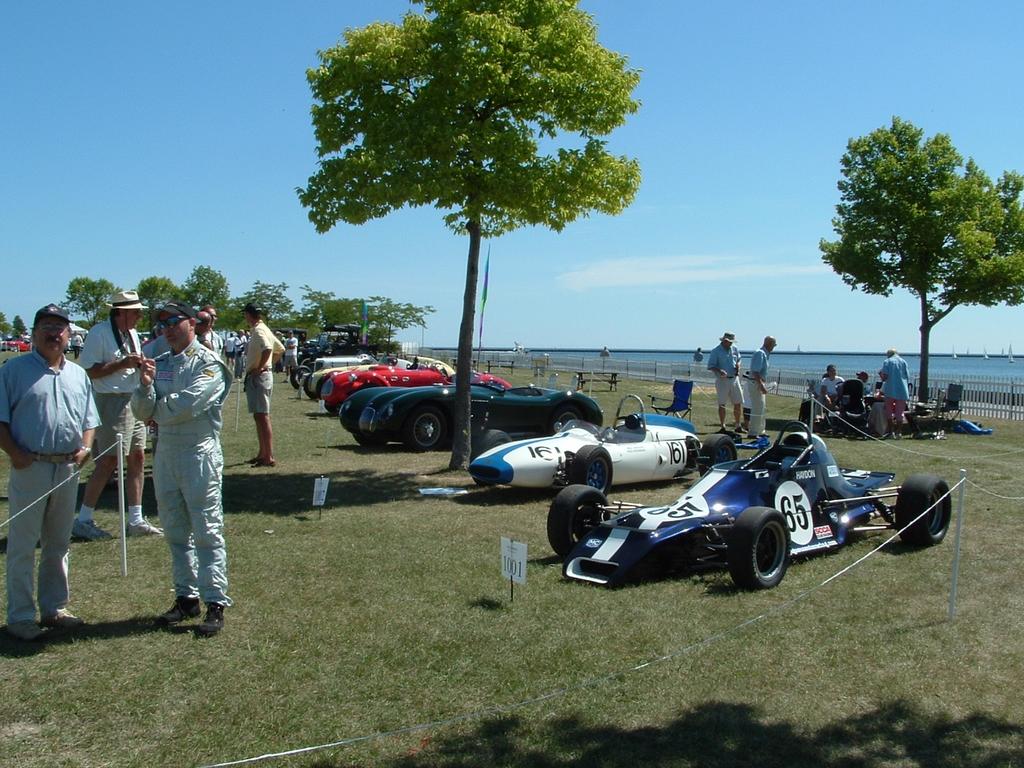 ster, 1937 Rolls Royce PIII Aero Coupe, and my father's 1932 Packard Coupe Roadster), some great early cars (1902 Curved Dash Oldsmobile, 1926 Stanley "steamer", and a 1905 one-cylinder Cadillac), and competition cars, including my car. The show was carefully planned and staged so that the cars were displayed in groups emphasizing their similarities: finned cars were in a circle with the fins pointing outwards; roadsters were in a circle with the tops down; and competition cars were in a row from oldest (1927 Bugatti Grand Prix car) to newest (1979 Tiga Formula Ford). Proceeds from the show benefitted Jewish Family Services, who are eager to team up for a repeat next year.
Labor Day weekend was unusual for me, to say the least. Races were being held at two tracks in Michigan: Midwestern Council ran at GingerMan in South Haven on Saturday, and SCCA ran two Regional races (Saturday and Sunday) at Grattan near Grand Rapids. I decided that going all the way to Michigan would make more sense if I ran both days. I wanted to get the points for Midwestern Council, and I needed to run more SCCA races to keep that license current. Since the tracks are roughly an hour or two apart, getting a hotel midway between them made sense. The Best Western in Holland turned out to be a great choice. Clean and quiet, with a jaccuzzi tub in the room! Very swank.
Saturday looked like it was going to be uneventful, but looks can deceive. I was the only Club Formula Ford entered, so all I needed to do was finish the race to get a win. I qualified in the thick of the usual group: Dave Knaack's D Sports Racer qualified in front of me, Frank Riemann's FF would be next to me, and Chuck Cassaro's Sports 2000 qualified behind me. When I checked over the car after qualifying, I found that the rear wheel hubs were loose again. I wasn't too concerned, since I know it's due to the relatively soft Brazilian hubs compressing and mushrooming due to the cornering forces that they were never designed for. All I'd have to do would be to retorque the axle nuts and I'd be ready to cruise to an easy win.
Someone once said, "Nothing easy is ever worthwhile." Maybe this was proof that what I'm doing is worthwhile, but when I tried to tighten the right rear axle nut, the threads stripped out of the nut. Bad timing. I don't carry a spare nut (but I will now), and I had about an hour and a half to get the car fixed for the race. I went through the paddock looking for anyone likely to have something to fit. It's an old VW Beetle part, so I checked with some VW Rabbit racers, Porsche drivers, and even the FV brigade, but no luck. As I returned to the Lindstrand Motorsports tent, Nicole Temple told me that a friend of theirs knew a local guy... He had one, but he was 45 minutes away, and the race was in an hour.
A couple of phone calls later, Patrick Ohmann arranged to meet Rob Ritt of Epicenter Design halfway between the track and his shop in Holland. As he sped off, I finished preparing the car and began arranging the details to get the car together and on the track as quickly as possible. Pat would install the new nut as I belted in the car, Nicole Temple from LMI would install the wheel, my roommate David Cox would lower the jack while Amy would take care of the jumpstart battery. All we needed now was the nut. While I waited for Pat and watched the minutes tick away, I mentally prepared myself to start from the pit lane after the other cars had taken the green flag, then just get the required number of laps to be considered a finisher. That was all I needed to do.
As the announcement came over the PA system that the grid for our race was closed*, Pat came running up to me with the new nut in his hand. I jumped in the car and held the brake pedal down as he tightened the nut as much as he dared. As I belted myself in, Nicole got the wheel on quicker than I've ever been able to do, and as I felt the car being lowered off the jack I hit the starter. The engine eagerly barked to life. I got the thumbs-up from Amy and drove toward the grid.
The grid configuration at GingerMan is a little odd. Due to a one-way lane, we had to drive the wrong way down the grid between the lines of cars, turn around, and then join the lineup. When I turned the corner to drive down between the cars, the crews for all the other cars pointed at me in disbelief and began applauding and cheering as though I had already won the race. It's amazing how much the other racers pull for you, even if they're trying to beat you on the track.
Since I was late to the grid, I started from the back. My plan was to just get the required laps, take it easy, get my finish, and pull in. But I don't know a racer who is able to keep his foot off the throttle when the green flag flies. Seeing a slower car disappear in your mirror is just too inspiring. When I got past the first car, I couldn't help trying to pass the next... then the next... I think I passed a car each lap for the first half of the race. I chased down all the cars gridded behind me and actually improved my finishing position by one spot.
We packed up the truck and loaded the trailer after the race to get back to the hotel for the night. I soaked in the jaccuzzi for a while until my throat started to burn a little, which I figured was due to breathing in all of the hot chlorinated water vaporizing all around me. When I woke up Sunday morning, I realized that it was really the start of a cold. There wasn't much I could do about it then except get some hot cider and oatmeal at the hotel's continental breakfast and hit the road to Grattan.
We got to Grattan right on time, got through Registration and Tech without any delays or difficulties, and found a great paddock spot without even looking. After we got the car unloaded I realized that I would have plenty of time to change the gears to suit the longer track. I got the gear change done in record time with Amy's help -- despite a boneheaded error on my part that cost me about 15 extra minutes -- and waited for the morning qualifying session.
Qualifying went well enough, but I didn't set the world on fire. I only needed to finish the race to fulfill the renewal requirements for my SCCA license, but I enjoy Grattan too much not to drive hard. Once I managed to match my best time from May, I cut my session short by a few minutes and pulled in, hoping to save the engine and tires a bit. I was sent to Impound for a spot-check, and I rolled across the scales at 1191 pounds. I had a few more gallons of fuel than I would at the end of a race, so it sounded accurate to me. I returned to my paddock space and began the nut-and-bolt check for the afternoon's race.
I finished two items on the list and started to feel dizzy and exhausted. I realized that the cold was catching up to me, and it was not going down without a fight. I wrapped up in a blanket and a fleece sweatshirt and sat in the sun, shivering for about an hour. I actually felt much better after that little rest, so I set about finishing the preparations for the race. Everything was in order... except the exhaust header pipe from the #1 cylinder had a big crack in the tubing.
The exhaust header's primary job is to direct hot exhaust gasses out of the engine, away from things that need to be kept cool, and eventually out the back of the car via the tailpipe. It also plays a rather significant role in the performance of the engine. The correct length header tubes can work together, harmonizing the exhaust pulses and increasing the power output of the engine. A less appreciated duty of the exhaust header is to prevent cold outside air from coming in contact with the hot exhaust valves. If the header breaks, cold air can suddenly rush in, potentially cracking or bending the exhaust valve. If you've ever dunked a cold glass in steaming hot wash water, you have experienced this same kind of thermal shock: the glass breaks because of the extremely quick change of temperature.
I really like this cylinder head, and I don't want anything to happen to it. Pushing the car hard, especially on the undulating Grattan circuit, would almost certainly cause the cracked header to break. I had to drive as easily as possible, minimizing the bumps and jumps that make Grattan so much fun. I also had to go easy on the throttle, since pushing the engine too hard could also make the crack develop into a full fracture.
We watched the start of the first race group, and I noticed that they were taking a pace lap and a half. The false grid at Grattan enters the track at corner 3. The pace lap would take the field out onto the track at corner 3, make the rest of that lap, cross the start/finish line, then make another full lap before the green flag. I realized that was 4 miles of driving I didn't need to put on the car, so I spoke to the starters about starting from the pit lane after the green flag. I explained that the header was cracked and that I was feeling under the weather, and they were very nice and supportive -- "No problem, we'll take care of it," "Remember, you only need 8 laps to get a finish," "Good luck, hope it holds together," "Feel better!" I already felt better after talking to them.
While puttering around at 4000 rpm, I learned a few things. First, I learned that if I drive down the front straight at 4000 rpm instead of 7000 rpm, I can brake at my usual turn-in point and still make it through corner 1. I learned that there is so much used rubber off the racing line that if you drive down the front straight off the line and then try to carry some speed through corner 1, you get the feeling that you're driving through some kind of weird rubber storm with all the bits of rubber being thrown up by your tires. I also learned that if you drive ten laps at Grattan off the normal line, you gain about 5 pounds of used rubber.
I pulled in after 10 laps and went to Impound. Since there was only one other CFF there, I would get credit for a second place finish. The Impound workers gave me a cold washcloth and two bottles of water and insisted that I stay on the scales in the shade until the other cars were done racing.
The scoreboard for MC looks the same as it did before, but add 25 more points to my total. And it only cost one knee (Amy's -- injured on the trailer before we had gone one block), one nasty wasp sting (Amy again), one 1" strip of skin off my pinky finger (another boneheaded move during the gearchange), and one nasty head cold.
Next up: Showing off the car again, this time at a British car show in Palos Hills, IL on Sunday.
*The grid "closes" five minutes before the start of the race. If a car gets to the grid after the grid is closed, that car must start at the back of the pack.
Monday, August 22, 2005
The Racetrack at the End of the Universe
I confess, I didn't get the joke until I saw the graphics on Pete Wood's car: "Arthur Dent" and "Ford Prefect" on the sides... and then he wore a bathrobe to the drivers' meeting. Too bad nobody else got the joke even after that. The title of the race was a play on the title of a book in a series that enjoyed a cult following in the '80s. The central character, Arthur Dent, is a normal Englishman who finds himself a passenger on a spaceship with his new friend Ford Prefect while wearing his bathrobe. Or something like that. I've only read the first book in the series, and it's been a long time since I read that one. (Pete has even run car number 42 for years, which will mean something to those who have read the book.)
We were the fifth group to hit the track, which left plenty of time for worrying and second-guessing about the repairs we had just completed. I did my best to stay calm and rational while I waited for our group to be called to the grid. The car was ready, and I had to trust that we had done everything correctly.
Practice went very well despite some oil on the track in a couple of corners. I managed to keep up with a yellow and blue Sports 2000 -- a much faster car* -- for several laps, which shocked me... until I found out that it was being driven by a racer who had never driven a mid-engined, right-hand-drive car. He is used to the front-engine V8 sedans that he's raced for years, and he was busy learning that the techniques are very different.
Debbie Campbell, a co-worker at Pegasus Auto Racing Supplies, arrived after practice with her parents, who had never been to Blackhawk before. Her father and I chatted about racing while she and her mother chatted with my mother about dogs. Debbie used to show dogs all over the country, and my mother is a dog training instructor, so they had plenty to talk about.
For qualifying I asked my parents to once again time Pete while I monitored my own times on my on-board lap timer. The best number I saw on the pit board was 1:20, while my fastest qualifying time was a 1:18.89. I knew I had turned a few laps in the :19s, so I was confident that I had the pole. The grid sheet confirmed it: I turned a 1:18.89, and Pete's best was a 1:20.26.
Between the qualifying session and the race, there is generally enough time to give the car a thorough inspection and repair most problems that may show up. The between-session checklist includes such things as bleeding the brakes, checking the wheel bearings and rod ends, and retightening any fasteners that may have worked loose. Everything was pretty much normal, with the same old bolts working themselves loose, everything else staying tight as usual, but the right rear hub was suddenly loose. The hub I've been using is a modified VW piece that just doesn't seem to be holding up too well to the stresses of racing. Oh well... take off the wheel, remove the cotter pin, have Dad hold the brakes, torque the axle nut down again, new cotter pin, wheel back on... wow, that's a lot easier and quicker with two people! When it's a one-person operation, you jack up the car, remove the wheel, remove the cotter pin, put the wheel back on, lower the car, somehow stop the wheel from turning -- usually by locking the transmission in two gears at once (a big job on its own) -- tighten the nut, unlock the transmission, jack up the car, take off the wheel, put in a fresh pin, wheel back on, car back down...
The car was ready in plenty of time for the race. I had enough time to watch a couple of other groups race, including the Formula Vee / Spec Racer group, where I used to run. The polesitting Vee, driven by Hal Adkins, spun or got hit on the first lap. By the time the pack went through corner 4, he was at least 15 seconds behind the back of the pack. He drove like a madman, gaining huge chunks of time every lap. Within about 10 laps, he had regained the lead. I confess that Hal is one reason I got out of FV. I realized that I would probably never be able to beat him, at least not with the car I had. I still joke with him that I had to move up a class to have any chance to keep up with him.
We gridded for our race and waited in the cars for ten or fifteen minutes while the safety crews cleaned up after the group before ours. I don't know what it was about this weekend, but every single group -- including ours -- had an incident (or multiple incidents), stranded cars, or blown engines that needed to be cleaned up and cleared away before the next group could hit the track. It was unusual to say the least, and it got us so far off schedule that the last three races had to be shortened by five minutes each and victory laps were cancelled.
I gridded directly behind the yellow and blue Sports 2000 I had followed in practice, and Pete lined up next to me. I was a little concerned that the driver in front of me still wouldn't be familiar enough with the gearbox and might miss a shift on the start. That would give Pete a clear advantage of several car lengths at best -- a good reason for Pete to hope for it. I got lucky, and everyone in front of us got away cleanly. I got a slight edge on Pete and crowded him just a little bit exiting corner 1 to try to keep him behind me. As the race progressed, some cars fell off the track here and there. On the second lap, corner 6 was waving their yellow flag, indicating that there was something dangerous or someone vulnerable on the track or near the track. I slowed and tiptoed around the corner, looking for the incident that caused the flag... but I couldn't see anything out of the ordinary. The next lap, corner 6 still had their yellow flag out, but this time I saw a driver standing next to the track. Apparently he had spun exiting the corner and his car went into the weeds about 50 feet off the track. The car was completely hidden by the foliage, and it stayed there for the rest of the race.
My father was showing me the gap times between Pete and me on the pit board -- :03, :04, :06. About halfway through the race, the board showed :13... and my oil pressure gauge suddenly dropped! The rule of thumb for oil pressure is to have 10psi per 1000rpm. Since we spin the Formula Ford engines to 6000rpm, 60psi would be ideal, but most of us settle for 40psi. My car had 40psi all day, but suddenly it dropped to 20psi. Better than nothing, but it seemed to me that if it started dropping, it was likely to drop the rest of the way to zero. I tried everything I could to nurse the engine, keeping the revs as low as I could while still conserving speed. I don't know which would have been a more disappointing sight in my mirrors: Blue-white smoke indicating a blown motor, or the purple nose of Pete's car!
The car held together and the oil pressure didn't drop any farther. I finished about 10 seconds ahead of Pete and shut the car off as soon as I could. Now to diagnose just what happened and what we need to do about it...
The points now look like this:
* A Sports 2000 is a little hard to describe. Imagine a formula car, with a 2.0-liter Ford engine in the back, but with two seats and fiberglass fenders. The design of the fenders can make the car handle better than a Formula Ford, and the larger engine gives it better acceleration and top speed.
We were the fifth group to hit the track, which left plenty of time for worrying and second-guessing about the repairs we had just completed. I did my best to stay calm and rational while I waited for our group to be called to the grid. The car was ready, and I had to trust that we had done everything correctly.
Practice went very well despite some oil on the track in a couple of corners. I managed to keep up with a yellow and blue Sports 2000 -- a much faster car* -- for several laps, which shocked me... until I found out that it was being driven by a racer who had never driven a mid-engined, right-hand-drive car. He is used to the front-engine V8 sedans that he's raced for years, and he was busy learning that the techniques are very different.
Debbie Campbell, a co-worker at Pegasus Auto Racing Supplies, arrived after practice with her parents, who had never been to Blackhawk before. Her father and I chatted about racing while she and her mother chatted with my mother about dogs. Debbie used to show dogs all over the country, and my mother is a dog training instructor, so they had plenty to talk about.
For qualifying I asked my parents to once again time Pete while I monitored my own times on my on-board lap timer. The best number I saw on the pit board was 1:20, while my fastest qualifying time was a 1:18.89. I knew I had turned a few laps in the :19s, so I was confident that I had the pole. The grid sheet confirmed it: I turned a 1:18.89, and Pete's best was a 1:20.26.
Between the qualifying session and the race, there is generally enough time to give the car a thorough inspection and repair most problems that may show up. The between-session checklist includes such things as bleeding the brakes, checking the wheel bearings and rod ends, and retightening any fasteners that may have worked loose. Everything was pretty much normal, with the same old bolts working themselves loose, everything else staying tight as usual, but the right rear hub was suddenly loose. The hub I've been using is a modified VW piece that just doesn't seem to be holding up too well to the stresses of racing. Oh well... take off the wheel, remove the cotter pin, have Dad hold the brakes, torque the axle nut down again, new cotter pin, wheel back on... wow, that's a lot easier and quicker with two people! When it's a one-person operation, you jack up the car, remove the wheel, remove the cotter pin, put the wheel back on, lower the car, somehow stop the wheel from turning -- usually by locking the transmission in two gears at once (a big job on its own) -- tighten the nut, unlock the transmission, jack up the car, take off the wheel, put in a fresh pin, wheel back on, car back down...
The car was ready in plenty of time for the race. I had enough time to watch a couple of other groups race, including the Formula Vee / Spec Racer group, where I used to run. The polesitting Vee, driven by Hal Adkins, spun or got hit on the first lap. By the time the pack went through corner 4, he was at least 15 seconds behind the back of the pack. He drove like a madman, gaining huge chunks of time every lap. Within about 10 laps, he had regained the lead. I confess that Hal is one reason I got out of FV. I realized that I would probably never be able to beat him, at least not with the car I had. I still joke with him that I had to move up a class to have any chance to keep up with him.
We gridded for our race and waited in the cars for ten or fifteen minutes while the safety crews cleaned up after the group before ours. I don't know what it was about this weekend, but every single group -- including ours -- had an incident (or multiple incidents), stranded cars, or blown engines that needed to be cleaned up and cleared away before the next group could hit the track. It was unusual to say the least, and it got us so far off schedule that the last three races had to be shortened by five minutes each and victory laps were cancelled.
I gridded directly behind the yellow and blue Sports 2000 I had followed in practice, and Pete lined up next to me. I was a little concerned that the driver in front of me still wouldn't be familiar enough with the gearbox and might miss a shift on the start. That would give Pete a clear advantage of several car lengths at best -- a good reason for Pete to hope for it. I got lucky, and everyone in front of us got away cleanly. I got a slight edge on Pete and crowded him just a little bit exiting corner 1 to try to keep him behind me. As the race progressed, some cars fell off the track here and there. On the second lap, corner 6 was waving their yellow flag, indicating that there was something dangerous or someone vulnerable on the track or near the track. I slowed and tiptoed around the corner, looking for the incident that caused the flag... but I couldn't see anything out of the ordinary. The next lap, corner 6 still had their yellow flag out, but this time I saw a driver standing next to the track. Apparently he had spun exiting the corner and his car went into the weeds about 50 feet off the track. The car was completely hidden by the foliage, and it stayed there for the rest of the race.
My father was showing me the gap times between Pete and me on the pit board -- :03, :04, :06. About halfway through the race, the board showed :13... and my oil pressure gauge suddenly dropped! The rule of thumb for oil pressure is to have 10psi per 1000rpm. Since we spin the Formula Ford engines to 6000rpm, 60psi would be ideal, but most of us settle for 40psi. My car had 40psi all day, but suddenly it dropped to 20psi. Better than nothing, but it seemed to me that if it started dropping, it was likely to drop the rest of the way to zero. I tried everything I could to nurse the engine, keeping the revs as low as I could while still conserving speed. I don't know which would have been a more disappointing sight in my mirrors: Blue-white smoke indicating a blown motor, or the purple nose of Pete's car!
The car held together and the oil pressure didn't drop any farther. I finished about 10 seconds ahead of Pete and shut the car off as soon as I could. Now to diagnose just what happened and what we need to do about it...

The points now look like this:
- John Haydon: 150
- Pete Wood: 125
- Michael Schindlbeck: 69
- Denis Downs: 33
- Scott Reif: 33
- Larry Noble: 17
- Jon Borkowski: 16
- Paul Schindlbeck: 16
- Dick Plank: 13
- Bob Fleming: 8
Next stop: Milwaukee's lakefront, Veteran's Park, for the "Masterpiece Style & Speed Showcase" car show.
* A Sports 2000 is a little hard to describe. Imagine a formula car, with a 2.0-liter Ford engine in the back, but with two seats and fiberglass fenders. The design of the fenders can make the car handle better than a Formula Ford, and the larger engine gives it better acceleration and top speed.
Monday, August 08, 2005
East-West Challenge
In recent years, one question has been asked over and over at road races across the country: “Where have all the cars gone?” In the ‘70s and ‘80s, so many cars would show up to a race that some classes (Formula Ford among them) would have to be run as two separate groups because all the cars couldn’t fit on the track at once.
Something happened in the ‘80s and ‘90s, and nobody can pin down what it was. Maybe it was the “me” era, maybe it was the rising cost of racing, maybe it was the advent of VCRs and video games. Whatever the reason, race attendance dropped. Classes which once enjoyed 80-car fields now saw 10-car fields. Where were all the cars?
Steve Beeler, a Club Formula Ford racer from Michigan, realized several years ago that the cars still existed, but the owners just weren’t racing them. He asked around, and most people agreed that the reason they didn’t race was because there were so few cars racing. A depressing catch-22.
Steve began a concerted effort to promote several specific races within the SCCA Central Division. Since CenDiv is roughly divided by Lake Michigan, all drivers were either on the “East” team or the “West” team based on each driver’s hometown. Continuing the east/west theme, two of the four race weekends would take place east of the lake, and the other two would be on tracks west of the lake.
The “East-West Challenge” was an instant success. Companies pitched in with contingency awards, which attracted more drivers. Car counts were back up in the 20s and 30s, which was enough to convince most Regions to give the FF/CFF race its own group instead of mixing them with other classes. Over 70 drivers have raced in the series, with more joining every race.
My initial plan for the season was to run the East-West Challenge again this year with only a few Midwestern Council races mixed in. But as I said once before, a racing schedule is at best flexible, a mere suggestion of what may happen. After winning the first two MC races and breaking the car at the first EWC race, I decided to concentrate on the MC season. I still want to run at least one or two EWC weekends, including this weekend’s races at Road America. Since I have missed the first four rounds of the series, I won’t be trying quite so hard to finish in the points. I plan to hook up with someone – maybe Speedy Petey – and just race for the fun of it. It is impressive to see a pack of 30 Formula Fords, even from the back!
Something happened in the ‘80s and ‘90s, and nobody can pin down what it was. Maybe it was the “me” era, maybe it was the rising cost of racing, maybe it was the advent of VCRs and video games. Whatever the reason, race attendance dropped. Classes which once enjoyed 80-car fields now saw 10-car fields. Where were all the cars?
Steve Beeler, a Club Formula Ford racer from Michigan, realized several years ago that the cars still existed, but the owners just weren’t racing them. He asked around, and most people agreed that the reason they didn’t race was because there were so few cars racing. A depressing catch-22.
Steve began a concerted effort to promote several specific races within the SCCA Central Division. Since CenDiv is roughly divided by Lake Michigan, all drivers were either on the “East” team or the “West” team based on each driver’s hometown. Continuing the east/west theme, two of the four race weekends would take place east of the lake, and the other two would be on tracks west of the lake.
The “East-West Challenge” was an instant success. Companies pitched in with contingency awards, which attracted more drivers. Car counts were back up in the 20s and 30s, which was enough to convince most Regions to give the FF/CFF race its own group instead of mixing them with other classes. Over 70 drivers have raced in the series, with more joining every race.
My initial plan for the season was to run the East-West Challenge again this year with only a few Midwestern Council races mixed in. But as I said once before, a racing schedule is at best flexible, a mere suggestion of what may happen. After winning the first two MC races and breaking the car at the first EWC race, I decided to concentrate on the MC season. I still want to run at least one or two EWC weekends, including this weekend’s races at Road America. Since I have missed the first four rounds of the series, I won’t be trying quite so hard to finish in the points. I plan to hook up with someone – maybe Speedy Petey – and just race for the fun of it. It is impressive to see a pack of 30 Formula Fords, even from the back!
Subscribe to:
Posts (Atom)