Showing posts with label Grattan. Show all posts

Monday, June 02, 2008

Results, I've Had a Few

The first race weekend at Blackhawk in April was a two-day drivers' school followed by a Regional race on Sunday. Only one other CFF showed, and he qualified two spots behind me. I think he got caught up in traffic on the start because I didn't see him for most of the race. But around the halfway point, just when I was starting to curse myself for never actually getting around to exercising like I had planned, I noticed a distant speck in my mirror. The speck was getting closer, gaining a little on me every lap. After a few more laps I could see that it was a red car like the other CFF. I tried to calculate how many laps he would need to overtake me, and if there was any way I could hold him off long enough. At the start of the last lap, it was clear that it would be a close finish. I tried to put the other car out of my mind so I could concentrate on driving as well as I possibly could. Finally, coming into the last corner, he was close enough that I could see the car more clearly. It was not the other CFF, but Jeff Primm, a student of mine driving an FF. I had been coaching him throughout the day, and he was doing a great job of putting my advice into practice! We drag-raced to the finish, and he got me by a quarter of a second. The other CFF finished about 16 seconds behind me. But once again, the big story was Bruce Lindstrand. He test-drove a customer's 1998 Van Diemen FF, starting at the back of the pack after the green flag, and worked his way up to second overall, winning FF and lapping everyone up to 4th place.

On Memorial Day weekend, we went to Grattan for a double Regional. This weekend was the first two rounds of the 2008 East-West FF/CFF Challenge, but turnout was surprisingly light. Four FFs and 7 CFFs entered. I blame the long drive for my 5th place (8th overall) finish on Saturday. This weekend also had a little twist. Usually the race grid is determined by the fastest lap time turned during qualifying, but this time the Sunday morning qualifying session was a 7-lap sprint race, and the finishing order would determine the grid for the race. I managed to get a great start, passing two CFFs and lining up behind Bruce Lindstrand in the LMI Tiga (the car had stickier tires than are allowed in CFF, so he ran in FF). Steve Beeler in a Lola and Joe Marcinski in another Tiga were right behind me for a couple of laps, but when I failed to capitalize on a (rare) misstep by Lindstrand, Beeler took advantage of my error and passed us both. Lindstrand passed him back before Marcinski passed both me and Beeler for third. I finished 5th again, but that sprint was so much fun I didn't care. I was also testing a new video camera that weekend, and fortunately the one session I managed to make it work was the qualifying sprint.

The race was a bit weird. Beeler shot up the middle at the start and ran away with the two leaders. I tried to keep up with Marcinski but I couldn't keep up the pace and finally let him go. When I realized I had nobody to chase or to defend against, I slowed a little bit and just waited for the last lap. Suddenly, the last corner on the last lap was showing a waving yellow flag. I lifted off the throttle slightly in case I had to stop or avoid a spinning car, but when I crested the hill I saw Beeler coasting, out of gas. I put my foot down and passed him for 4th. In impound, I learned that Dave Harmison's Royale had overheated and dropped out after 3 laps, which would have given me 3rd place. But the results sheet showed Beeler in 3rd and me in 4th. I couldn't understand it. I had passed Beeler well before the flag stand, so why did the results show that he had crossed the finish line a full second before I had? Cindy Lindstrand investigated and was reminded that at Grattan, the finish line is actually about 100 yards before the starter's stand. Beeler had crossed the line before me. I only beat him to the starter's stand.

One quick turnaround later, and it was time for a double Regional at Road America. We had a fair group, with 23 cars total, but again only 2 CFFs. Alan Murray was having a hard time getting back in the groove in his Crossle, and he started the weekend in bad shape: registration mishaps, a late start (he got to the track just as we were about to start the qualifying session), and a misfire above 4000 rpm -- and that was all before lunch on Saturday, so he would start the race at the back of the grid. Saturday's qualifying session was tough. The track was wet in some places and dry in others. You could come full-bore up the front straight, through 1 and 3, then full-bore down the back straight, but the braking zone for corner 5 was wet. Tiptoe through 5, and you could blast up the hill for 6, full throttle through 7, plenty of traction in 8 and through the carousel -- but the track was wet from the Kink through corner 12. That's a very fast section, so losing traction there was a scary prospect. I managed to turn a 2:47, which was fast enough to grid 10th overall.
I spent most of the race trying to chase down Bill Bonow in an FST and Dan Johnson in an FF as they traded 7th place back and forth for several laps. Suddenly Johnson slowed, and as I passed him I could hear that his engine didn't sound right. Neither did mine, though. It sounded like a diesel truck was tailgating me, which either meant horribly misadjusted valves or a blown exhaust header gasket. I concentrated on chasing down Bonow, whittling down the gap until he also slowed and let me pass, which gave me 7th overall. Sunday's qualifying started off poorly. Murray was ahead of me, but we were stuck in a pack of cars for a few laps. Once traffic cleared, I passed Murray on the front straight and he followed me as I passed a F500 coming into corner 1. He stuck with me through corner 3 and fell back a bit coming into 5. I didn't see him again through the carousel, but I just assumed I had lost him (the Tiga is amazingly stable and quick through the carousel). The next lap, corner 4 was waving yellow. As I crested the hill, I could see two wreckers at the side of the track near the braking zone for 5... pulling Murray's Crossle off the wall. Fortunately, it looked a lot worse than it was. The car had a bent tie rod and four flat-spotted tires, but no other damage, and Alan was unhurt. He told me later he had just jumped on the brakes a little too hard, locking the wheels. Before he had a chance to react, the car was backwards in the wall. I gridded 12th for the race and spent the first few laps playing with Carl Middelegge in an FST. He would draft me on the straights (using my horsepower for a tow) and I would let him pass before the corner, because I knew he could corner much faster than I could. We repeated that trick until he had a solid lead over Bonow in the other FST, when he let me go. I tried to chase down Dan Johnson again, but his car was running much better than it had on Saturday. I cruised to a 6th overall and another win. While Carl and I were playing and trying to chase down the faster cars, I managed to beat my qualifying time by almost 3 seconds (2:39.9), getting me to within 2 seconds of my best time ever. And that's only 7 seconds off the track record. I think I can make that up just in the braking zone for corner 5.

Next stop: Blackhawk, July 12 & 13 for the "Firecracker" double Regional (rounds 3 & 4 of the East-West Challenge series)

Monday, May 15, 2006

Squish, squish, slide, slide

I think I'm almost getting back in the groove with this whole driving thing.

Last weekend was an SCCA National race at Grattan, Michigan. It was another rainy, soggy weekend. On the plus side, the high winds that whipped the area on Thursday had died down by Friday, leaving us with that kind of on again / off again rain that can't quite make up its mind if it wants to soak you with big drops or just annoy you with a fine mist.

The downside to that kind of weather (besides everything getting wet) is that it can be tough to decide which tires to run. Some big-budget teams will have dry tires, rain tires, and "intermediate" tires for just this kind of weather. Rain tires have deep grooves to channel a lot of water out from between the tire and the track, and the softer rubber gets sticky at a lower temperature than dry tires. The grooves on an intermediate tire are not as deep as on a rain tire, and the rubber compound is usually a little harder to deal with partially dry track conditions. If the track is not wet enough, full rain tires can easily overheat and fall apart. (On the other hand, my rain tires are several years old, so the rubber is harder than it used to be. I could probably run them on a completely dry track without overheating them, but I'm not keen to test that theory just yet.)

When we got to the track on Saturday morning, the rain had stopped long enough for us to think that dry tires might be the way to go, at least for the morning practice. (Before anyone calls me a bonehead, I would like to point out that more than half the cars in my group ran that session on dry tires. So at least I wasn't the only bonehead out there.)

For those who have never experienced it, let me explain that Grattan is a challenging track on a good day. If you or your car is not performing just right, it can be a nightmare. If the track is wet and your car has dry tires, it can teach you several new combinations of four-letter words. If it is possible for a car to slide in two different directions at once, it happened to me during that session. It was a struggle to get the lap times under two minutes, which was about 30 seconds slower than a mid-pack time in the dry, and maybe 20 seconds slower than a fast time in the wet.

I managed to keep the car on the track and pointing in approximately the right direction for the entire session. Before we had a chance to debate which tires to run for the afternoon qualifying session, someone reminded me of the old racing adage, "To finish first, you must first finish." More to the point, you don't earn any points by wrapping the car around a tree during qualifying. That translated to, "Put the rain tires on."

My brother Jim switched the tires in plenty of time for us to watch some other race groups trying to figure out the conditions. The on again / off again rain seemed to stop at the end of each session, only to start again halfway through the next, or vice versa. We were not the only ones struggling with the conditions.

The qualifying session was much less scary, but not much more comfortable. I ran about 10 laps, getting down to a 1:53 before calling it quits for the day. I had scared myself several times, and I felt that I wasn't learning anything more, so I pulled in before I had the chance to wreck the car. This season is all about finishes, not results. I qualified 5th of 6 in class, 15th of 16 overall. I only needed to hold that position during the race to score 5 more points and make the trip worthwhile.

Jim and I checked over the car and got everything ready for Sunday's race. One person can go through my "track" checklist in about an hour and a half, but having a helper makes it feel like about fifteen minutes, even if the helper only reads off the items on the list. When the helper is as much fun as Jim is, you're done before you know it. We packed everything up for the night and watched the last few qualifying sessions from the relative comfort of the truck.

Bruce Lindstrand invited us to walk the track with him after the last session of the day, and we jumped at the chance. I knew I would learn a lot from him, and Jim hadn't even seen the track in over 25 years. He was looking forward to testing his memory.

Bruce talked me through the spots where I had the biggest problems and reinforced the areas where I was doing things right. The single biggest gain was in the last corner heading onto the front straight. This is a fast left-hand corner that follows a blind right-hand corner and leads onto a straight that is over half a mile long. Losing speed in this corner means losing speed for the entire length of the front straight. I had been sliding the car along the inside line, tiptoeing along and waiting until the car was stable enough to feed on the throttle. Bruce pointed out that placing the car about two-thirds of the way farther to the outside of the corner would put me on some pavement with much more grip, allowing me to carry more speed through the corner as well as getting on the throttle earlier. That tip alone would cut three full seconds off my lap time during the race.

We got back to the hotel fairly early (single digits), took some hot showers, laid out our soggy clothes to dry, and fell asleep before we could even open a beer. Sunday's activities were scheduled to start later than Saturday did, so we slept in for an extra hour as well. I guess we had worked harder Friday and Saturday than we had thought.

Jim and I shared a laugh or two on the false grid before the race. The false grid is one place where good crew helpers can make a big difference to a driver. Many helpers don't realize that even amateur racers are under a lot of stress just before the race, with too many things to think about. Will the car finish the race? Should I hang back at the start to avoid being caught up in an incident? Was it a mistake not to replace that one bolt? Was I just imagining that noise during practice? Have we forgotten anything? Some of these helpers will talk at the driver about things not connected to the race. Whether they think that distracting the driver is helpful I do not know, but I do know that dealing with chatter about the legality of a car in another class, or complaints about the attitude of someone at a race two years ago, or opinions of someone else's family issues can be mentally exhausting.

A good helper will keep one eye on the grid workers and one eye on the driver. The only conversation will be about the car, the race, or just some random silliness to remind the driver not to take himself too seriously. My brother is definitely a good crew helper. He learned the serious part while crewing for my father in the '70s, but his sense of humor is beyond description. His explanation is that his brain simply makes bizarre connections, and that he is missing the filter that keeps most people from saying inappropriate or silly things out loud. Multiply that by the fact that he has a much quicker wit than almost anyone around him, and you might get some idea why my ribs hurt after spending a day with him.

Only a few cars spun during the race, and lucky me, I wasn't one of them. I tried Bruce's line through the last corner, gradually carrying more speed through the corner and giving it more throttle each lap. When I got down to a 1:50.02, I realized that I was catching the Formula Vee in front of me. But as I chased him during the next lap, I realized that I was overdriving the car and sliding too much. I had nothing to gain by passing him, so I eased off and held my position until the end of the race. Dan Faust, who had qualified third in Formula Ford, dropped out after 9 laps, which gave me 4th place and my first National race trophy.

This weekend's Formula Ford results:
1. Mark Davison, Swift DB-1
2. Russ Ruedisuelli, Van Diemen RF99-K
3. Bruce Lindstrand, Van Diemen RF92
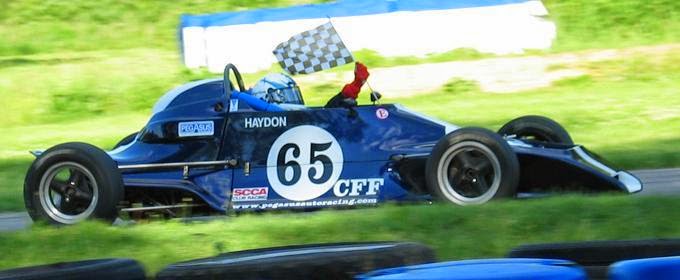
4. John Haydon, Tiga FFA-80
5. Lynn Serra, Crossle 50F
DNF Dan Faust, Van Diemen RF93

I was thrilled to find out that my fastest lap in the race was only just over two seconds slower than Bruce Lindstrand's fast time of 1:47.794. Davison and Ruedisuelli simply ran away from the rest of us. They probably have more experience at this track in the rain than I do in the dry. Not to say that they aren't good drivers -- when Mark lapped me for the second time, I tried to keep him in sight long enough to figure out his line through the back section of the course. I lost sight of him before I could even see the line he took through the corner where he had passed me. Those guys were flying, and I was happy to have finished only three laps behind them.

We got the car loaded in time to have some of Lindstrand's pasta e fagioli soup before hitting the road. Despite an error in the Mapquest directions, we made it to the Muskegon port over an hour before the ferry was due to leave. That gave us time to put on some dry socks (and in my case, a dry shirt, dry jeans, dry sweatshirt, and a dry coat) and review the weekend before boarding the ferry.

What did we learn this weekend?

  • The Lake Express Ferry is an excellent alternative to driving through Chicago.
  • When in doubt, put on the rain tires.
  • I have spent about half of my total driving time at Grattan steering into the slide.
  • Be careful what you say to a trapeze artist; she may be a high school principal.
Next stop: Blackhawk Farms, May 20-21, SCCA "Carl Mueller Memorial" National race. Hey, a little sunshine might be nice!

Wednesday, September 07, 2005

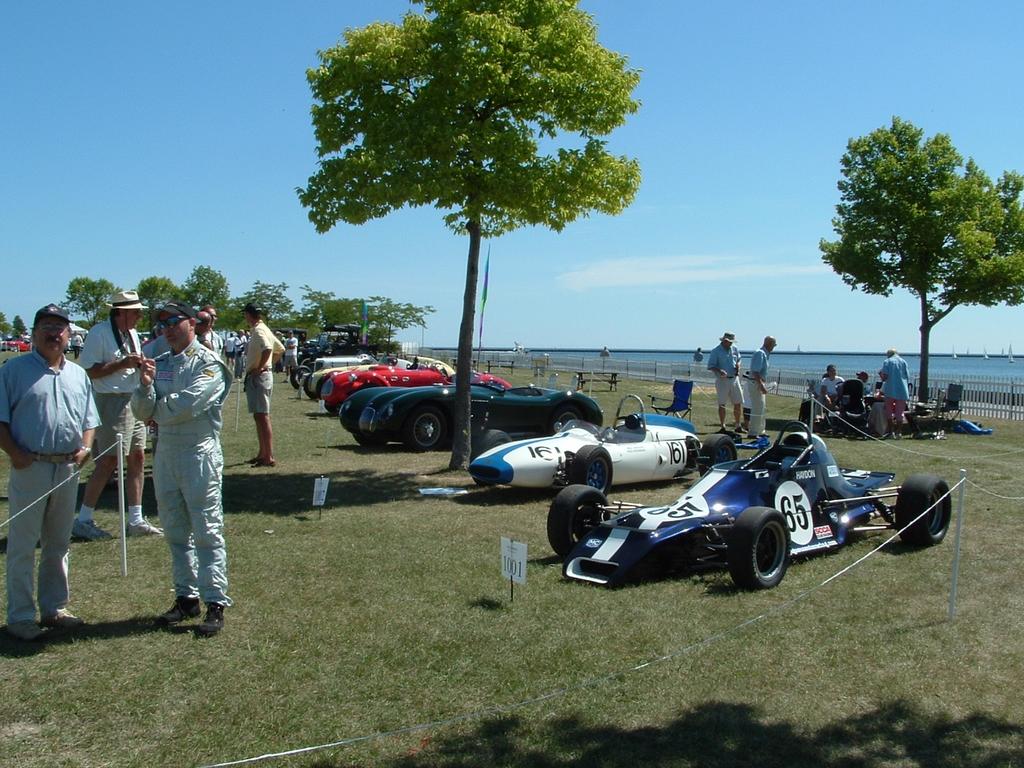
There has been plenty of action since the last update. August 28 was "The Masterpiece: Style & Speed Showcase" car show at Veteran's Park in Milwaukee. It was the first car show of its type in the area, with some spectacular cars (1931 Cadillac V-16 Coupe Roadster, 1937 Rolls Royce PIII Aero Coupe, and my father's 1932 Packard Coupe Roadster), some great early cars (1902 Curved Dash Oldsmobile, 1926 Stanley "steamer", and a 1905 one-cylinder Cadillac), and competition cars, including my car. The show was carefully planned and staged so that the cars were displayed in groups emphasizing their similarities: finned cars were in a circle with the fins pointing outwards; roadsters were in a circle with the tops down; and competition cars were in a row from oldest (1927 Bugatti Grand Prix car) to newest (1979 Tiga Formula Ford). Proceeds from the show benefitted Jewish Family Services, who are eager to team up for a repeat next year.

Labor Day weekend was unusual for me, to say the least. Races were being held at two tracks in Michigan: Midwestern Council ran at GingerMan in South Haven on Saturday, and SCCA ran two Regional races (Saturday and Sunday) at Grattan near Grand Rapids. I decided that going all the way to Michigan would make more sense if I ran both days. I wanted to get the points for Midwestern Council, and I needed to run more SCCA races to keep that license current. Since the tracks are roughly an hour or two apart, getting a hotel midway between them made sense. The Best Western in Holland turned out to be a great choice. Clean and quiet, with a jaccuzzi tub in the room! Very swank.

Saturday looked like it was going to be uneventful, but looks can deceive. I was the only Club Formula Ford entered, so all I needed to do was finish the race to get a win. I qualified in the thick of the usual group: Dave Knaack's D Sports Racer qualified in front of me, Frank Riemann's FF would be next to me, and Chuck Cassaro's Sports 2000 qualified behind me. When I checked over the car after qualifying, I found that the rear wheel hubs were loose again. I wasn't too concerned, since I know it's due to the relatively soft Brazilian hubs compressing and mushrooming due to the cornering forces that they were never designed for. All I'd have to do would be to retorque the axle nuts and I'd be ready to cruise to an easy win.

Someone once said, "Nothing easy is ever worthwhile." Maybe this was proof that what I'm doing is worthwhile, but when I tried to tighten the right rear axle nut, the threads stripped out of the nut. Bad timing. I don't carry a spare nut (but I will now), and I had about an hour and a half to get the car fixed for the race. I went through the paddock looking for anyone likely to have something to fit. It's an old VW Beetle part, so I checked with some VW Rabbit racers, Porsche drivers, and even the FV brigade, but no luck. As I returned to the Lindstrand Motorsports tent, Nicole Temple told me that a friend of theirs knew a local guy... He had one, but he was 45 minutes away, and the race was in an hour.

A couple of phone calls later, Patrick Ohmann arranged to meet Rob Ritt of Epicenter Design halfway between the track and his shop in Holland. As he sped off, I finished preparing the car and began arranging the details to get the car together and on the track as quickly as possible. Pat would install the new nut as I belted in the car, Nicole Temple from LMI would install the wheel, my roommate David Cox would lower the jack while Amy would take care of the jumpstart battery. All we needed now was the nut. While I waited for Pat and watched the minutes tick away, I mentally prepared myself to start from the pit lane after the other cars had taken the green flag, then just get the required number of laps to be considered a finisher. That was all I needed to do.

As the announcement came over the PA system that the grid for our race was closed*, Pat came running up to me with the new nut in his hand. I jumped in the car and held the brake pedal down as he tightened the nut as much as he dared. As I belted myself in, Nicole got the wheel on quicker than I've ever been able to do, and as I felt the car being lowered off the jack I hit the starter. The engine eagerly barked to life. I got the thumbs-up from Amy and drove toward the grid.

The grid configuration at GingerMan is a little odd. Due to a one-way lane, we had to drive the wrong way down the grid between the lines of cars, turn around, and then join the lineup. When I turned the corner to drive down between the cars, the crews for all the other cars pointed at me in disbelief and began applauding and cheering as though I had already won the race. It's amazing how much the other racers pull for you, even if they're trying to beat you on the track.

Since I was late to the grid, I started from the back. My plan was to just get the required laps, take it easy, get my finish, and pull in. But I don't know a racer who is able to keep his foot off the throttle when the green flag flies. Seeing a slower car disappear in your mirror is just too inspiring. When I got past the first car, I couldn't help trying to pass the next... then the next... I think I passed a car each lap for the first half of the race. I chased down all the cars gridded behind me and actually improved my finishing position by one spot.

We packed up the truck and loaded the trailer after the race to get back to the hotel for the night. I soaked in the jaccuzzi for a while until my throat started to burn a little, which I figured was due to breathing in all of the hot chlorinated water vaporizing all around me. When I woke up Sunday morning, I realized that it was really the start of a cold. There wasn't much I could do about it then except get some hot cider and oatmeal at the hotel's continental breakfast and hit the road to Grattan.

We got to Grattan right on time, got through Registration and Tech without any delays or difficulties, and found a great paddock spot without even looking. After we got the car unloaded I realized that I would have plenty of time to change the gears to suit the longer track. I got the gear change done in record time with Amy's help -- despite a boneheaded error on my part that cost me about 15 extra minutes -- and waited for the morning qualifying session.

Qualifying went well enough, but I didn't set the world on fire. I only needed to finish the race to fulfill the renewal requirements for my SCCA license, but I enjoy Grattan too much not to drive hard. Once I managed to match my best time from May, I cut my session short by a few minutes and pulled in, hoping to save the engine and tires a bit. I was sent to Impound for a spot-check, and I rolled across the scales at 1191 pounds. I had a few more gallons of fuel than I would at the end of a race, so it sounded accurate to me. I returned to my paddock space and began the nut-and-bolt check for the afternoon's race.

I finished two items on the list and started to feel dizzy and exhausted. I realized that the cold was catching up to me, and it was not going down without a fight. I wrapped up in a blanket and a fleece sweatshirt and sat in the sun, shivering for about an hour. I actually felt much better after that little rest, so I set about finishing the preparations for the race. Everything was in order... except the exhaust header pipe from the #1 cylinder had a big crack in the tubing.

The exhaust header's primary job is to direct hot exhaust gasses out of the engine, away from things that need to be kept cool, and eventually out the back of the car via the tailpipe. It also plays a rather significant role in the performance of the engine. The correct length header tubes can work together, harmonizing the exhaust pulses and increasing the power output of the engine. A less appreciated duty of the exhaust header is to prevent cold outside air from coming in contact with the hot exhaust valves. If the header breaks, cold air can suddenly rush in, potentially cracking or bending the exhaust valve. If you've ever dunked a cold glass in steaming hot wash water, you have experienced this same kind of thermal shock: the glass breaks because of the extremely quick change of temperature.

I really like this cylinder head, and I don't want anything to happen to it. Pushing the car hard, especially on the undulating Grattan circuit, would almost certainly cause the cracked header to break. I had to drive as easily as possible, minimizing the bumps and jumps that make Grattan so much fun. I also had to go easy on the throttle, since pushing the engine too hard could also make the crack develop into a full fracture.

We watched the start of the first race group, and I noticed that they were taking a pace lap and a half. The false grid at Grattan enters the track at corner 3. The pace lap would take the field out onto the track at corner 3, make the rest of that lap, cross the start/finish line, then make another full lap before the green flag. I realized that was 4 miles of driving I didn't need to put on the car, so I spoke to the starters about starting from the pit lane after the green flag. I explained that the header was cracked and that I was feeling under the weather, and they were very nice and supportive -- "No problem, we'll take care of it," "Remember, you only need 8 laps to get a finish," "Good luck, hope it holds together," "Feel better!" I already felt better after talking to them.

While puttering around at 4000 rpm, I learned a few things. First, I learned that if I drive down the front straight at 4000 rpm instead of 7000 rpm, I can brake at my usual turn-in point and still make it through corner 1. I learned that there is so much used rubber off the racing line that if you drive down the front straight off the line and then try to carry some speed through corner 1, you get the feeling that you're driving through some kind of weird rubber storm with all the bits of rubber being thrown up by your tires. I also learned that if you drive ten laps at Grattan off the normal line, you gain about 5 pounds of used rubber.

I pulled in after 10 laps and went to Impound. Since there was only one other CFF there, I would get credit for a second place finish. The Impound workers gave me a cold washcloth and two bottles of water and insisted that I stay on the scales in the shade until the other cars were done racing.

The scoreboard for MC looks the same as it did before, but add 25 more points to my total. And it only cost one knee (Amy's -- injured on the trailer before we had gone one block), one nasty wasp sting (Amy again), one 1" strip of skin off my pinky finger (another boneheaded move during the gearchange), and one nasty head cold.

Next up: Showing off the car again, this time at a British car show in Palos Hills, IL on Sunday.

*The grid "closes" five minutes before the start of the race. If a car gets to the grid after the grid is closed, that car must start at the back of the pack.