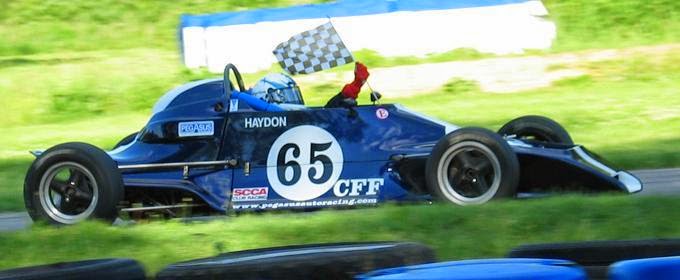
"It was the best of times, it was the worst of times."
-- Charles Dickens, A Tale of Two Cities
Well, no, it wasn't the worst of times by a long shot. More like, "it was the best of times, it was the wettest of times." It wasn't raining when I got to Blackhawk on Sunday morning, but a big storm had rolled through Saturday night, dumping enough water to break several canopies around the paddock (including one of mine) and to flood my paddock area. Everything I owned was wet, and before I could get anything sorted out, it started raining again.
It continued to rain -- hard -- during the first practice session. The track was underwater in a few spots, creating a new racing line that was less about finding traction and more about not drowning. I was happy to bring the car back in one piece, delighted that it was once again running perfectly, and surprised that I managed to get below a 2 minute lap time.
The rain eased up a bit for qualifying, so I was able to take a couple of seconds off of my practice time (still a 1:50, 11th on the grid). The car was running strong, but at one point when I opened the throttle, the exhaust note suddenly changed dramatically. It sounded a little like a blown exhaust header gasket, so I stayed out just long enough to ensure that I got enough laps to start the race.
When I pulled the engine cover, the gasket was still in one piece. The 4-year-old crack in the header looked worse, but there was still no evidence that it had cracked through. I started the engine again to try to find the leak, but there was nothing -- no visible smoke and no gas escaping anywhere -- just that weird noise that didn't sound so much like a header gasket after all. Luckily, Nicole Temple walked over from the Lindstrand Motorsports trailer just in time. She listened for just a few seconds, looked it over for a moment, and spotted the problem. One of the tabs which holds the exhaust collector to the header primary tubes had broken. The collector slipped off just enough to allow the #2 pipe to pop out, creating the bizarre, lumpy-cam-V8 racket. (Yes, she's better at this stuff than I am, but to be fair, she was standing on the other side of the car, so she could see the collector.)
The rain stopped soon after qualifying, and the sun came out. It was like a Christmas miracle. The flood waters began to recede, and we all changed from rain tires to dry tires, from clear and amber face shields to smoked and mirrored shields. Of course, just before the first call to grid, the sky clouded over again, and we all began to wonder if we had made a terrible miscalculation.
We hadn't. The rain held off, and the sun even peeked out a few more times during the afternoon. The track had drained somewhat before the start of our race, but it was still wet everywhere, and there were still puddles on the front straight. I got a great start, passing a CFF and an FC going into corner 1. Someone spun in either corner 2 or 5 (or both??), and cars went off both sides of the track. I picked my way through the group and found myself 4th overall! One of the cars still in front of me was Matt Lagessie (usually a big V8 sedan driver) in Jack Bartelt's Lola CFF. I caught up to him a few laps later, just in time for a front-row seat when he spun in corner 2. We narrowly missed each other as I passed, taking over the CFF lead. I tried to get some distance on him before he could recover.
The track conditions were tricky to say the least. It started out wet, but within 10 laps some of the corners were visibly drying. I worked on increasing my cornering speed in those corners, trying to take advantage of the increase in traction. The hard part was trying to keep from turning on "full dry" mode. Corners 2 and 5 and the dogleg between 3A and 4 are the last sections of the track to dry. Even when all of the other corners dry completely, you still have to take it easy through those areas. You're not driving a rain race, but you can't drive like it's a dry race either. It's hard to build a rhythm that way, and a lot of very fast drivers struggled with having to switch back and forth from corner to corner.
I ran as hard as I dared, trying a little harder each lap until I was at full dry speed in almost every corner. I managed to get down to a 1:19.14, just a second off of my best dry time. Soon I recognized the white Hawke of Mike Green in the distance ahead of me. Putting him a lap down would take a lot of pressure off of my pit stop. I turned up the heat a bit to catch up to him. Braking for corner 7, he briefly locked a wheel, and like a fool I started thinking that I had pressured him into a mistake... until I felt my own tires sliding, and I realized he had snookered me into a mistake! Fortunately I recovered from it -- and from the same mistake entering corner 1, and from another mistake in corner 2 (boy, was I getting greedy). The next time down the back straight, I was almost ready to set up for a pass, but he stayed to the right exiting the kink... and ducked into the pits. He later told me they had planned it that way. Clever, but he might have done better to drive defensively for another lap or two. He could have easily kept me behind him, maybe drawing me into a bigger mistake that I couldn't recover from.
"That Loooong Race" (yes, officially 4 "o"s) is a 100-mile race. Back in the day, the Formula Ford rules (at least in England, or someplace) actually specified that the fuel cell could be no larger than 5 gallons. Making some assumptions about fuel consumption, that means a Formula Ford has an expected range of about 30 minutes, which is about 50 miles at Blackhawk. In reality, I have had about 1 1/2 to 2 gallons left after a 30 minute race. The TLR rules allow auxilliary fuel tanks, but I've never come up with a design that I'd be proud of. I would need to stop for fuel too.
Of course, this isn't NASCAR or Formula 1 or CART. Our pit stops take a little longer. We don't have the high-dollar quick-refuelling rigs. We also don't have safety crews stationed up and down pit lane, so we have to be more cautious when it comes to refuelling. Our rules require the driver to be out of the car with the engine off, with a crew member standing by with a fire extinguisher. The person doing the fuelling is also required to wear so much safety equipment that it makes sense for the driver to do the actual fuelling.
With Mike in the pits, I drove as hard as I could to try to maximize the number of laps between us. I had told my crew to expect me around lap 30, so I waited for the right combination of traffic, lap number, and... something else, which I hadn't quite decided on yet. Soon enough, I got a sign. My water temperature gauge had reached 210 and was edging towards 220. I wasn't hot outside by any means (maybe high 60s), but I knew right away what the problem was. It's late fall in Illinois at a track with a thick canopy of trees. I noticed on the pace lap that corner 2 was covered in leaves, and of course I had scooped some huge amount of them into the radiator intake. It was only strange that it had taken 30 laps for it to run this hot.
I pulled into the pits for my fuel stop. Before I could get out of the car, Jack Bartelt had already cleaned the leaves out of the radiator intake for me. I dumped in the 2 gallons we had left in the fuel jug and got back in the car. I saw Matt and Mike both pass while I was buckling in, but were they already lapping me or just unlapping themselves? I asked my dad how long Mike had been in the pits, and I think he said that our stop was faster.
With the leaves out of the radiator, the track drying off, and fewer than 20 laps to go, I tried to drive like it was a sprint race. I tried to keep the lap times in the :19s, which was tough with so much traffic, both slower and faster. I have a new empathy for the drivers at LeMans, and the wide mix of cars and speeds they deal with. The fastest 5 cars in our group had fast lap times between 1:10 and 1:16; the slowest were between 1:29 and 1:35. The fastest car must have been passing the slowest car every 3 laps! And there I was in the middle, alternately lapping slower traffic and being lapped by faster cars.
I passed Matt in the Lola once more after my stop, getting back a lap I had lost during my pit stop. But how many laps he had already done was a mystery to me. Was he now behind me or still ahead of me? Were we on the same lap now?
As it turned out, we weren't. I forgot that Jack had constructed an auxiliary fuel tank for that car long ago, which meant that Matt didn't need to pit for fuel. I was only unlapping myself, but I still had another lap to make up before we would be on the same lap! He won CFF with 47 laps (finishing 5th overall), and I took second (9th overall) with 46 laps. I was catching him at a rate of about 4 seconds a lap, and at the end I was only about 20 seconds from getting back on the same lap as he was. But then I would have needed another 20 laps to make up the rest of that lap, which would have required another pit stop.
I am very proud of how I did, not just the finishing position and lap times, but I really felt like I drove better than I ever have. I was more confident under braking, I carried more speed through the corners, and my line took advantage of every bit of traction I could find.
Now if I could just start the 2011 season with a drive like that, we might really have something.
Showing posts with label Blackhawk. Show all posts
Showing posts with label Blackhawk. Show all posts
Monday, October 25, 2010


Monday, October 11, 2010
Back In It, Again
Yes, a year. It's been a year. And not a good one. Not racing hasn't helped.
Fortunately, I finally overcame my acute case of inertia and started working on racing things last month. The car was still in good shape from the last race in October 2009 (much better than I was). It was almost ready to go. Just a few issues needed to be addressed.
First, the restraints had expired at the end of last year. Even if they hadn't, they would have been too short to get around me (I'm twice the driver I once was), and the right shoulder strap had been rubbing on the fuel cell outlet fitting. The fraying was minimal, but it wouldn't make a tech inspector happy. Replacing the harness means removing the sidepods, which exposed Problem #1: The fire system tubing was broken. Way back in 2004, the fire bottle had broken out of its mount (since replaced with a stronger mount) and spent some unknown number of laps at Grattan -- plus the ride home from Grattan -- hanging by the tubing. The tubing managed to hold for a few years after, but the stress was finally too much. This gave me an opportunity to reroute the tubing a little more directly and securely, but it required a few pieces from the hardware store. Problem #2: The fuel cell fitting was still in the way of the shoulder strap. This was easy to solve. The fitting is offset on a round plate held in place by 6 screws. Unscrew, rotate the plate 2 positions (120 degrees), and the fitting is out of the way. Both of those jobs gave me a great sense of accomplishment, but also a real "duh" feeling -- why didn't I notice the easy solutions before they became problems?
Once the belts were in and the sidepods were back on, I changed the oil filter, put in fresh Red Line oil, and charged the battery. The car cranked eagerly and fired up pretty quickly. It sounded just as good as ever.
In the Sunday paper on September 26, I found out that the Classic Thunderbird Club of Wisconsin would be holding a car show at a Ford dealership just down the road from me to benefit Children's Hospital of Wisconsin. A good cause, at a Ford dealership, just a mile or two away -- how could I not go? Plus, I enjoy showing the car. Car shows are like very very low-stress race weekends. You get to take the car out and be around car people; you just don't have the stress (or enjoyment) of actually racing. The short tow also revealed two more problems that needed to be addressed. The trailer lights were only working at about 25% -- I had just one taillight and one brake light. And the trailer was making this weird "rongrongrongrong" noise going down the road. The bearings were toast. Rust, actually. The long, wet winter had corroded the bearings badly. It took a few days (and 5 trips to 3 different parts stores) to get the trailer rewired with new lights and to replace all of the bearings, but it was all done and ready to roll by midweek before the race.
The last problem standing in the way of me racing again was the small issue of a suit. Despite almost-daily exercise, I still couldn't fit into either of my driver's suits. Bruce Lindstrand offered to lend me his for the weekend, but since I really didn't know if it would fit, I decided to just buy a new suit. Yes, that's 3 now. But at least one of them fits me.
Like last year, this race was a 4-race weekend, with a qualifying session Saturday morning, two 8-lap sprint races Saturday, another 8-lap sprint on Sunday morning, and an 18-lap "feature" race Sunday afternoon. The lack of downtime worried me, but I figured that the short sprint races would be a good way to work myself back in.
I was right. For qualifying, I tried to find another car to follow (Formula Vees especially are a great car to warm up behind -- they're all about corner speed and smoothness; the relative lack of outright speed helps to calm the nerves and get you out of your own head), but I was all alone. The best lap I managed was a 1:24.5 -- not embarrassing, reasonable for the first session after a 363-day hiatus, and close to my weekend goal of a 1:21. That put me behind an F500, two FVs, and a Formula First, ahead of several other Vees and at least one Formula Ford, but separated from the other CFFs and FFs by those few VW engines.
I didn't realize how badly I had needed a car to follow during qualifying. I think it was the second lap of the race (the first chance I had to glance at my lap timer), I turned a 1:20, and it felt easier than the :24 I had done in qualifying. I passed the FVs and the FST, and settled in to follow the F500. He was fast on the straights but slower in some corners -- not all of them, but where it mattered to me: I got a good run out of corner 6 and passed him exiting the silo turn. My best lap time ended up being a 1:19.2 -- just half a second away from my best.
When I started the car for the second sprint race, something weird happened with my tachometer. It said the car was idling at 5000rpm. I knew that wasn't right (or helpful), so I switched the car off and tried again. Then I saw what had happened. On this brand, when you turn on the ignition, the needle goes backwards and bumps against a stop pin located between 0 and 8000, then it comes back to rest at zero. The little stop pin had fallen out, so the needle swung all the way around to 4000, then settled back at 5000. The second time I switched on, the needle swung to about 5000, then settled around 6000. A few more clicks on and off, and it came back to just a bit below zero. Close enough!
The grid for the second sprint race was set by finishing positions from the first race, so I had improved my starting position considerably. I was in front of the Vees and next to the F500, with the other CFFs in sight ahead of me. But a few fast cars DNF'ed in the first race, so they would start at the back. I forgot all about that part. Fortunately I hadn't moved over too far to let the yellow blur that was Dan Cobb's F500 squeeze between me and the pit wall on the start. That startled me enough that the other F500 next to me got ahead of me going into corner 1, but I passed him a few laps later in the silo turn again. With the tach reading inaccurately, it was tough to really push the car hard for fear of over-revving. I did discover that the shift light still worked, but I would have given anything for a rev limiter.
I was also using that session to scrub in a new set of tires, but for some reason I just couldn't break out of the 1:20s. Rolling through the scales at impound, I found the culprit. The wheels I chose for the new tires weigh some 30 pounds more than the other set I was using! That's 7 1/2 extra pounds of unsprung, rotating mass on each corner. I immediately felt better about my driving -- and worse about my equipment.
For several laps we were nose-to-tail, with Mike threatening Tom in a few corners. Mike and I pulled out to draft past Tom on the front straight, but we couldn't quite make it work. (Now I'm wondering if I should have kept trying -- I had to lift to stay behind Mike...) They pulled away from me a little bit by the end, but I was close enough to see that Tom spent the last lap on defense. He played it brilliantly, and so did Mike. Tom somehow made his car very very wide, but Mike kept looking for an opening and trying to force Tom into a mistake. The most brilliant part is that neither one pressed the point too hard, and they both finished in one piece. It was just exciting to watch. The 1:18.571 on my lap timer didn't hurt either. That beat my personal best by 0.137 second!
The only other problem of the weekend cropped up in impound. When I hit the starter button to drive back to my paddock spot, all I got was a "CLUNK". Something was wrong with the starter... or the relay... or the battery... I would call it unlucky except for one very important thing: All day Saturday, we pushed the car back from impound. Sunday morning, we were not directed to report to impound, but most of us went anyway. If I hadn't gone to impound, or if I hadn't decided to try to drive the car back, my first warning could have been when I tried to start the car on the grid for the feature. As it happened, the two starter mounting bolts both fell out, leaving the starter hanging by the power cable. The pinion gear end was just supported in the bellhousing. The pinion was just clear of the flywheel ring gear, and the positive terminal was just barely not touching the frame. That was the other lucky thing. Half an inch in either direction would have been disastrous: a shorted terminal would have burned out the starter at least; hitting the flywheel would have ground the ring gear off the flywheel (so replacing the starter wouldn't make a difference); a broken cable could have let the starter fall out on the track and really ruin someone's day. And then, I had just 2 of the correct size bolts in my spares. Maybe I should have packed up and gone home. I had certainly used up all of my luck for one day!
The feature race on Sunday afternoon was exciting, but for the wrong reasons. I got stuck in traffic a few laps in, so I didn't get close enough to see the CFF battle in front of me. Still, there was still plenty to keep my eyes occupied. The FST was stopped on the outside the silo turn, maybe after spinning. Corner 7 was yellow for an incident I couldn't spot. The next lap, I saw a rescue truck on the side of the track at 7, again for no apparent reason. Then I finally saw a flash of red deep in the weeds -- I couldn't identify the car, but someone had gotten stuck off-track. A few cars did some really amazing things (amazing in a bad way) in front of me. It seemed that every corner had a debris flag up at some point, and the yellow flags got quite a workout as well. A tailpipe was left sitting on track in front of the corner 6A station. But perhaps most importantly... I passed Tom Tipsword as he was limping his car back to the pits. He had blown a water hose in his battle with Mike, which gave Mike an easy win and me an unearned second place.
If you don't count the bruises, sore muscles, sore lungs, and pounding headache, I feel pretty good about the weekend.
Next stop: Mid-Ohio.
Fortunately, I finally overcame my acute case of inertia and started working on racing things last month. The car was still in good shape from the last race in October 2009 (much better than I was). It was almost ready to go. Just a few issues needed to be addressed.
First, the restraints had expired at the end of last year. Even if they hadn't, they would have been too short to get around me (I'm twice the driver I once was), and the right shoulder strap had been rubbing on the fuel cell outlet fitting. The fraying was minimal, but it wouldn't make a tech inspector happy. Replacing the harness means removing the sidepods, which exposed Problem #1: The fire system tubing was broken. Way back in 2004, the fire bottle had broken out of its mount (since replaced with a stronger mount) and spent some unknown number of laps at Grattan -- plus the ride home from Grattan -- hanging by the tubing. The tubing managed to hold for a few years after, but the stress was finally too much. This gave me an opportunity to reroute the tubing a little more directly and securely, but it required a few pieces from the hardware store. Problem #2: The fuel cell fitting was still in the way of the shoulder strap. This was easy to solve. The fitting is offset on a round plate held in place by 6 screws. Unscrew, rotate the plate 2 positions (120 degrees), and the fitting is out of the way. Both of those jobs gave me a great sense of accomplishment, but also a real "duh" feeling -- why didn't I notice the easy solutions before they became problems?
Once the belts were in and the sidepods were back on, I changed the oil filter, put in fresh Red Line oil, and charged the battery. The car cranked eagerly and fired up pretty quickly. It sounded just as good as ever.
In the Sunday paper on September 26, I found out that the Classic Thunderbird Club of Wisconsin would be holding a car show at a Ford dealership just down the road from me to benefit Children's Hospital of Wisconsin. A good cause, at a Ford dealership, just a mile or two away -- how could I not go? Plus, I enjoy showing the car. Car shows are like very very low-stress race weekends. You get to take the car out and be around car people; you just don't have the stress (or enjoyment) of actually racing. The short tow also revealed two more problems that needed to be addressed. The trailer lights were only working at about 25% -- I had just one taillight and one brake light. And the trailer was making this weird "rongrongrongrong" noise going down the road. The bearings were toast. Rust, actually. The long, wet winter had corroded the bearings badly. It took a few days (and 5 trips to 3 different parts stores) to get the trailer rewired with new lights and to replace all of the bearings, but it was all done and ready to roll by midweek before the race.
The last problem standing in the way of me racing again was the small issue of a suit. Despite almost-daily exercise, I still couldn't fit into either of my driver's suits. Bruce Lindstrand offered to lend me his for the weekend, but since I really didn't know if it would fit, I decided to just buy a new suit. Yes, that's 3 now. But at least one of them fits me.
Like last year, this race was a 4-race weekend, with a qualifying session Saturday morning, two 8-lap sprint races Saturday, another 8-lap sprint on Sunday morning, and an 18-lap "feature" race Sunday afternoon. The lack of downtime worried me, but I figured that the short sprint races would be a good way to work myself back in.
I was right. For qualifying, I tried to find another car to follow (Formula Vees especially are a great car to warm up behind -- they're all about corner speed and smoothness; the relative lack of outright speed helps to calm the nerves and get you out of your own head), but I was all alone. The best lap I managed was a 1:24.5 -- not embarrassing, reasonable for the first session after a 363-day hiatus, and close to my weekend goal of a 1:21. That put me behind an F500, two FVs, and a Formula First, ahead of several other Vees and at least one Formula Ford, but separated from the other CFFs and FFs by those few VW engines.
I didn't realize how badly I had needed a car to follow during qualifying. I think it was the second lap of the race (the first chance I had to glance at my lap timer), I turned a 1:20, and it felt easier than the :24 I had done in qualifying. I passed the FVs and the FST, and settled in to follow the F500. He was fast on the straights but slower in some corners -- not all of them, but where it mattered to me: I got a good run out of corner 6 and passed him exiting the silo turn. My best lap time ended up being a 1:19.2 -- just half a second away from my best.
When I started the car for the second sprint race, something weird happened with my tachometer. It said the car was idling at 5000rpm. I knew that wasn't right (or helpful), so I switched the car off and tried again. Then I saw what had happened. On this brand, when you turn on the ignition, the needle goes backwards and bumps against a stop pin located between 0 and 8000, then it comes back to rest at zero. The little stop pin had fallen out, so the needle swung all the way around to 4000, then settled back at 5000. The second time I switched on, the needle swung to about 5000, then settled around 6000. A few more clicks on and off, and it came back to just a bit below zero. Close enough!
The grid for the second sprint race was set by finishing positions from the first race, so I had improved my starting position considerably. I was in front of the Vees and next to the F500, with the other CFFs in sight ahead of me. But a few fast cars DNF'ed in the first race, so they would start at the back. I forgot all about that part. Fortunately I hadn't moved over too far to let the yellow blur that was Dan Cobb's F500 squeeze between me and the pit wall on the start. That startled me enough that the other F500 next to me got ahead of me going into corner 1, but I passed him a few laps later in the silo turn again. With the tach reading inaccurately, it was tough to really push the car hard for fear of over-revving. I did discover that the shift light still worked, but I would have given anything for a rev limiter.
I was also using that session to scrub in a new set of tires, but for some reason I just couldn't break out of the 1:20s. Rolling through the scales at impound, I found the culprit. The wheels I chose for the new tires weigh some 30 pounds more than the other set I was using! That's 7 1/2 extra pounds of unsprung, rotating mass on each corner. I immediately felt better about my driving -- and worse about my equipment.
For the first sprint on Sunday I was gridded with only one car between me and the other CFFs. When we lined up on the track, I was directly behind Mike Green in the Hawke, with Tom Tipsword's Van Diemen next to him and Alan Murray in Tom Stillwell's Swift FF next to me. I almost got Alan on the start, but by the end of lap 1 we were in grid order again: Tom, Mike, Alan, me. Tom had been running very fast times on Saturday, but he was getting balked by a slower car. meanwhile, Alan tried to pass Mike -- who wasn't having any of it -- and spun off in corner 3. I was close behind Mike, but I knew that we would never have a chance if we battled with each other, so I vowed to stay in 3rd and try to help Mike catch Tom.
 |
| Narrowly avoiding a 3-car pileup in corner 6 |
For several laps we were nose-to-tail, with Mike threatening Tom in a few corners. Mike and I pulled out to draft past Tom on the front straight, but we couldn't quite make it work. (Now I'm wondering if I should have kept trying -- I had to lift to stay behind Mike...) They pulled away from me a little bit by the end, but I was close enough to see that Tom spent the last lap on defense. He played it brilliantly, and so did Mike. Tom somehow made his car very very wide, but Mike kept looking for an opening and trying to force Tom into a mistake. The most brilliant part is that neither one pressed the point too hard, and they both finished in one piece. It was just exciting to watch. The 1:18.571 on my lap timer didn't hurt either. That beat my personal best by 0.137 second!
The only other problem of the weekend cropped up in impound. When I hit the starter button to drive back to my paddock spot, all I got was a "CLUNK". Something was wrong with the starter... or the relay... or the battery... I would call it unlucky except for one very important thing: All day Saturday, we pushed the car back from impound. Sunday morning, we were not directed to report to impound, but most of us went anyway. If I hadn't gone to impound, or if I hadn't decided to try to drive the car back, my first warning could have been when I tried to start the car on the grid for the feature. As it happened, the two starter mounting bolts both fell out, leaving the starter hanging by the power cable. The pinion gear end was just supported in the bellhousing. The pinion was just clear of the flywheel ring gear, and the positive terminal was just barely not touching the frame. That was the other lucky thing. Half an inch in either direction would have been disastrous: a shorted terminal would have burned out the starter at least; hitting the flywheel would have ground the ring gear off the flywheel (so replacing the starter wouldn't make a difference); a broken cable could have let the starter fall out on the track and really ruin someone's day. And then, I had just 2 of the correct size bolts in my spares. Maybe I should have packed up and gone home. I had certainly used up all of my luck for one day!
 |
| This is what it looks like when you have to work on the starter. |
The feature race on Sunday afternoon was exciting, but for the wrong reasons. I got stuck in traffic a few laps in, so I didn't get close enough to see the CFF battle in front of me. Still, there was still plenty to keep my eyes occupied. The FST was stopped on the outside the silo turn, maybe after spinning. Corner 7 was yellow for an incident I couldn't spot. The next lap, I saw a rescue truck on the side of the track at 7, again for no apparent reason. Then I finally saw a flash of red deep in the weeds -- I couldn't identify the car, but someone had gotten stuck off-track. A few cars did some really amazing things (amazing in a bad way) in front of me. It seemed that every corner had a debris flag up at some point, and the yellow flags got quite a workout as well. A tailpipe was left sitting on track in front of the corner 6A station. But perhaps most importantly... I passed Tom Tipsword as he was limping his car back to the pits. He had blown a water hose in his battle with Mike, which gave Mike an easy win and me an unearned second place.
If you don't count the bruises, sore muscles, sore lungs, and pounding headache, I feel pretty good about the weekend.
Next stop: Mid-Ohio.
Wednesday, October 21, 2009
Is that 4, or is that 5?
For the Fall Sprints, the last CenDiv Regional race of the season, Chicago Region decided to spice things up a bit. Instead of a single race spread out over two days, or 2 races (one race each day), they put together a 4-race schedule. The first three races would be 8-lap sprint races, with each race setting the grid for the following race. The last race would be an 18-lap "feature" race. The feature race would be the only one that counted towards the Regional championship, but each of the four races would count towards a "weekend" championship.
 When we got to Blackhawk Farms Raceway Saturday morning, a layer of frost covered everything (sound familiar?) and the track was a little wet, but the sun was peeking out from behind the clouds. The morning qualifying session was difficult because the cold weather made for some great horsepower, but it also took away a lot of traction. On top of that, the track was wet in several spots, including the front straight. Any heat that built up in the tires would be rinsed away before corner 1, which made braking dicey. I got a little spooked after locking the brakes a few times. That plagued me for the rest of the weekend, and I braked too early every lap. Still, the lap times were promising for such challenging conditions. 1:31, 1:27, 1:28, 1:26... then a 1:24.6 on the last lap! That last lap was good enough to catapult me to the CFF pole. (Mike Green had tried using tire warmers before the session. He warmed the tires up to 170 degrees before going out. When he came back, the tires were all at 80 degrees.)
 With Johnson out, that put me on the front row. We went out for the pace lap(s) and we all proceeded to toss the cars back and forth, trying to scrub some heat into the tread. Back and forth, back and forth... but as we exited corner 5, I realized just how tired I was. My arms were completely exhausted! I didn't know how I could make it through a second pace lap, much less 18 race laps.
I was looking forward to the quick sprint races, but not to the weather. Friday (towing day) was cold and rainy all day, and the forecast for the weekend called for highs in the 40s and overnight lows below freezing. I pulled out the long underwear, gloves, and winter coats.
 When we got to Blackhawk Farms Raceway Saturday morning, a layer of frost covered everything (sound familiar?) and the track was a little wet, but the sun was peeking out from behind the clouds. The morning qualifying session was difficult because the cold weather made for some great horsepower, but it also took away a lot of traction. On top of that, the track was wet in several spots, including the front straight. Any heat that built up in the tires would be rinsed away before corner 1, which made braking dicey. I got a little spooked after locking the brakes a few times. That plagued me for the rest of the weekend, and I braked too early every lap. Still, the lap times were promising for such challenging conditions. 1:31, 1:27, 1:28, 1:26... then a 1:24.6 on the last lap! That last lap was good enough to catapult me to the CFF pole. (Mike Green had tried using tire warmers before the session. He warmed the tires up to 170 degrees before going out. When he came back, the tires were all at 80 degrees.)
Sprint 1 Grid (top 10):
FF 22 John Spinello 1:21.6
FF 38 Dan Johnson 1:22.1
FF 10 Steve Barkley 1:23.8
CFF 65 John Haydon 1:24.6
CFF 7 Mike Green 1:25.3
FV 88 Hal Adkins
FV 19 Matt King
FF 49 John Luxon
FV 70 Daniel Eick
CFF 15 Bruce Drenth
When the green flag came out for Sprint 1, I got a jump on Mike and took a defensive line into corner 1. He tucked in behind me, but somehow I carried more speed and managed to open up a comfortable gap before corner 3. When I stopped watching my mirrors, I realized that I was close enough to the three lead FFs that I was in a good position to challenge Spinello for 3rd overall! Just as I was trying to talk myself into settling for 4th overall and the class win, Spinello dropped out. A lap later, William Cobb in a F500 passed me for 3rd overall. I would have liked to finish higher overall, but as my dad said later, "You won your class, and you can't get any firster than first!"
Many of us (including me) had assumed that the finishing order from each sprint would set the grid for the next race. We were a little surprised to learn that the grid would actually be set by fast lap time during the race, not by finishing position. Clever -- but it cost me a grid spot! While I settled in and cruised to the finish, Mike had actually turned a faster lap trying to chase me down. Touche'.
Sprint 2 Grid (top 7):
F500 28 Cobb 1:17.9*
FF 38 Johnson 1:18.6
FF 10 Barkley 1:18.9
FF 22 Spinello 1:21.5
CFF 7 Green 1:22.3
CFF 65 John Haydon 1:22.5
FF 49 Luxon 1:22.8
*Cobb did not go out for the morning qualifying session. He started Sprint 1 at the back of the grid and worked his way up to 3rd overall, setting fast lap of the race in the process.
When I saw the results from Sprint 1 and the grid for Sprint 2, it struck me how well I was  keeping up with the FFs. These cars usually run soft-compound tires, which offer better traction than the hard spec tires that CFFs run. Then it dawned on me: The FFs couldn't get an advantage because the cold weather prevented their tires from getting warm enough to be effective. (Cold? It snowed during the lunch break!) The CFF hard tires, on the other hand, never get very sticky, so their behavior in the cold is about the same as it is on a hot day. Another thing working to my advantage is the fact that I have spent the majority of my racing career on old, used tires which have very little stickiness left. For the first several years, I actually raced on street tires. I'm not used to relying on sticky tires.
 keeping up with the FFs. These cars usually run soft-compound tires, which offer better traction than the hard spec tires that CFFs run. Then it dawned on me: The FFs couldn't get an advantage because the cold weather prevented their tires from getting warm enough to be effective. (Cold? It snowed during the lunch break!) The CFF hard tires, on the other hand, never get very sticky, so their behavior in the cold is about the same as it is on a hot day. Another thing working to my advantage is the fact that I have spent the majority of my racing career on old, used tires which have very little stickiness left. For the first several years, I actually raced on street tires. I'm not used to relying on sticky tires.
 Before Sprint 2 started, Dan Johnson told me that he had one shock absorber that had failed. I was a little surprised that he decided not to run in Sprint 2 (he had set the fastest FF time with the failed shock, after all) and at least set a time so he wouldn't have to chase from the back in Sprint 3. But he decided to try to locate a replacement shock, probably because he would only have to set a good lap time in Sprint 3 (not finish well) to grid well for the feature.
When Dan didn't show to the grid, that put me one row behind Mike. He got a good jump on me and led me for the first 3 laps. I stayed on his tail to try to find an advantage. Finally I got a good run coming out of corner 6 and managed to get in front of him before corner 7. I wasn't able to catch the leaders this time, but I got down to a 1:21.5 and once again settled in for a 4th overall finish and another class win.
Sprint 3 Grid (top 8):
F500 28 Cobb 1:16.9
FF 22 Spinello 1:18.6
FF 10 Barkley 1: 19.0
FF 49 Luxon 1:20.4
CFF 65 John Haydon 1:21.5
FV 81 Bertolucci 1:22.1
CFF 7 Green 1:22.5*
CFF 15 Drenth 1:22.5*
*Green's and Drenth's fast lap times matched to 0.001 second. They were actually gridded by their second-fastest lap times, which differed by 0.041 seconds.
Sunday morning dawned just as cold and frosty as Saturday. It was so cold, the Stewards decided that we should have two pace laps for each race, so we could have more of a chance to warm up engines and tires. That was a good decision, in my opinion. I even came up with a plan: The first lap would be spent warming the engine and tires; the second lap would be just for warming the left front tire and the brakes -- in anticipation of the right-hand corner 1.
When we gridded for Sprint 3, we were surprised to watch Cobb take the pole position and then drive back to his paddock spot. I'm not sure what happened there, but I'm assuming the cold was making his car misbehave. Which is odd, considering that F500s have snowmobile engines. That meant that the fastest car in the group would start the feature race at the back. Meanwhile, Johnson had found a new shock and was ready to start Sprint 3 from the back.
Once again the race start worked out in my favor. I accelerated away, but Green got balked by another car going into corner 1. That let me open up a comfortable lead on Green before the end of the first lap. Meanwhile, Johnson had made his way through the pack. He passed me in corner 1 on the second lap and passed Spinello soon after. He challenged Barkley for the overall lead, pulling out to pass in several corners, but he wasn't confident that he could make the pass, so he backed out and pulled back in line at the last moment. That dicing was slowing Barkley down enough that I caught up to the lead pack within a couple of laps, and three laps in a row I watched Johnson try to pass in corner 7, only to back out and concede the corner. Finally, he decided that he would make the pass, even if it meant forcing Barkley to back out. He pulled out to pass Barkley going into corner 7 again and tried to outbrake him. Unfortunately, he miscalculated and the car began a slow spin onto the grass on the inside of the corner. Spinello and I both saw this and backed off to let things unfold before we got to the corner. Johnson slid sideways through the grass, hit the curbing at the inside edge of the track... and his car barrel-rolled onto the track, sliding upside-down across the corner exit. Barkley came to a full stop to avoid him, but Spinello and I were both able to sneak around the mess, passing Barkley in the process.
Actually, I didn't quite make it. Barkley got going again just as I was next to him. He looked over and recognized that I wasn't in his class, so he was ready to let me go. Then he realized that Spinello was also in front of him, so he put his foot down to try to get the lead back. Unfortunately for him, this was the last lap and he didn't have enough time left to chase him down. I finished 3rd overall and got another class win.
Feature Race Grid (top 6):
FF 22 Spinello 1:23.1
FF 38 Johnson 1:23.5
CFF 65 John Haydon 1:23.8
FF 10 Barkley 1:23.8
CFF 7 Green 1:24.7
FF 49 Luxon 1:25.6
 With Johnson out, that put me on the front row. We went out for the pace lap(s) and we all proceeded to toss the cars back and forth, trying to scrub some heat into the tread. Back and forth, back and forth... but as we exited corner 5, I realized just how tired I was. My arms were completely exhausted! I didn't know how I could make it through a second pace lap, much less 18 race laps.
 Thank goodness for adrenaline. The green flag flew and Spinello and I dashed for corner 1. Luxon and Cobb both passed Green on the first lap, giving me a bit of a gap. Barkley passed me somewhere in the first lap as well, but I still had the CFF lead. About halfway through the race I caught up to a Formula Vee and lapped him just before corner 7. Once I was past him (and just before Green and Luxon had passed him), he spun. That opened up my lead a little, and I was able to relax a bit. I tried to be conservative, telling myself that steady 1:21s should keep me in front. When I looked at my lap timer several minutes later, I saw that I had done a 1:20.9. Then a 1:19.9. 1:19.8. Finally, I got down to a 1:19.007 -- just 0.3 seconds slower than my best time ever. I finished 4th overall, with another class win.
Winning my class in each of the four races secured the "Weekend Championship", which was an excellent way to finish off another Regional Championship in CFF.
So that's 2 Midwestern Council championships and 2 Regional Championships. Can I count the Weekend Championship as a 5th?
Friday, July 17, 2009
More Competition
The third race weekend of the year (yes, here we are in July and there have been only 3 race weekends) was the Blackhawk Valley Region "Firecracker" at Blackhawk Farms Raceway . This event is usually a double Regional (one race Saturday and one race Sunday), but to encourage more entries, BVR made it a quad Regional, with two races each day. This weekend would effectively count as one-third of the season.
The four-race schedule had me in a bit of a panic. Would there be enough time between sessions to take care of a full nut-and-bolt check? Would I have time to change out of my driver's suit? When would I eat lunch?? It wasn't until Friday afternoon that I realized what a goof I was being. Circle track racers run as many sessions in a single night as I would be running over the course of two days. Why was I so worried?
Early entries looked promising, with 4 cars pre-registered. Marty Handberg would be bringing his Tiga, Alan Murray would have his Crossle, and Bob Hall would bring his Crossle. Unfortunately, Bob backed out early in the week. I think he ended up running at Watkins Glen with Pete Wood instead. But the three of us could still have some fun races together. After I got to the track, though, I found that Alan couldn't bring his car. Now it was down to just Marty and me.
On the other hand, there were many more Fomula First entries than usual. We normally run together with FST, F500, and FV, but the total entries for that group were over 30. Meanwhile there were only 9 cars in the FA / FB / FC / FE / CSR / DSR / S2000 group, so the stewards decided to even things out by moving the FF and CFF cars to the FA group. That was just fine with me. That moved us from Group 2 to Group 4, and I love being in a later group. That also meant that our first race would be the first session after lunch.
It was a hot, sticky weekend, so I chose my oldest, hardest race tires. I figured that anything newer and softer would just overheat, and I wasn't far off. I felt like I had good traction all weekend, and the tires were still in decent shape Sunday night. But it rained Friday night, and it threatened to rain Saturday, so I brought rain tires with me too. They weren't needed, and I took them home Saturday night.
Saturday's morning qualifying session went well. The car was running strong, and the handling felt solid. The track was a little greasy, so everyone was running a little slow. I qualified with a 1:22.9, one second faster than Marty but still on the same row.
I quickly changed out of my driver's suit and started the nut-and-bolt check before the car had cooled off. I ran through the list and realized that I still had about 2 hours before the race! That was more than enough time for lunch and a bit of rest and relaxation. We had paddocked next to the grid lane, coincidentally within two spaces of my qualifying spot. All we had to do was push the car out from under the canopy and I was gridded.
The pace lap was rather fast, so there was no time to scrub the tires to heat them up. Lucky it was so hot outside. The green flag came out, and I looked for any way I could get in front of Marty. I looked to the right side of the track and considered a diving move into corner 1, but I thought better of it. If I wrote the car off in the first race of the weekend, I'd lose a lot more points than if I finished second. I decided just to try to stay with the cars in front of me for a few laps. I managed to gain a bit of ground, but what really helped me was when the leaders came to lap us. The lead cars seemed to time it just right for me and just wrong for him. I saw at least two of the lead cars outbrake Marty going into a corner, forcing them both to slow down. Both of those cars passed me on a straight, exiting a corner, so I lost no time at all. I don't think any of the leaders cost me any time when they lapped me, and the one car I lapped also didn't cost me any time.
On the victory lap, I came around the Silo turn to see that the corner 6A station was waving double yellow flags. That was a little odd. Not that they would have flags out on a victory lap, but that they would be double waving yellow. Officially, there is no "double waving yellow" in SCCA. The "official" conditions are standing (or stationary) yellow, waving yellow, or double yellow (a.k.a. full-course yellow). Before I could guess what they meant, I saw that another car was stopped on-track at corner 7, and a worker was waving the red flag at me. Now I was really confused. The car wasn't blocking the track, so couldn't I just drive around him? But the worker was signalling for me to pull in behind the other car. Just then, the other car pulled away, and I noticed that all three workers were wearing Hawaiian shirts. I stopped where they indicated. The man with the red flag shook my hand and congratulated me. Another man handed me a bottle of water, and a woman put a lei around my neck. How fun!
It turned out that Marty had also gotten slowed a little by battling with Tom Stillwell, who was turning similar lap times in a Swift FF. Marty tried to pass but realized that he would have to take too great a chance to do it. So I wasn't the only one who figured that finishing second would be smarter than finishing the weekend early. But the starting grid for the second race of the day would be based on the finishing positions from this race. That put me one row in front of Marty.
The interesting consequence of the grid being determined by finishing positions is that a few cars that ran into problems during the first race would have to start at the back of the grid. That would mean more traffic to deal with, but nobody in the group was trying to crowd or intimidate anyone else. I felt very safe with everyone.
We had just as much time for the nut-and-bolt check between races. I found a couple of loose fasteners that hadn't come loose in a few years, but everything looked good, and the car was running very strong. I sat down and tried to relax before the second race.
The grid for the second race had me directly behind Katie List in a yellow C Sports Racer on the outside lane with Marty in the next row directly behind me. On the start, Katie didn't accelerate as quickly as I expected. Just as I realized that I wasn't at full throttle, I also noticed a huge hole in the right lane. Orie Voigtmann's red Sports 2000 had been in the same row as Katie, but he took off quickly, and Tom Stillwell, whose Swift was next to me, didn't. I dove for the opening, passing Katie and almost passing someone else before corner 1. Again, I tried to stay with the cars in front of me for a while, but Marty did an even better job of staying with me. For at least the first four or five laps, he was right on my tail. I was starting to prepare myself for him passing me, when I realized that Katie had passed him. He didn't seem to be right behind her, either. When she passed me, I saw a comfortable gap between Marty and me. I just tried to concentrate on driving smoothly while I waited for the leaders. Once again, they seemed to want to pass Marty in the corners, but they almost always passed me on the straights. (Do I drive like a menace? Now I'm paranoid that nobody wants to share corners with me.) I made it to the end and stopped in corner 7 for another bottle of water and another lei. Later I found out that Marty's fastest lap in that race was a full second faster than mine. I would have to work even harder on Sunday.
Sunday was less humid but also less breezy than Saturday. Overall it felt a little cooler, but not by much. The hard tires would still be the right choice. We lined up for qualifying, and I tried to get close enough to Marty that I could draft him, or at least watch him. Unfortunately, we were separated and my pit signals weren't very useful. This time, he outqualified me by less than half a second.
For the race, Marty should have been gridded on the outside lane with me in the inside lane behind him, but I think someone in front of us may have been late to the grid, because I ended up in the outside lane on the same row. I was behind Jim Smalley in a Formula Mazda, and Marty was behind Katie List's CSR. Marty and I got a little behind on the pace lap somehow, and we ended up with a gap between us and the row in front of us as we exited corner 7. I could hear Marty get on the gas before the flag came out, and I reacted a little slowly. I got on the gas as well, but he was already well in front of me. Once again, though, I got lucky. The timing of the green flag was on my side. Marty caught up to Katie before the flag came out, and he had to get off the throttle. I was just far enough behind Marty that the green came out just before I would have had to lift -- and while Marty's foot was still off the throttle. If the timing had been any different, I'd have lost the battle. I passed Katie and followed Jim through the first few corners. He shook me fairly early though, and Katie passed me soon after, but by then, Marty was nowhere in sight. He disappeared so quickly, I was worried that he may have gotten tangled in an incident on the first lap. I wasn't getting any pit signals, so I had no idea what was going on with him. For all I knew, he could have been in front of me. I tried to signal my crew that I wanted to know where he was, but before they could respond, I saw him in front of me! By then, the checkered flag was out, but it was clear that he was having car troubles. It sounded awful on the cool-off lap. One more lei.
It turned out that the top plate of his carburetor had come loose, and he was suffering from a terrible vacuum leak. My crew relaxed when they heard his car popping and banging, but they neglected to let me know about it. Marty told me later that he made a bad mistake on the start after the green flag too. A Formula C car which had lapped the field on Saturday had a different driver today, but he didn't know that. He let the car go, figuring that the driver must have had a problem in the morning qualifying session. But on Sunday, the driver's fastest lap time was only a second faster than Marty's fast time -- which, once again, was one second faster than mine.
The grid for the second race was similar to the second race on Saturday. I was in the outside lane behind Lyle Rundhaug's D Sports Racer, with Gayle Gaborski in the FC next to me and Marty directly behind me. This time, Marty didn't let Gayle go first. But I got a good start again. I moved over to the inside lane to try to pass Lyle. He got back in front of me and also passed Tony Foster's Swift before the corner, so I followed Tony through the first few corners. Marty was on my tail again, but within a lap or two, Alex Murray (who had been having bad luck with his FC all weekend) was ready to pass us as he moved up through the pack. He separated us a bit, but it wasn't until the leaders came around that I got a comfortable lead on Marty. I never really did relax, but I could concentrate on driving smoothly, instead of trying to stay in front. It paid off with another lei.
But the biggest victory of the weekend was that for the first time since 2005, I don't feel like I'm fighting the car anymore. In 2005, I felt like I was on the same wavelength as the car. It felt like it was obvious what to do. When I needed more cornering speed, I would do this. When I needed to brake later, I would do that. The car would always do what I needed, and sometimes it felt like I didn't even need to know what to do. But since 2006, I've felt like I just couldn't get it right. The car wouldn't turn in -- or was I cranking the wheel too hard? The back end would step out in a corner -- or had I just lifted? And I just couldn't trust the brakes not to lock the wheels coming into a corner. I had actually started to coast coming into some corners because the car just didn't feel right. I'm not sure what changed, but this weekend, I was able to keep my foot down much later. The car always did what I needed, and it seemed like I knew what to do again. It was an amazing feeling, and had I finished 8th, it still would have felt great to have that back again.
TRO Central Division Championship CFF points:
John Haydon 100
Marty Handberg 64
Bruce Drenth 28
Alan Murray 24
Peter Wood 15
Each lei has a laminated tag attached that reads:
"I got LEI'D at turn 7."
The four-race schedule had me in a bit of a panic. Would there be enough time between sessions to take care of a full nut-and-bolt check? Would I have time to change out of my driver's suit? When would I eat lunch?? It wasn't until Friday afternoon that I realized what a goof I was being. Circle track racers run as many sessions in a single night as I would be running over the course of two days. Why was I so worried?
Early entries looked promising, with 4 cars pre-registered. Marty Handberg would be bringing his Tiga, Alan Murray would have his Crossle, and Bob Hall would bring his Crossle. Unfortunately, Bob backed out early in the week. I think he ended up running at Watkins Glen with Pete Wood instead. But the three of us could still have some fun races together. After I got to the track, though, I found that Alan couldn't bring his car. Now it was down to just Marty and me.
On the other hand, there were many more Fomula First entries than usual. We normally run together with FST, F500, and FV, but the total entries for that group were over 30. Meanwhile there were only 9 cars in the FA / FB / FC / FE / CSR / DSR / S2000 group, so the stewards decided to even things out by moving the FF and CFF cars to the FA group. That was just fine with me. That moved us from Group 2 to Group 4, and I love being in a later group. That also meant that our first race would be the first session after lunch.
It was a hot, sticky weekend, so I chose my oldest, hardest race tires. I figured that anything newer and softer would just overheat, and I wasn't far off. I felt like I had good traction all weekend, and the tires were still in decent shape Sunday night. But it rained Friday night, and it threatened to rain Saturday, so I brought rain tires with me too. They weren't needed, and I took them home Saturday night.
Saturday's morning qualifying session went well. The car was running strong, and the handling felt solid. The track was a little greasy, so everyone was running a little slow. I qualified with a 1:22.9, one second faster than Marty but still on the same row.
I quickly changed out of my driver's suit and started the nut-and-bolt check before the car had cooled off. I ran through the list and realized that I still had about 2 hours before the race! That was more than enough time for lunch and a bit of rest and relaxation. We had paddocked next to the grid lane, coincidentally within two spaces of my qualifying spot. All we had to do was push the car out from under the canopy and I was gridded.
The pace lap was rather fast, so there was no time to scrub the tires to heat them up. Lucky it was so hot outside. The green flag came out, and I looked for any way I could get in front of Marty. I looked to the right side of the track and considered a diving move into corner 1, but I thought better of it. If I wrote the car off in the first race of the weekend, I'd lose a lot more points than if I finished second. I decided just to try to stay with the cars in front of me for a few laps. I managed to gain a bit of ground, but what really helped me was when the leaders came to lap us. The lead cars seemed to time it just right for me and just wrong for him. I saw at least two of the lead cars outbrake Marty going into a corner, forcing them both to slow down. Both of those cars passed me on a straight, exiting a corner, so I lost no time at all. I don't think any of the leaders cost me any time when they lapped me, and the one car I lapped also didn't cost me any time.
On the victory lap, I came around the Silo turn to see that the corner 6A station was waving double yellow flags. That was a little odd. Not that they would have flags out on a victory lap, but that they would be double waving yellow. Officially, there is no "double waving yellow" in SCCA. The "official" conditions are standing (or stationary) yellow, waving yellow, or double yellow (a.k.a. full-course yellow). Before I could guess what they meant, I saw that another car was stopped on-track at corner 7, and a worker was waving the red flag at me. Now I was really confused. The car wasn't blocking the track, so couldn't I just drive around him? But the worker was signalling for me to pull in behind the other car. Just then, the other car pulled away, and I noticed that all three workers were wearing Hawaiian shirts. I stopped where they indicated. The man with the red flag shook my hand and congratulated me. Another man handed me a bottle of water, and a woman put a lei around my neck. How fun!
It turned out that Marty had also gotten slowed a little by battling with Tom Stillwell, who was turning similar lap times in a Swift FF. Marty tried to pass but realized that he would have to take too great a chance to do it. So I wasn't the only one who figured that finishing second would be smarter than finishing the weekend early. But the starting grid for the second race of the day would be based on the finishing positions from this race. That put me one row in front of Marty.
The interesting consequence of the grid being determined by finishing positions is that a few cars that ran into problems during the first race would have to start at the back of the grid. That would mean more traffic to deal with, but nobody in the group was trying to crowd or intimidate anyone else. I felt very safe with everyone.
We had just as much time for the nut-and-bolt check between races. I found a couple of loose fasteners that hadn't come loose in a few years, but everything looked good, and the car was running very strong. I sat down and tried to relax before the second race.
The grid for the second race had me directly behind Katie List in a yellow C Sports Racer on the outside lane with Marty in the next row directly behind me. On the start, Katie didn't accelerate as quickly as I expected. Just as I realized that I wasn't at full throttle, I also noticed a huge hole in the right lane. Orie Voigtmann's red Sports 2000 had been in the same row as Katie, but he took off quickly, and Tom Stillwell, whose Swift was next to me, didn't. I dove for the opening, passing Katie and almost passing someone else before corner 1. Again, I tried to stay with the cars in front of me for a while, but Marty did an even better job of staying with me. For at least the first four or five laps, he was right on my tail. I was starting to prepare myself for him passing me, when I realized that Katie had passed him. He didn't seem to be right behind her, either. When she passed me, I saw a comfortable gap between Marty and me. I just tried to concentrate on driving smoothly while I waited for the leaders. Once again, they seemed to want to pass Marty in the corners, but they almost always passed me on the straights. (Do I drive like a menace? Now I'm paranoid that nobody wants to share corners with me.) I made it to the end and stopped in corner 7 for another bottle of water and another lei. Later I found out that Marty's fastest lap in that race was a full second faster than mine. I would have to work even harder on Sunday.
Sunday was less humid but also less breezy than Saturday. Overall it felt a little cooler, but not by much. The hard tires would still be the right choice. We lined up for qualifying, and I tried to get close enough to Marty that I could draft him, or at least watch him. Unfortunately, we were separated and my pit signals weren't very useful. This time, he outqualified me by less than half a second.
For the race, Marty should have been gridded on the outside lane with me in the inside lane behind him, but I think someone in front of us may have been late to the grid, because I ended up in the outside lane on the same row. I was behind Jim Smalley in a Formula Mazda, and Marty was behind Katie List's CSR. Marty and I got a little behind on the pace lap somehow, and we ended up with a gap between us and the row in front of us as we exited corner 7. I could hear Marty get on the gas before the flag came out, and I reacted a little slowly. I got on the gas as well, but he was already well in front of me. Once again, though, I got lucky. The timing of the green flag was on my side. Marty caught up to Katie before the flag came out, and he had to get off the throttle. I was just far enough behind Marty that the green came out just before I would have had to lift -- and while Marty's foot was still off the throttle. If the timing had been any different, I'd have lost the battle. I passed Katie and followed Jim through the first few corners. He shook me fairly early though, and Katie passed me soon after, but by then, Marty was nowhere in sight. He disappeared so quickly, I was worried that he may have gotten tangled in an incident on the first lap. I wasn't getting any pit signals, so I had no idea what was going on with him. For all I knew, he could have been in front of me. I tried to signal my crew that I wanted to know where he was, but before they could respond, I saw him in front of me! By then, the checkered flag was out, but it was clear that he was having car troubles. It sounded awful on the cool-off lap. One more lei.
It turned out that the top plate of his carburetor had come loose, and he was suffering from a terrible vacuum leak. My crew relaxed when they heard his car popping and banging, but they neglected to let me know about it. Marty told me later that he made a bad mistake on the start after the green flag too. A Formula C car which had lapped the field on Saturday had a different driver today, but he didn't know that. He let the car go, figuring that the driver must have had a problem in the morning qualifying session. But on Sunday, the driver's fastest lap time was only a second faster than Marty's fast time -- which, once again, was one second faster than mine.
The grid for the second race was similar to the second race on Saturday. I was in the outside lane behind Lyle Rundhaug's D Sports Racer, with Gayle Gaborski in the FC next to me and Marty directly behind me. This time, Marty didn't let Gayle go first. But I got a good start again. I moved over to the inside lane to try to pass Lyle. He got back in front of me and also passed Tony Foster's Swift before the corner, so I followed Tony through the first few corners. Marty was on my tail again, but within a lap or two, Alex Murray (who had been having bad luck with his FC all weekend) was ready to pass us as he moved up through the pack. He separated us a bit, but it wasn't until the leaders came around that I got a comfortable lead on Marty. I never really did relax, but I could concentrate on driving smoothly, instead of trying to stay in front. It paid off with another lei.
But the biggest victory of the weekend was that for the first time since 2005, I don't feel like I'm fighting the car anymore. In 2005, I felt like I was on the same wavelength as the car. It felt like it was obvious what to do. When I needed more cornering speed, I would do this. When I needed to brake later, I would do that. The car would always do what I needed, and sometimes it felt like I didn't even need to know what to do. But since 2006, I've felt like I just couldn't get it right. The car wouldn't turn in -- or was I cranking the wheel too hard? The back end would step out in a corner -- or had I just lifted? And I just couldn't trust the brakes not to lock the wheels coming into a corner. I had actually started to coast coming into some corners because the car just didn't feel right. I'm not sure what changed, but this weekend, I was able to keep my foot down much later. The car always did what I needed, and it seemed like I knew what to do again. It was an amazing feeling, and had I finished 8th, it still would have felt great to have that back again.
TRO Central Division Championship CFF points:
John Haydon 100
Marty Handberg 64
Bruce Drenth 28
Alan Murray 24
Peter Wood 15
Each lei has a laminated tag attached that reads:
"I got LEI'D at turn 7."
Wednesday, July 15, 2009
O the Drama
Where to begin? If you don't mind, I'll try to start at the beginning of the interesting stuff.
April 26 was the first SCCA race of the season. It was a one-day single Regional race at Blackhawk Farms Raceway, capping off a three-day weekend that included two days of driver's schools. The students who attended and passed both driver's schools would qualify to run the Regional on Sunday, and to encourage entries, this was designated as a double-points event. Still, entries were very light. I was the only Club Formula Ford entered.
Unfortunately, it rained for much of the weekend. By Sunday morning, many paddock spots were underwater. The rain came and went through the day, but every time it stopped, it just came back that much harder later on.
I had parked under the Lindstrand Motorsports tent in an attempt to stay dry. Allen Wheatcroft and I both waited until the very last moment before going out for qualifying. When you're moving, at least in the Tiga, rain doesn't have much of a chance to fall into the cockpit of the car. I managed to stay pretty dry that session. The wet conditions kept my lap times up in the 1:55s, but I kept the car on the track and facing in the right direction.
The car didn't need much maintenance between sessions, which was lucky. It's hard to work on a precision machine when you're parked in the middle of a muddy lake. As we waited for the race, the clouds seemed to part. We even saw something resembling sunlight in the sky. For the first time all day, the predawn half-light gave way, and it really seemed to be the middle of the day instead of the end. But not long after Allen and I commented on that, the sky really opened up. Just in time for us to push our cars to the grid.
I mentioned before that you can stay fairly dry when the car is moving through the rain. When you're sitting still on the grid for 10 minutes, you give the rain a much better chance of hitting you. Over and over and over.
By the time we rolled out onto the track for the pace lap, the rain had soaked through my driver's suit and had even splashed onto the inside of my helmet visor. The wind might clear the rain off the outside of the visor, but there wasn't much I could do about the rain on the inside. Shaking my head back and forth didn't do much. I would just have to live with the blurriness.
We set off for the pace lap (still shaking my head), and I immediately discovered some new things. I had seen a deep puddle on the track at the apex of corner 3A before, but I had never seen standing water anywhere else. It turns out that when it rains really hard for a couple of days, standing water collects in a lot of new places. One of these places is the apex of corner 1. And it turns out that when you drive right through a deep enough puddle, you create a really big wave, like a wall of water taller than the car. The next thing that happens after you create this wave is you drive right through it. When that happens, a shocking amount of said wave ends up in your lap. In case you're wondering how that could possibly be shocking, it's because the temperature never got above 50 degrees, and all that icy water ended up, as I said, in my lap. I hit similar puddles (with similar results) in 3A (yes, I should have known), the braking zone for 4, 6, and 7. And I kept hitting them throughout the race. Each time I would make a mental note to avoid it on the next lap, but it was like my mental notes kept getting washed away.
The only scary moment in the race was when the car suddenly slowed while exiting corner 4 about halfway through the race. It felt incredibly harsh inside the car, like someone had turned off the engine for a second. Oddly, I have a hard time picking it out in the video. Could it be that I'm really concentrating that much harder, and I'm that much more tuned in to the car when I'm driving, that the slightest hesitation feels like an eternity in freefall? Or am I just a drama queen?
Back to the point: The car stumbled under acceleration. It felt a bit like it was out of gas (I know that feeling well), but I had filled the fuel before the start. Plus, we were running so slowly, I would probably only burn about 2 gallons during the race. The only other possibility I could think of was that the battery was dying. Moments later, my onboard lap time display confirmed my suspicions by displaying a very helpful blank screen.
The battery I was running that weekend came with the car in 2004. I have no reason to doubt that it was the same one Pete Wood had been using in 2003 and 2002. Seven years of racing, and I never replaced it? Keeping a battery for 5 years in a street car is pushing your luck, as far as I'm concerned. Now here I was, taxing this antique battery with the added demands of the rain light and an electrical temperature gauge. What was I thinking?
If there's one thing I know about, it's nursing an ailing car to the finish. That's not to say that I'm any good at it, but I've read about it a lot. The ignition system needs maximum battery voltage under heavy acceleration, so it was time to ease up and coast a lot. I considered turning off the rain light, but I would have been black-flagged without it. The race was nearly halfway through, and all I needed was a finish. As miserable and soggy and cold as I was, I preferred some slow track time to an early ending to the race.
In Impound, we discovered that the car now weighed a full 8 pounds more than it had after qualifying. All of it was water.
Almost as soon as the race was over, the clouds parted and the sun came out. It didn't matter much; everything inside the truck was soaked, too.
April 26 was the first SCCA race of the season. It was a one-day single Regional race at Blackhawk Farms Raceway, capping off a three-day weekend that included two days of driver's schools. The students who attended and passed both driver's schools would qualify to run the Regional on Sunday, and to encourage entries, this was designated as a double-points event. Still, entries were very light. I was the only Club Formula Ford entered.
Unfortunately, it rained for much of the weekend. By Sunday morning, many paddock spots were underwater. The rain came and went through the day, but every time it stopped, it just came back that much harder later on.
I had parked under the Lindstrand Motorsports tent in an attempt to stay dry. Allen Wheatcroft and I both waited until the very last moment before going out for qualifying. When you're moving, at least in the Tiga, rain doesn't have much of a chance to fall into the cockpit of the car. I managed to stay pretty dry that session. The wet conditions kept my lap times up in the 1:55s, but I kept the car on the track and facing in the right direction.
The car didn't need much maintenance between sessions, which was lucky. It's hard to work on a precision machine when you're parked in the middle of a muddy lake. As we waited for the race, the clouds seemed to part. We even saw something resembling sunlight in the sky. For the first time all day, the predawn half-light gave way, and it really seemed to be the middle of the day instead of the end. But not long after Allen and I commented on that, the sky really opened up. Just in time for us to push our cars to the grid.
I mentioned before that you can stay fairly dry when the car is moving through the rain. When you're sitting still on the grid for 10 minutes, you give the rain a much better chance of hitting you. Over and over and over.
By the time we rolled out onto the track for the pace lap, the rain had soaked through my driver's suit and had even splashed onto the inside of my helmet visor. The wind might clear the rain off the outside of the visor, but there wasn't much I could do about the rain on the inside. Shaking my head back and forth didn't do much. I would just have to live with the blurriness.
We set off for the pace lap (still shaking my head), and I immediately discovered some new things. I had seen a deep puddle on the track at the apex of corner 3A before, but I had never seen standing water anywhere else. It turns out that when it rains really hard for a couple of days, standing water collects in a lot of new places. One of these places is the apex of corner 1. And it turns out that when you drive right through a deep enough puddle, you create a really big wave, like a wall of water taller than the car. The next thing that happens after you create this wave is you drive right through it. When that happens, a shocking amount of said wave ends up in your lap. In case you're wondering how that could possibly be shocking, it's because the temperature never got above 50 degrees, and all that icy water ended up, as I said, in my lap. I hit similar puddles (with similar results) in 3A (yes, I should have known), the braking zone for 4, 6, and 7. And I kept hitting them throughout the race. Each time I would make a mental note to avoid it on the next lap, but it was like my mental notes kept getting washed away.
The only scary moment in the race was when the car suddenly slowed while exiting corner 4 about halfway through the race. It felt incredibly harsh inside the car, like someone had turned off the engine for a second. Oddly, I have a hard time picking it out in the video. Could it be that I'm really concentrating that much harder, and I'm that much more tuned in to the car when I'm driving, that the slightest hesitation feels like an eternity in freefall? Or am I just a drama queen?
Back to the point: The car stumbled under acceleration. It felt a bit like it was out of gas (I know that feeling well), but I had filled the fuel before the start. Plus, we were running so slowly, I would probably only burn about 2 gallons during the race. The only other possibility I could think of was that the battery was dying. Moments later, my onboard lap time display confirmed my suspicions by displaying a very helpful blank screen.
The battery I was running that weekend came with the car in 2004. I have no reason to doubt that it was the same one Pete Wood had been using in 2003 and 2002. Seven years of racing, and I never replaced it? Keeping a battery for 5 years in a street car is pushing your luck, as far as I'm concerned. Now here I was, taxing this antique battery with the added demands of the rain light and an electrical temperature gauge. What was I thinking?
If there's one thing I know about, it's nursing an ailing car to the finish. That's not to say that I'm any good at it, but I've read about it a lot. The ignition system needs maximum battery voltage under heavy acceleration, so it was time to ease up and coast a lot. I considered turning off the rain light, but I would have been black-flagged without it. The race was nearly halfway through, and all I needed was a finish. As miserable and soggy and cold as I was, I preferred some slow track time to an early ending to the race.
In Impound, we discovered that the car now weighed a full 8 pounds more than it had after qualifying. All of it was water.
Almost as soon as the race was over, the clouds parted and the sun came out. It didn't matter much; everything inside the truck was soaked, too.
Thursday, October 23, 2008
Fall Sprints
The last SCCA race of the year is usually a single Regional race spanning two days in October. This race is also usually worth double points, so the maximum number of points possible is 28 instead of 14. With a 30 point lead going in, I could have stayed home and watched Bob Hall take all 28 points and still won the championship. But where’s the fun in that? Several other people seemed to agree with that thought, so we had a good field of 5 CFFs and 23 cars in the group.
I had to get new tires for this race, but new race tires live longer if they are run through one heat cycle and then allowed to rest for 24 hours before being run again. That meant that I would also need a new set of old tires. Pete Wood came through with a set of tires that had a lot of tread, but they were so old that he playfully called them “rim protectors” rather than race tires. They were round, they were black, and they held air. That was all I needed.

Saturday morning was wet and chilly. Not as wet as Road America (did I mention it rained there?), but the track was damp in a few spots. The worst was corner 2. Normally flat-out, this corner becomes a brake-and-downshift corner in the rain, and it’s the last to dry out because of a thick canopy of trees overhead. I had a few tense moments there, but still managed to turn a 1:23 lap or two, and everybody made it though safely.
I put the new tires on for qualifying and tried my best to bring them up to temperature gently. Unfortunately, I couldn’t pass up the opportunity to run a few hard laps behind Alan Murray. We turned a 1:19.9 before I passed him and got down to a 1:19.5, which was good enough for the second CFF grid position. Alan would be two cars behind me, with Gunnar Lindstrom (who hauled his Lola all the way from California! ) between us. The three of us had qualified within half a second of each other, and the entire Club Ford field was within 3.5 seconds.

I was very disappointed to hear that Alan had broken a stub axle during qualifying and wouldn’t make the race. The same thing happened in July, and he had to search to find the very last replacement stub axle in the country. That meant he didn’t have a spare when the other one broke, and nobody had another to send to him by air freight. I may not have been as disappointed as he was, but I think I was a close second. I was hoping to either enjoy a fun drafting session with him and Gunnar while Bob Hall drove away… or to work together with Alan and Gunnar to chase down and pass Bob. Alan said his goal for the weekend had been to turn a 1:18 lap, but that it was now up to me to do it for him.
Sunday was dry and sunny, but windy enough to be somewhat chilly. The morning races went quickly, and cleanup between sessions was done so efficiently that by lunchtime the races were running a full hour ahead of schedule. I had originally planned to sleep in on Sunday and just show up around 1pm, which would have been an hour early by the printed schedule… and would have been too late in reality. It’s great that things ran so smoothly, but they never made a single call to the grid for our race. Gunnar and William Cobb, the F500 gridded second overall, were both paddocked away from the rest of us, so they never saw us when we started pushing our cars to the grid around 12:30. Gunnar told me later that his first warning was when he heard our engines start at the 5 minute signal on grid. He rushed to get to the grid just in time to see us pulling away without him.
We all tried desperately to get some heat in our tires and engines during the pace lap. I was in the left row, with Bob Hall lined up directly in front of me and Allen Wheatcroft in front of him. Pete Wood was a row back from me. When the green flag dropped, my engine coughed as I stood on the gas, but I didn’t lose much ground. I started to catch up to Bob a little as we approached corner 1, but he was trying to pass Allen on the left edge of the track. Allen hadn’t left any room on that side though, so Bob ended up dropping his left rear wheel off the track surface just as he hit the brakes, snapping his car into a spin and sending it backwards across the track in front of me. I thanked myself for being too chicken to follow him any closer than I had (I had left at least a full car length between us), but then I saw a yellow blur come up from behind me. Cobb had decided to try to slice his way through the entire pack all at once and get back to second overall in just one move. He had a huge head of steam going when Bob’s car suddenly appeared in front of him. The yellow F500 bounced off of Bob’s black Crossle and started heading back toward me. I actually had to get back on the throttle to try to get out of the way. Two cars out, and we’re not even through the first turn.
Entering corner 6 on the same lap, Brad Ellingson tried to pass Dan Johnson’s Van Diemen FF on the right. Unfortunately, Dan was already trying to pass another car. There isn’t quite room there for three cars, especially when one is a car as wide as Brad’s Swift DB1 FF. Brad hit the curbing, which made his left front wheel hit Dan’s right front wheel. That impact catapulted Brad up into the air, vaulting over Dan’s car and landing on Rick Eskola’s F500. Three more cars out, and we still hadn’t completed a single lap. The pace car came out, and we crawled around for four laps under full course yellow while the safety crews tried to untangle all the cars. It took me a couple of laps to realize how few cars were in front of me. There was one F500, two FFs, and then me. I was suddenly 4th overall and leading CFF!
When the green flag came out again, I charged hard to try to keep the lead. After two laps, my crew showed me that I had a 3 second lead over Pete Wood in second place. A few laps later, I realized that I was still hot on the tail of John Luxon’s Piper FF. John has been to the Runoffs a few times, and I was determined to stay with him for as long as I could. I turned a 1:18.7 (there you go, Alan! ) before losing him in lapped traffic. I tried to chase him down again, but I reminded myself that I didn’t need to push so hard. I just needed to stay in front of Pete, who was now 26 seconds back, and Gunnar, who was trying to pass Pete for second place. Actually, I didn’t need to stay in front of anyone. I didn’t even need a finish. I just wanted to have fun and bring the car home in one piece. The championship had already been locked before the weekend even started. Still, I couldn't help being a little disappointed with myself for giving up 4th overall. I thought I was being lapped by the overall leader, but it turned out to be Darrel Greening, who was running 2nd in F500.
The TRO Manufacturing Central Division Regional Championship requires each participant to run a minimum of 4 races to be eligible for the championship. Although 14 drivers earned points in CFF this year, only four qualified for the championship. I ran all 9 events (the last counted double, so it is considered to be two events), Bob Hall ran 6, and Pete Wood and Alan Murray each ran 5.
At first I felt that I had won the championship by racing (and winning) the first three races that the runner-up did not attend. That gave me an “automatic” 42-point advantage. But take out those three events and that still leaves me with a 12-point lead and the championship.

I had to get new tires for this race, but new race tires live longer if they are run through one heat cycle and then allowed to rest for 24 hours before being run again. That meant that I would also need a new set of old tires. Pete Wood came through with a set of tires that had a lot of tread, but they were so old that he playfully called them “rim protectors” rather than race tires. They were round, they were black, and they held air. That was all I needed.
Saturday morning was wet and chilly. Not as wet as Road America (did I mention it rained there?), but the track was damp in a few spots. The worst was corner 2. Normally flat-out, this corner becomes a brake-and-downshift corner in the rain, and it’s the last to dry out because of a thick canopy of trees overhead. I had a few tense moments there, but still managed to turn a 1:23 lap or two, and everybody made it though safely.
I put the new tires on for qualifying and tried my best to bring them up to temperature gently. Unfortunately, I couldn’t pass up the opportunity to run a few hard laps behind Alan Murray. We turned a 1:19.9 before I passed him and got down to a 1:19.5, which was good enough for the second CFF grid position. Alan would be two cars behind me, with Gunnar Lindstrom (who hauled his Lola all the way from California! ) between us. The three of us had qualified within half a second of each other, and the entire Club Ford field was within 3.5 seconds.
I was very disappointed to hear that Alan had broken a stub axle during qualifying and wouldn’t make the race. The same thing happened in July, and he had to search to find the very last replacement stub axle in the country. That meant he didn’t have a spare when the other one broke, and nobody had another to send to him by air freight. I may not have been as disappointed as he was, but I think I was a close second. I was hoping to either enjoy a fun drafting session with him and Gunnar while Bob Hall drove away… or to work together with Alan and Gunnar to chase down and pass Bob. Alan said his goal for the weekend had been to turn a 1:18 lap, but that it was now up to me to do it for him.
Sunday was dry and sunny, but windy enough to be somewhat chilly. The morning races went quickly, and cleanup between sessions was done so efficiently that by lunchtime the races were running a full hour ahead of schedule. I had originally planned to sleep in on Sunday and just show up around 1pm, which would have been an hour early by the printed schedule… and would have been too late in reality. It’s great that things ran so smoothly, but they never made a single call to the grid for our race. Gunnar and William Cobb, the F500 gridded second overall, were both paddocked away from the rest of us, so they never saw us when we started pushing our cars to the grid around 12:30. Gunnar told me later that his first warning was when he heard our engines start at the 5 minute signal on grid. He rushed to get to the grid just in time to see us pulling away without him.
We all tried desperately to get some heat in our tires and engines during the pace lap. I was in the left row, with Bob Hall lined up directly in front of me and Allen Wheatcroft in front of him. Pete Wood was a row back from me. When the green flag dropped, my engine coughed as I stood on the gas, but I didn’t lose much ground. I started to catch up to Bob a little as we approached corner 1, but he was trying to pass Allen on the left edge of the track. Allen hadn’t left any room on that side though, so Bob ended up dropping his left rear wheel off the track surface just as he hit the brakes, snapping his car into a spin and sending it backwards across the track in front of me. I thanked myself for being too chicken to follow him any closer than I had (I had left at least a full car length between us), but then I saw a yellow blur come up from behind me. Cobb had decided to try to slice his way through the entire pack all at once and get back to second overall in just one move. He had a huge head of steam going when Bob’s car suddenly appeared in front of him. The yellow F500 bounced off of Bob’s black Crossle and started heading back toward me. I actually had to get back on the throttle to try to get out of the way. Two cars out, and we’re not even through the first turn.
Entering corner 6 on the same lap, Brad Ellingson tried to pass Dan Johnson’s Van Diemen FF on the right. Unfortunately, Dan was already trying to pass another car. There isn’t quite room there for three cars, especially when one is a car as wide as Brad’s Swift DB1 FF. Brad hit the curbing, which made his left front wheel hit Dan’s right front wheel. That impact catapulted Brad up into the air, vaulting over Dan’s car and landing on Rick Eskola’s F500. Three more cars out, and we still hadn’t completed a single lap. The pace car came out, and we crawled around for four laps under full course yellow while the safety crews tried to untangle all the cars. It took me a couple of laps to realize how few cars were in front of me. There was one F500, two FFs, and then me. I was suddenly 4th overall and leading CFF!
When the green flag came out again, I charged hard to try to keep the lead. After two laps, my crew showed me that I had a 3 second lead over Pete Wood in second place. A few laps later, I realized that I was still hot on the tail of John Luxon’s Piper FF. John has been to the Runoffs a few times, and I was determined to stay with him for as long as I could. I turned a 1:18.7 (there you go, Alan! ) before losing him in lapped traffic. I tried to chase him down again, but I reminded myself that I didn’t need to push so hard. I just needed to stay in front of Pete, who was now 26 seconds back, and Gunnar, who was trying to pass Pete for second place. Actually, I didn’t need to stay in front of anyone. I didn’t even need a finish. I just wanted to have fun and bring the car home in one piece. The championship had already been locked before the weekend even started. Still, I couldn't help being a little disappointed with myself for giving up 4th overall. I thought I was being lapped by the overall leader, but it turned out to be Darrel Greening, who was running 2nd in F500.
The TRO Manufacturing Central Division Regional Championship requires each participant to run a minimum of 4 races to be eligible for the championship. Although 14 drivers earned points in CFF this year, only four qualified for the championship. I ran all 9 events (the last counted double, so it is considered to be two events), Bob Hall ran 6, and Pete Wood and Alan Murray each ran 5.
At first I felt that I had won the championship by racing (and winning) the first three races that the runner-up did not attend. That gave me an “automatic” 42-point advantage. But take out those three events and that still leaves me with a 12-point lead and the championship.
Wednesday, October 22, 2008
Catching Up Part 2: All Tired Out
Although my 2008 season has been all about SCCA, it was easy to talk me into running the Midwestern Council 50th anniversary race at Blackhawk on September 21. Unfortunately, I had committed to that event long before running the Double Regional at Road America the week before. I came down with a cold after spending the weekend outside in the cold and the rain (did I mention I was wet?), and I was seriously considering sleeping in when Sunday came around.
The title of the event was “All Tired Out,” so it was fitting that I had to drag myself out of bed at oh-dark-thirty and spend two hours trying to pick my way through a pea soup fog to get to the track. The fog lifted by the time I got to the track, but it was still cool and humid when we hit the track. I got out of the car after the practice session and realized that I was blowing a lot of fog around. I was breathing heavy, and the cool air turned my breath into quite a cloud every time I exhaled. I tried to calm my breathing a bit, but I was still engulfed in steam. Finally I realized that the steam was coming off my body! My slight fever combined with the exertion raised my body temperature, and the perspiration was all but sizzling off of me. Yes, I was hot.
I couldn’t hook up with anyone during qualifying. I was balked by sports racers nearly every lap, and it seemed that nobody was turning the same lap times that I was. I settled for a 1:22 and 3rd in CFF. Several DSRs had come to test for the Runoffs, so the field was large and fast. Third in CFF was 21st overall on the grid.
The race started off very badly. On lap 2, a Runoffs-bound DSR broke and stopped at the side of the track. On lap 3, an S2000 hit the wall, and an FC broke and stopped. On lap 7, another FC and another DSR both stopped. There were not enough wreckers available to get all of the broken cars to safety, so the officials had no choice but to stop the race until the track could be cleared.
When we lined up for the restart, I was directly behind Scott Reif, who was running 2nd in CFF. I thought I could get a jump on him at the start, and I was right. By the next lap, he was almost a straightaway behind me, balked by a sports racer. I did my best to deal with increasing understeer, but I could only manage a 1:21. Meanwhile Scott had passed the sports racer and was turning 1:19s in pursuit of me. He passed me with only a few laps to go, and I finished 3rd, just 5 seconds behind him.
After the race it became clear why the car had been understeering. The left front tire had just about shredded, losing a significant portion of its tread. But this wasn’t an entirely bad thing. While it was happening, I felt as though I learned (or re-learned) a lot about driving the car. I tried to compensate for the loss of traction by turning in to the corner a little earlier, so I could turn the wheel a little less abruptly. That not only made the car turn better, it also made the car handle much more neutrally than it had been doing. The back end was finally sliding as much as the front, which is what I had been struggling to make happen since 2006. I was probably as spent as that tire, but I felt so much better about everything that nothing really seemed to matter.
That would have been a terrifically high note to end the season, but there was still one more race to go.
The title of the event was “All Tired Out,” so it was fitting that I had to drag myself out of bed at oh-dark-thirty and spend two hours trying to pick my way through a pea soup fog to get to the track. The fog lifted by the time I got to the track, but it was still cool and humid when we hit the track. I got out of the car after the practice session and realized that I was blowing a lot of fog around. I was breathing heavy, and the cool air turned my breath into quite a cloud every time I exhaled. I tried to calm my breathing a bit, but I was still engulfed in steam. Finally I realized that the steam was coming off my body! My slight fever combined with the exertion raised my body temperature, and the perspiration was all but sizzling off of me. Yes, I was hot.
I couldn’t hook up with anyone during qualifying. I was balked by sports racers nearly every lap, and it seemed that nobody was turning the same lap times that I was. I settled for a 1:22 and 3rd in CFF. Several DSRs had come to test for the Runoffs, so the field was large and fast. Third in CFF was 21st overall on the grid.
The race started off very badly. On lap 2, a Runoffs-bound DSR broke and stopped at the side of the track. On lap 3, an S2000 hit the wall, and an FC broke and stopped. On lap 7, another FC and another DSR both stopped. There were not enough wreckers available to get all of the broken cars to safety, so the officials had no choice but to stop the race until the track could be cleared.
When we lined up for the restart, I was directly behind Scott Reif, who was running 2nd in CFF. I thought I could get a jump on him at the start, and I was right. By the next lap, he was almost a straightaway behind me, balked by a sports racer. I did my best to deal with increasing understeer, but I could only manage a 1:21. Meanwhile Scott had passed the sports racer and
 was turning 1:19s in pursuit of me. He passed me with only a few laps to go, and I finished 3rd, just 5 seconds behind him.
After the race it became clear why the car had been understeering. The left front tire had just about shredded, losing a significant portion of its tread. But this wasn’t an entirely bad thing. While it was happening, I felt as though I learned (or re-learned) a lot about driving the car. I tried to compensate for the loss of traction by turning in to the corner a little earlier, so I could turn the wheel a little less abruptly. That not only made
 the car turn better, it also made the car handle much more neutrally than it had been doing. The back end was finally sliding as much as the front, which is what I had been struggling to make happen since 2006. I was probably as spent as that tire, but I felt so much better about everything that nothing really seemed to matter.
That would have been a terrifically high note to end the season, but there was still one more race to go.
Friday, August 01, 2008
Firecracker Double
July 12-13 was a double Regional race at Blackhawk known as the "Firecracker". Saturday morning was very damp from soaking rains overnight (which created a fun little moat in my paddock space), but most of us went out on dry tires for the first session. I still don't know why any of us thought that was a good idea. None of us turned a respectable lap time in that session, and a few of us came perilously close to writing off our cars completely. Yes, my hand is raised.
The track was dry for the afternoon qualifying session, so all of us dropped our times dramatically. I qualified toward the back of the pack, but I'll need to check my excuse file to tell you why. Here we go: I was having an off weekend, the weather was hot, the sun was in my eyes, and the goldfish ate my homework. I certainly can't blame the car. It was begging to go faster.
 During Saturday's race I tried to keep up with Pete Wood while he tried to pressure Bob Hall into making a mistake. Neither of us succeeded. Pete was in much better shape than I was, so it was all I could do to keep him in sight while the leaders drove off into the distance. For some reason, Pete slowed down towards the end of the race. That only made me drive faster (and beat my qualifying time by 2 seconds), but I still couldn't catch him until just after the finish line.
Pete had somewhere else to be on Sunday, so I had to find another rabbit to chase that day. Fortunately, Tom Stillwell fit the bill very well. I chased his white Swift for several laps, and he helped me to come within a half second of my fast time from Saturday. I had a lot of fun that session. I always think it's a lot more fun to chase a quick car than to just run laps alone, even if the car you’re chasing is too aerodynamic to give you much of a tow.
I got a fairly good start in the race, and on the second lap I was right on Bob Hall's gearbox through corner 5. Unfortunately, his off-track excursions during qualifying had damaged the fasteners on the nose cone of his car, and the nose actually came off as we exited corner 6. It was an amazing sight. The nose seemed to dance in the air, climbing and tumbling high enough and long enough that three of us drove under it before it came back down. The trouble was, I was completely mesmerized by it. By the time I finally peeled my eyes off of it, Bob had opened up a lead of at least five car lengths. I might have been able to stay with him (yes, that's a stretch, but humor me), but after that mistake there was no way for me to catch him. I had to settle for a 5th and a 4th for the weekend.
This was the first weekend that had more than two CFF competitors, and the standings for the TRO Manufacturing Central Division Regional Championship suddenly had a lot more depth than before.
John Haydon - 56
P. Kingham - 28
A. Murray - 25
D. Harmison - 24
R. Hall - 20
M. Green - 16
C. Smith - 11
P. Wood - 8
The track was dry for the afternoon qualifying session, so all of us dropped our times dramatically. I qualified toward the back of the pack, but I'll need to check my excuse file to tell you why. Here we go: I was having an off weekend, the weather was hot, the sun was in my eyes, and the goldfish ate my homework. I certainly can't blame the car. It was begging to go faster.
 During Saturday's race I tried to keep up with Pete Wood while he tried to pressure Bob Hall into making a mistake. Neither of us succeeded. Pete was in much better shape than I was, so it was all I could do to keep him in sight while the leaders drove off into the distance. For some reason, Pete slowed down towards the end of the race. That only made me drive faster (and beat my qualifying time by 2 seconds), but I still couldn't catch him until just after the finish line.
Pete had somewhere else to be on Sunday, so I had to find another rabbit to chase that day. Fortunately, Tom Stillwell fit the bill very well. I chased his white Swift for several laps, and he helped me to come within a half second of my fast time from Saturday. I had a lot of fun that session. I always think it's a lot more fun to chase a quick car than to just run laps alone, even if the car you’re chasing is too aerodynamic to give you much of a tow.
I got a fairly good start in the race, and on the second lap I was right on Bob Hall's gearbox through corner 5. Unfortunately, his off-track excursions during qualifying had damaged the fasteners on the nose cone of his car, and the nose actually came off as we exited corner 6. It was an amazing sight. The nose seemed to dance in the air, climbing and tumbling high enough and long enough that three of us drove under it before it came back down. The trouble was, I was completely mesmerized by it. By the time I finally peeled my eyes off of it, Bob had opened up a lead of at least five car lengths. I might have been able to stay with him (yes, that's a stretch, but humor me), but after that mistake there was no way for me to catch him. I had to settle for a 5th and a 4th for the weekend.
This was the first weekend that had more than two CFF competitors, and the standings for the TRO Manufacturing Central Division Regional Championship suddenly had a lot more depth than before.
John Haydon - 56
P. Kingham - 28
A. Murray - 25
D. Harmison - 24
R. Hall - 20
M. Green - 16
C. Smith - 11
P. Wood - 8
Monday, June 02, 2008
Results, I've Had a Few
The first race weekend at Blackhawk in April was a two-day drivers' school followed by a Regional race on Sunday. Only one other CFF showed, and he qualified two spots behind me. I think he got caught up in traffic on the start because I didn't see him for most of the race. But around the halfway point, just when I was starting to curse myself for never actually getting around to exercising like I had planned, I noticed a distant speck in my mirror. The speck was getting closer, gaining a little on me every lap. After a few more laps I could see that it was a red car like the other CFF. I tried to calculate how many laps he would need to overtake me, and if there was any way I could hold him off long enough. At the start of the last lap, it was clear that it would be a close finish. I tried to put the other car out of my mind so I could concentrate on driving as well as I possibly could. Finally, coming into the last corner, he was close enough that I could see the car more clearly. It was not the other CFF, but Jeff Primm, a student of mine driving an FF. I had been coaching him throughout the day, and he was doing a great job of putting my advice into practice! We drag-raced to the finish, and he got me by a quarter of a second. The other CFF finished about 16 seconds behind me. But once again, the big story was Bruce Lindstrand. He test-drove a customer's 1998 Van Diemen FF, starting at the back of the pack after the green flag, and worked his way up to second overall, winning FF and lapping everyone up to 4th place.
On Memorial Day weekend, we went to Grattan for a double Regional. This weekend was the first two rounds of the 2008 East-West FF/CFF Challenge, but turnout was surprisingly light. Four FFs and 7 CFFs entered. I blame the long drive for my 5th place (8th overall) finish on Saturday. This weekend also had a little twist. Usually the race grid is determined by the fastest lap time turned during qualifying, but this time the Sunday morning qualifying session was a 7-lap sprint race, and the finishing order would determine the grid for the race. I managed to get a great start, passing two CFFs and lining up behind Bruce Lindstrand in the LMI Tiga (the car had stickier tires than are allowed in CFF, so he ran in FF). Steve Beeler in a Lola and Joe Marcinski in another Tiga were right behind me for a couple of laps, but when I failed to capitalize on a (rare) misstep by Lindstrand, Beeler took advantage of my error and passed us both. Lindstrand passed him back before Marcinski passed both me and Beeler for third. I finished 5th again, but that sprint was so much fun I didn't care. I was also testing a new video camera that weekend, and fortunately the one session I managed to make it work was the qualifying sprint.
The race was a bit weird. Beeler shot up the middle at the start and ran away with the two leaders. I tried to keep up with Marcinski but I couldn't keep up the pace and finally let him go. When I realized I had nobody to chase or to defend against, I slowed a little bit and just waited for the last lap. Suddenly, the last corner on the last lap was showing a waving yellow flag. I lifted off the throttle slightly in case I had to stop or avoid a spinning car, but when I crested the hill I saw Beeler coasting, out of gas. I put my foot down and passed him for 4th. In impound, I learned that Dave Harmison's Royale had overheated and dropped out after 3 laps, which would have given me 3rd place. But the results sheet showed Beeler in 3rd and me in 4th. I couldn't understand it. I had passed Beeler well before the flag stand, so why did the results show that he had crossed the finish line a full second before I had? Cindy Lindstrand investigated and was reminded that at Grattan, the finish line is actually about 100 yards before the starter's stand. Beeler had crossed the line before me. I only beat him to the starter's stand.
One quick turnaround later, and it was time for a double Regional at Road America. We had a fair group, with 23 cars total, but again only 2 CFFs. Alan Murray was having a hard time getting back in the groove in his Crossle, and he started the weekend in bad shape: registration mishaps, a late start (he got to the track just as we were about to start the qualifying session), and a misfire above 4000 rpm -- and that was all before lunch on Saturday, so he would start the race at the back of the grid. Saturday's qualifying session was tough. The track was wet in some places and dry in others. You could come full-bore up the front straight, through 1 and 3, then full-bore down the back straight, but the braking zone for corner 5 was wet. Tiptoe through 5, and you could blast up the hill for 6, full throttle through 7, plenty of traction in 8 and through the carousel -- but the track was wet from the Kink through corner 12. That's a very fast section, so losing traction there was a scary prospect. I managed to turn a 2:47, which was fast enough to grid 10th overall.
I spent most of the race trying to chase down Bill Bonow in an FST and Dan Johnson in an FF as they traded 7th place back and forth for several laps. Suddenly Johnson slowed, and as I passed him I could hear that his engine didn't sound right. Neither did mine, though. It sounded like a diesel truck was tailgating me, which either meant horribly misadjusted valves or a blown exhaust header gasket. I concentrated on chasing down Bonow, whittling down the gap until he also slowed and let me pass, which gave me 7th overall. Sunday's qualifying started off poorly. Murray was ahead of me, but we were stuck in a pack of cars for a few laps. Once traffic cleared, I passed Murray on the front straight and he followed me as I passed a F500 coming into corner 1. He stuck with me through corner 3 and fell back a bit coming into 5. I didn't see him again through the carousel, but I just assumed I had lost him (the Tiga is amazingly stable and quick through the carousel). The next lap, corner 4 was waving yellow. As I crested the hill, I could see two wreckers at the side of the track near the braking zone for 5... pulling Murray's Crossle off the wall. Fortunately, it looked a lot worse than it was. The car had a bent tie rod and four flat-spotted tires, but no other damage, and Alan was unhurt. He told me later he had just jumped on the brakes a little too hard, locking the wheels. Before he had a chance to react, the car was backwards in the wall. I gridded 12th for the race and spent the first few laps playing with Carl Middelegge in an FST. He would draft me on the straights (using my horsepower for a tow) and I would let him pass before the corner, because I knew he could corner much faster than I could. We repeated that trick until he had a solid lead over Bonow in the other FST, when he let me go. I tried to chase down Dan Johnson again, but his car was running much better than it had on Saturday. I cruised to a 6th overall and another win. While Carl and I were playing and trying to chase down the faster cars, I managed to beat my qualifying time by almost 3 seconds (2:39.9), getting me to within 2 seconds of my best time ever. And that's only 7 seconds off the track record. I think I can make that up just in the braking zone for corner 5.
Next stop: Blackhawk, July 12 & 13 for the "Firecracker" double Regional (rounds 3 & 4 of the East-West Challenge series)
On Memorial Day weekend, we went to Grattan for a double Regional. This weekend was the first two rounds of the 2008 East-West FF/CFF Challenge, but turnout was surprisingly light. Four FFs and 7 CFFs entered. I blame the long drive for my 5th place (8th overall) finish on Saturday. This weekend also had a little twist. Usually the race grid is determined by the fastest lap time turned during qualifying, but this time the Sunday morning qualifying session was a 7-lap sprint race, and the finishing order would determine the grid for the race. I managed to get a great start, passing two CFFs and lining up behind Bruce Lindstrand in the LMI Tiga (the car had stickier tires than are allowed in CFF, so he ran in FF). Steve Beeler in a Lola and Joe Marcinski in another Tiga were right behind me for a couple of laps, but when I failed to capitalize on a (rare) misstep by Lindstrand, Beeler took advantage of my error and passed us both. Lindstrand passed him back before Marcinski passed both me and Beeler for third. I finished 5th again, but that sprint was so much fun I didn't care. I was also testing a new video camera that weekend, and fortunately the one session I managed to make it work was the qualifying sprint.
The race was a bit weird. Beeler shot up the middle at the start and ran away with the two leaders. I tried to keep up with Marcinski but I couldn't keep up the pace and finally let him go. When I realized I had nobody to chase or to defend against, I slowed a little bit and just waited for the last lap. Suddenly, the last corner on the last lap was showing a waving yellow flag. I lifted off the throttle slightly in case I had to stop or avoid a spinning car, but when I crested the hill I saw Beeler coasting, out of gas. I put my foot down and passed him for 4th. In impound, I learned that Dave Harmison's Royale had overheated and dropped out after 3 laps, which would have given me 3rd place. But the results sheet showed Beeler in 3rd and me in 4th. I couldn't understand it. I had passed Beeler well before the flag stand, so why did the results show that he had crossed the finish line a full second before I had? Cindy Lindstrand investigated and was reminded that at Grattan, the finish line is actually about 100 yards before the starter's stand. Beeler had crossed the line before me. I only beat him to the starter's stand.
One quick turnaround later, and it was time for a double Regional at Road America. We had a fair group, with 23 cars total, but again only 2 CFFs. Alan Murray was having a hard time getting back in the groove in his Crossle, and he started the weekend in bad shape: registration mishaps, a late start (he got to the track just as we were about to start the qualifying session), and a misfire above 4000 rpm -- and that was all before lunch on Saturday, so he would start the race at the back of the grid. Saturday's qualifying session was tough. The track was wet in some places and dry in others. You could come full-bore up the front straight, through 1 and 3, then full-bore down the back straight, but the braking zone for corner 5 was wet. Tiptoe through 5, and you could blast up the hill for 6, full throttle through 7, plenty of traction in 8 and through the carousel -- but the track was wet from the Kink through corner 12. That's a very fast section, so losing traction there was a scary prospect. I managed to turn a 2:47, which was fast enough to grid 10th overall.

I spent most of the race trying to chase down Bill Bonow in an FST and Dan Johnson in an FF as they traded 7th place back and forth for several laps. Suddenly Johnson slowed, and as I passed him I could hear that his engine didn't sound right. Neither did mine, though. It sounded like a diesel truck was tailgating me, which either meant horribly misadjusted valves or a blown exhaust header gasket. I concentrated on chasing down Bonow, whittling down the gap until he also slowed and let me pass, which gave me 7th overall. Sunday's qualifying started off poorly. Murray was ahead of me, but we were stuck in a pack of cars for a few laps. Once traffic cleared, I passed Murray on the front straight and he followed me as I passed a F500 coming into corner 1. He stuck with me through corner 3 and fell back a bit coming into 5. I didn't see him again through the carousel, but I just assumed I had lost him (the Tiga is amazingly stable and quick through the carousel). The next lap, corner 4 was waving yellow. As I crested the hill, I could see two wreckers at the side of the track near the braking zone for 5... pulling Murray's Crossle off the wall. Fortunately, it looked a lot worse than it was. The car had a bent tie rod and four flat-spotted tires, but no other damage, and Alan was unhurt. He told me later he had just jumped on the brakes a little too hard, locking the wheels. Before he had a chance to react, the car was backwards in the wall. I gridded 12th for the race and spent the first few laps playing with Carl Middelegge in an FST. He would draft me on the straights (using my horsepower for a tow) and I would let him pass before the corner, because I knew he could corner much faster than I could. We repeated that trick until he had a solid lead over Bonow in the other FST, when he let me go. I tried to chase down Dan Johnson again, but his car was running much better than it had on Saturday. I cruised to a 6th overall and another win. While Carl and I were playing and trying to chase down the faster cars, I managed to beat my qualifying time by almost 3 seconds (2:39.9), getting me to within 2 seconds of my best time ever. And that's only 7 seconds off the track record. I think I can make that up just in the braking zone for corner 5.
Next stop: Blackhawk, July 12 & 13 for the "Firecracker" double Regional (rounds 3 & 4 of the East-West Challenge series)
Tuesday, November 13, 2007
Catching Up
It's all a blur.
Starting where we left off, Friday (October 26) during lunch I drove to NAPA to pick up the correct bearings. Then the fun began.
If you recall, we had to warm the upright and chill the bearings to loosen the interference fit between them. I put the bearings in the freezer and checked the LP tank on the gas grill at work. Everything was ready to go, but I didn't want to char the uprights or get burger grease on them. Fortunately, we tend to save things here. We had a company lunch a while back, with food from a local restaurant brought in inside pans of heavy aluminum foil. Knowing that the pans would come in handy somehow, we washed and saved the pans and the lids. One lid was the perfect size and shape to wrap the upright to protect it from smoke and hot spots. We fired up the grill and put the upright in to cook for an hour.

Bruce Lindstrand had told me that if I warmed the upright and chilled the bearings, the bearings would slip right in (insert slurping noise here). I confess I'm not used to things going that smoothly. When I hear, "They'll slip right in (slurping noise)," that translates to "You'll only have to fight with them for 15 minutes, not an hour or two." But this was a statement I could have taken at face value. I positioned the first bearing over its hole just to get it ready for the press, but the frost on the bearing made me lose my grip on it, and it fell out of my hand... and slipped right in (slurping noise). We were so thrilled that we flipped the upright over to get the other bearing in from the other side -- and the first bearing slipped right back out. A few minutes of Three Stooges re-enactment later, and both bearings were in. By the time the upright cooled to the point that the bearings would not fall out, it was after 5pm. I wrapped the assembly in racer's tape to ensure that the bearings would still be in the upright when I got home.
Reassembly was only a little more work than disassembly, but not by much. When everything was back together, I spun each axle and listened for any noise. The right axle had a little noise that seemed to be coming from the inner CV joint, so I took that joint apart to examine it. There was a little wear inside, and a couple of the balls had a little discoloration, so I decided to replace it. First I would need to grease the new joint. Which took a little longer than I anticipated, because I had to look for my grease gun (I'm still unpacking from the move). And the grease gun was empty. No problem, I have more grease in the basement. Twenty minutes later, the grease gun was loaded with fresh grease and so was I. Ten minutes later the new CV joint was installed and the car was on the ground. It was about 9pm at this point, so I was well ahead of schedule. I got the car on the trailer and went to bed.
I think I've mentioned before that I'm not a fan of being in the first group of the day. I'm not a morning person to begin with, and I don't like having to rush to be ready. But the truck was running well and the prior weekend's head wind had died down, so I was able to get to the track by 7am. The good people in Registration and Tech got me through in plenty of time to set up a work area. We got the canopy set up with the sidewalls on (50 degrees with a stiff wind is not nearly as pleasant as 50 degrees with no wind at all), unloaded the truck, and got some hot chocolate.
The first practice session was incident-free. Despite the cold, I turned a 1:21. The engine was very strong -- cold weather typically makes more horsepower than hot weather -- but the cold air seemed to be right at the limit of the carburetor jetting. There was a definite lag getting on the throttle, and the exhaust would pop frequently, but I had no competition, so I wasn't too worried.
We huddled around the car under the canopy during lunch. The warm tires, brakes, and engine were like a campfire in our tent. One quick nut-and-bolt check (and refueling) later, and we were ready for qualifying. The afternoon was slightly warmer than the morning, so the engine was running a bit better and the tires were gripping better. I qualified at a 1:19.6, which put be 8th overall in the group, but the official grid confirmed that I had no competition. I was the only car entered in CFF for this race. Of course I have mixed emotions about that. Every trophy and every win still means a lot to me, and running alone makes for a very relaxing race. On the other hand, it also makes for a boring race, both for me and for anyone I talked into coming to watch. It also means that the average number of entrants in the class is coming down. Still, I needed to run this race in order to keep my license current, so I wasn't about to go home.
We checked over the car before buttoning it up for the night. Everything looked good, but we struggled for a while with the zippers on the sidewalls. The car is just a little bit longer than the canopy is, and the sidewalls are only just barely long enough to go all the way around the canopy -- IF the legs are perfectly vertical. Which they weren't.
It was a bit like another Three Stooges episode. We'd close the zipper a little bit, then it would refuse to budge because the opening was too wide. Then we'd pull up the stakes holding a couple of legs down, move the legs in a bit, stake them back down, and try the zipper again. Better, closer, but still a bit too snug. Pull up the stakes, move the legs in, stake them back down, try the zipper. That one got us another 3/4 of an inch. (Before you yell, "Idiots! Why do you keep pounding the stakes back in before you try the zipper?" Please understand, it was windy. As soon as a stake came up, the canopy began dancing in the wind. We had to get the stakes back in the ground as quickly as we could or we'd lose the whole thing.)
We finally got the zippers almost all the way to the ground and called it good. Driving away, my father remarked that the canopy looked remarkably like a tomb. Yeah, let's not bring up death at a racetrack, okay?
Sunday morning was clear and nowhere near as windy, but we were greeted by a layer of frost on everything. Thankfully the sun was coming out when we got to the track, so it felt even warmer than Saturday. Unfortunately, that meant the frost on the canopy was melting quickly, and it was dripping on everything. We pushed the car out and left the canopy to dry in the sun.
I warmed up the car, changed into my driver's suit, and waited for the calls to grid. Normally, they will announce three calls to the grid over the PA system. When they give "third and final call," they will often warn that the grid will close soon (typically 5 minutes). Anyone who is not on the grid when the grid closes will lose his starting position and will have to start the race from the back of the grid.
The PA was eerily silent. Several of us were standing around, wondering out loud when the grid calls would start. Finally, about 5 minutes before the race was scheduled to start, they gave first call. I walked to the car and suddenly heard an oddly frantic voice over the PA shrieking, "Grid is at 5 minutes!! Grid is at 5 minutes!!" The grid had signalled that the race would begin in 5 minutes. I drove the 50 feet to the grid and was informed that I was late and would have to start at the back. Was this someone's idea of a joke? One grid call, and then we're suddenly late? What happened to second call, third call, and the warning that the grid was closed?
Actually, I wasn't that close to the back. Only four or five cars had made it to the grid "on time." The rest of us were being lined up as we came, and at least four cars were behind me. Suddenly I was very glad that I didn't have any competition. If I had been trying to beat someone, I'd have been furious. Or at least as upset as my dad was. I actually had to try to calm him down while I waited for the pace lap to start.
For the start of the pace lap, cars pull out from the grid and stop on the front straight as they wait for the rest of the field to line up behind them. Once the entire field is lined up on the front straight, the pace car pulls out to start the pace lap. I waited for the cars behind me (maybe it's more than four, this is taking a while) and saw the pace car pull away. The cars in front of me began to move, I went to pull away -- and stalled the car. I have never done that before -- have I? Maybe once before. Or twice. But not in the last 5 years, certainly. I think. I got the car started again and rejoined the field for what was perhaps the fastest pace lap of my life. Nobody had a chance to scrub tires or warm their brakes, but I'm sure we warmed up the track a bit.
The grid mix-up had put me behind several FVs and FSTs, which I decided to use for entertainment. I would gradually pull up behind a slower car and watch the driver's technique, looking for any little tricks that I haven't seen before. I learned a few new lines through some corners (not all of them successful), but after a corner or two behind each car I would begin to look for the safest and easiest place to pass. Some were easy to pass, either under acceleration or braking. Some drivers nearly pulled over and stopped to let me pass. When I finally reached the F500 which should have been gridded behind me, I realized that I was working very hard to pass him and even harder to keep him behind me. Since we were running in different classes, I let him re-pass me, choosing an easy finish over a potential mistake.
Two cars did make the kind of mistake I was trying to avoid. An F500 and an FST tangled in corner 6 on the first lap. The FST was one of the few cars who had made it to the grid on time, but his qualifying time was the slowest of the group. It appeared that the F500 (who had not made it to the grid on time) may have been trying too hard to pass the slower car, or at least may not have realized how much slower the other car was. Both cars were unable to continue.

I settled in behind the F500 and concentrated on running a conservative race. My fastest lap time in the race was a 1:20.4, which was likely when I was trying to chase down the F500. Most of my laps during the second half of the race were in the 1:22 to 1:23 range. But I finished the race and set a new record -- for the first time, I finished the last race of the season with a car that will not need any repairs over the winter.
While we were resting after the race, a photographer approached me and told me he had been looking for me for two years. He had taken pictures of my victory lap at this same event in 2005, but he hadn't seen me since.
He only needed to look on my couch; I was there pretty much the whole time.
Starting where we left off, Friday (October 26) during lunch I drove to NAPA to pick up the correct bearings. Then the fun began.
If you recall, we had to warm the upright and chill the bearings to loosen the interference fit between them. I put the bearings in the freezer and checked the LP tank on the gas grill at work. Everything was ready to go, but I didn't want to char the uprights or get burger grease on them. Fortunately, we tend to save things here. We had a company lunch a while back, with food from a local restaurant brought in inside pans of heavy aluminum foil. Knowing that the pans would come in handy somehow, we washed and saved the pans and the lids. One lid was the perfect size and shape to wrap the upright to protect it from smoke and hot spots. We fired up the grill and put the upright in to cook for an hour.

Bruce Lindstrand had told me that if I warmed the upright and chilled the bearings, the bearings would slip right in (insert slurping noise here). I confess I'm not used to things going that smoothly. When I hear, "They'll slip right in (slurping noise)," that translates to "You'll only have to fight with them for 15 minutes, not an hour or two." But this was a statement I could have taken at face value. I positioned the first bearing over its hole just to get it ready for the press, but the frost on the bearing made me lose my grip on it, and it fell out of my hand... and slipped right in (slurping noise). We were so thrilled that we flipped the upright over to get the other bearing in from the other side -- and the first bearing slipped right back out. A few minutes of Three Stooges re-enactment later, and both bearings were in. By the time the upright cooled to the point that the bearings would not fall out, it was after 5pm. I wrapped the assembly in racer's tape to ensure that the bearings would still be in the upright when I got home.
Reassembly was only a little more work than disassembly, but not by much. When everything was back together, I spun each axle and listened for any noise. The right axle had a little noise
 that seemed to be coming from the inner CV joint, so I took that joint apart to examine it. There was a little wear inside, and a couple of the balls had a little discoloration, so I decided to replace it. First I would need to grease the new joint. Which took a little longer than I anticipated, because I had to look for my grease gun (I'm still unpacking from the move). And the grease gun was empty. No problem, I have more grease in the basement. Twenty minutes later, the grease gun was loaded with fresh grease and so was I. Ten minutes later the new CV joint was installed and the car was on the ground. It was about 9pm at this point, so I was well ahead of schedule. I got the car on the trailer and went to bed.
I think I've mentioned before that I'm not a fan of being in the first group of the day. I'm not a morning person to begin with, and I don't like having to rush to be ready. But the truck was running well and the prior weekend's head wind had died down, so I was able to get to the track by 7am. The good people in Registration and Tech got me through in plenty of time to set up a work area. We got the canopy set up with the sidewalls on (50 degrees with a stiff wind is not nearly as pleasant as 50 degrees with no wind at all), unloaded the truck, and got some hot chocolate.
The first practice session was incident-free. Despite the cold, I turned a 1:21. The engine was very strong -- cold weather typically makes more horsepower than hot weather -- but the cold air seemed to be right at the limit of the carburetor jetting. There was a definite lag getting on the throttle, and the exhaust would pop frequently, but I had no competition, so I wasn't too worried.
We huddled around the car under the canopy during lunch. The warm tires, brakes, and engine were like a campfire in our tent. One quick nut-and-bolt check (and refueling) later, and we were ready for qualifying. The afternoon was slightly warmer than the morning, so the engine was running a bit better and the tires were gripping better. I qualified at a 1:19.6, which put be 8th overall in the group, but the official grid confirmed that I had no competition. I was the only car entered in CFF for this race. Of course I have mixed emotions about that. Every trophy and every win still means a lot to me, and running alone makes for a very relaxing race. On the other hand, it also makes for a boring race, both for me and for anyone I talked into coming to watch. It also means that the average number of entrants in the class is coming down. Still, I needed to run this race in order to keep my license current, so I wasn't about to go home.
We checked over the car before buttoning it up for the night. Everything looked good, but we struggled for a while with the zippers on the sidewalls. The car is just a little bit longer than the canopy is, and the sidewalls are only just barely long enough to go all the way around the canopy -- IF the legs are perfectly vertical. Which they weren't.
It was a bit like another Three Stooges episode. We'd close the zipper a little bit, then it would refuse to budge because the opening was too wide. Then we'd pull up the stakes holding a couple of legs down, move the legs in a bit, stake them back down, and try the zipper again. Better, closer, but still a bit too snug. Pull up the stakes, move the legs in, stake them back down, try the zipper. That one got us another 3/4 of an inch. (Before you yell, "Idiots! Why do you keep pounding the stakes back in before you try the zipper?" Please understand, it was windy. As soon as a stake came up, the canopy began dancing in the wind. We had to get the stakes back in the ground as quickly as we could or we'd lose the whole thing.)
We finally got the zippers almost all the way to the ground and called it good. Driving away, my father remarked that the canopy looked remarkably like a tomb. Yeah, let's not bring up death at a racetrack, okay?
Sunday morning was clear and nowhere near as windy, but we were greeted by a layer of frost
 on everything. Thankfully the sun was coming out when we got to the track, so it felt even warmer than Saturday. Unfortunately, that meant the frost on the canopy was melting quickly, and it was dripping on everything. We pushed the car out and left the canopy to dry in the sun.
I warmed up the car, changed into my driver's suit, and waited for the calls to grid. Normally, they will announce three calls to the grid over the PA system. When they give "third and final call," they will often warn that the grid will close soon (typically 5 minutes). Anyone who is not on the grid when the grid closes will lose his starting position and will have to start the race from the back of the grid.
The PA was eerily silent. Several of us were standing around, wondering out loud when the grid calls would start. Finally, about 5 minutes before the race was scheduled to start, they gave first call. I walked to the car and suddenly heard an oddly frantic voice over the PA shrieking, "Grid is at 5 minutes!! Grid is at 5 minutes!!" The grid had signalled that the race would begin in 5 minutes. I drove the 50 feet to the grid and was informed that I was late and would have to start at the back. Was this someone's idea of a joke? One grid call, and then we're suddenly late? What happened to second call, third call, and the warning that the grid was closed?
Actually, I wasn't that close to the back. Only four or five cars had made it to the grid "on time." The rest of us were being lined up as we came, and at least four cars were behind me. Suddenly I was very glad that I didn't have any competition. If I had been trying to beat someone, I'd have been furious. Or at least as upset as my dad was. I actually had to try to calm him down while I waited for the pace lap to start.
For the start of the pace lap, cars pull out from the grid and stop on the front straight as they wait for the rest of the field to line up behind them. Once the entire field is lined up on the front straight, the pace car pulls out to start the pace lap. I waited for the cars behind me (maybe it's more than four, this is taking a while) and saw the pace car pull away. The cars in front of me began to move, I went to pull away -- and stalled the car. I have never done that before -- have I? Maybe once before. Or twice. But not in the last 5 years, certainly. I think. I got the car started again and rejoined the field for what was perhaps the fastest pace lap of my life. Nobody had a chance to scrub tires or warm their brakes, but I'm sure we warmed up the track a bit.
The grid mix-up had put me behind several FVs and FSTs, which I decided to use for entertainment. I would gradually pull up behind a slower car and watch the driver's technique, looking for any little tricks that I haven't seen before. I learned a few new lines through some corners (not all of them successful), but after a corner or two behind each car I would begin to look for the safest and easiest place to pass. Some were easy to pass, either under acceleration or braking. Some drivers nearly pulled over and stopped to let me pass. When I finally reached the F500 which should have been gridded behind me, I realized that I was working very hard to pass him and even harder to keep him behind me. Since we were running in different classes, I let him re-pass me, choosing an easy finish over a potential mistake.
Two cars did make the kind of mistake I was trying to avoid. An F500 and an FST tangled in corner 6 on the first lap. The FST was one of the few cars who had made it to the grid on time, but his qualifying time was the slowest of the group. It appeared that the F500 (who had not made it to the grid on time) may have been trying too hard to pass the slower car, or at least may not have realized how much slower the other car was. Both cars were unable to continue.

I settled in behind the F500 and concentrated on running a conservative race. My fastest lap time in the race was a 1:20.4, which was likely when I was trying to chase down the F500. Most of my laps during the second half of the race were in the 1:22 to 1:23 range. But I finished the race and set a new record -- for the first time, I finished the last race of the season with a car that will not need any repairs over the winter.
While we were resting after the race, a photographer approached me and told me he had been looking for me for two years. He had taken pictures of my victory lap at this same event in 2005, but he hadn't seen me since.
He only needed to look on my couch; I was there pretty much the whole time.
Tuesday, October 23, 2007
That Loooong Race '07
"Couldn't ask for better weather" was the most often heard phrase last weekend. The late October weather in northern Illinois has not been the best for outdoor activities in the past. Rain, cold, wind, bitter cold, snow, and cold are typical conditions for "The Looong Race," but cloudless skies and temperatures in the 70s made the stiff breeze tolerable all weekend.
This was my first race at Blackhawk since losing the oil pump in the rain last May, and I was looking forward to it. Blackhawk is a fun track with a welcoming atmosphere. Pro teams test there, but the track doesn't host any pro events. Unlike other tracks that cater to the pro racer (and to the spectators), Blackhawk hasn't clearcut groves of trees to set up grandstands or paved everything in sight. The creek where I used to catch tadpoles and snails and grasshoppers as a kid is still a creek. The track is still shaded by trees in many areas. Yes, the bathrooms are far from glamorous and we all paddock on grass or gravel, but the place feels more like a park or a picnic area than a business.
Most of the races we run are short sprint races, somewhere around 30 minutes or 50 miles. The Looong Race is a 100 mile race (technically, it's 97 1/2 -- 50 laps around a 1.95 mile track). Many cars stop to refuel (as I would have to do), and many people co-drive the event (as my competition, Mike and Paul Schindlbeck, would do). Most of our races don't involve pit stops, so this race can see some real entertainment in the pits. Unless the race is going to decide a championship, many of us take a fairly laid-back approach to setting up a pit crew. I hadn't actually arranged for a crew to help me refuel, but the great thing about club racing is that I knew could count on someone to help me. My parents were there, and my father agreed to hand me the fuel jug and hold the fire extinguisher ready while I poured in the fuel. That was all I needed, and I only needed enough fuel to make it to the finish.
Practice was relatively uneventful as I got reacquainted with the track. It was amazing how quickly some of the reference points came back, and equally amazing how baffling some of the corners seemed, even at the end of the session. Still, I turned a 1:20.655, which is only a few seconds off my best time. The car ran flawlessly, and I was even able to buckle the belts without holding my breath this time.
Practice didn't go so well for everyone. For some reason, people in fast cars seemed content to follow slower cars for many laps. I caught up to a group of cars including FCs, FFs, a CSR, and a CS2000 (all faster) following a slower car. I was directly behind a Reynard FC, just watching and trying to copy his rhythm, when the CS2 spun entering corner 3A. A couple of cars went right, one car went left, a couple of cars stopped, and the Reynard went off the track to the left. He must have hit a curb on his way out, because the car went bounding over the grass like a huge metal puppy. He came back on the track in front of me, but he slowed and pulled off at corner 4 with a bent suspension.
I shouldn't have put so much emphasis on qualifying, since winning this race would not earn me any points. Only one other CFF was running (Schindlbecks), and I would still get a trophy for second place. They would probably beat me in the pits anyway, since they have co-driven this race in their car more times than I have in all the cars I've driven. But I didn't come to finish second. I worked hard during qualifying, turning a 1:19.7 to Paul Schindlbeck's 1:22.5.
Paul told me during lunch that they had found their two and a half seconds -- the ignition points were badly burned out, keeping the car from making any power above 5000rpm. With the new set of points, he predicted he'd be right on my tail. I didn't doubt him. But what he didn't tell me is that they wouldn't need to refuel. They would only change drivers. That would be a big advantage for them.
The pace lap was incredibly fast. I don't remember the last time I was in 4th gear during a pace lap. (That may have been my fastest lap of the race.) Once the green flag dropped, I tried to settle in to a conservative pace, turning 1:22 laps and driving as smoothly as I could. Traffic spread out almost immediately, which was surprising after the clumps in the morning practice session. Soon I was all alone. No faster cars in sight in front of me, but more surprising, no cars in my mirrors either. Where was Paul, and when would I see him flying past me? I started cursing my decision not to burden my mother with the stopwatch and pit board. I really wanted to know what was going on around me!
A peculiar thing happens when you're all alone with your thoughts in a noisy racecar. The noises seem to change, though it may only be your interpretation of the noises that changes. Every click, every buzz, every pop, and every rattle worries you. Is that clicking sound new? Was that pop the sound of something breaking? Is something wearing out? Is this car going to last the entire race? You can go crazy listening for new sounds, trying to picture just what the sound is, and trying to calculate how much longer you can afford to push it before the sound turns into an explosion.
I started to worry about the gearbox. This was the same race that cost me a transmission in 2005. I had checked the oil level before this race, though, and it was fine. I kept telling myself to concentrate on the track, on the steering, the throttle and brake. But I kept hearing a rattling, popping noise. I kept picturing a tooth broken off of a gear, bouncing around inside the transmission, waiting for just the right moment to jump between two meshed gears and jam everything solid. I actually stopped using first and second gears, thinking that shifting less often would be less strain on the gearbox. Not that it would have helped. If something had broken off and was rattling around, it could have jammed everything regardless of what gear I was in at the time.
I had a very loose plan in place to stop for fuel somewhere around the 25 lap mark. On my 22nd lap, I recognized my fuel jug being waved in the air at the pit wall. But the person waving it was wearing a helmet, and I couldn't figure out who it was! The next lap, the person had taken his helmet off, and I recognized that it was David Cox. I pulled in the next time around and hopped out of the car. I found out later that David had approached my father and offered to do the fueling so I could rest. I'm so thankful that he did. I had forgotten how tiring it is to race for that long.
I pulled out of the pit lane and saw that my lap timer showed a time of 5:49.5. I had lost 4 minutes in the pits -- most of it spent struggling to buckle myself back in the car. I found out later that the Schindlbecks had changed drivers in less than 30 seconds, and their total pit stop, including entering and exiting pit lane, cost them only about one minute. After both pit stops, I was one lap down. I would really have to turn some seriously fast laps to catch them.
Or I could rely on luck. The next thing I knew (which was about 15 laps later), I passed Mike on the track. He was going very slow, and the car didn't sound right. Even with a helmet on, I could see he wasn't happy. Shortly after they had changed drivers, Mike spent about 5 minutes in the pits because the car was overheating. Several laps later -- probably shortly after I passed him -- he pulled back in with a blown head gasket. Their race was done after 35 laps.
I nursed the car to the finish, turning a best lap of 1:21.5. This was my first time ever winning The Looong Race (and only my third time making it to the checkered flag) in 9 tries. I was so worn out at the end, I know the car was in better shape than I was. I could barely hold the checkered flag because my hand was so sore from gripping the steering wheel. I couldn't push the clutch pedal because my foot hurt so badly from bracing myself against the footrest. My eyes were as dry as the Sahara and I could barely hold my head upright. But it felt great.
Now I need to open the gearbox and find out what is going on in there before the last SCCA Regional race of the season at Blackhawk this weekend. Wish me luck.
This was my first race at Blackhawk since losing the oil pump in the rain last May, and I was looking forward to it. Blackhawk is a fun track with a welcoming atmosphere. Pro teams test there, but the track doesn't host any pro events. Unlike other tracks that cater to the pro racer (and to the spectators), Blackhawk hasn't clearcut groves of trees to set up grandstands or paved everything in sight. The creek where I used to catch tadpoles and snails and grasshoppers as a kid is still a creek. The track is still shaded by trees in many areas. Yes, the bathrooms are far from glamorous and we all paddock on grass or gravel, but the place feels more like a park or a picnic area than a business.
Most of the races we run are short sprint races, somewhere around 30 minutes or 50 miles. The Looong Race is a 100 mile race (technically, it's 97 1/2 -- 50 laps around a 1.95 mile track). Many cars stop to refuel (as I would have to do), and many people co-drive the event (as my competition, Mike and Paul Schindlbeck, would do). Most of our races don't involve pit stops, so this race can see some real entertainment in the pits. Unless the race is going to decide a championship, many of us take a fairly laid-back approach to setting up a pit crew. I hadn't actually arranged for a crew to help me refuel, but the great thing about club racing is that I knew could count on someone to help me. My parents were there, and my father agreed to hand me the fuel jug and hold the fire extinguisher ready while I poured in the fuel. That was all I needed, and I only needed enough fuel to make it to the finish.
Practice was relatively uneventful as I got reacquainted with the track. It was amazing how quickly some of the reference points came back, and equally amazing how baffling some of the corners seemed, even at the end of the session. Still, I turned a 1:20.655, which is only a few seconds off my best time. The car ran flawlessly, and I was even able to buckle the belts without holding my breath this time.
Practice didn't go so well for everyone. For some reason, people in fast cars seemed content to follow slower cars for many laps. I caught up to a group of cars including FCs, FFs, a CSR, and a CS2000 (all faster) following a slower car. I was directly behind a Reynard FC, just watching and trying to copy his rhythm, when the CS2 spun entering corner 3A. A couple of cars went right, one car went left, a couple of cars stopped, and the Reynard went off the track to the left. He must have hit a curb on his way out, because the car went bounding over the grass like a huge metal puppy. He came back on the track in front of me, but he slowed and pulled off at corner 4 with a bent suspension.
I shouldn't have put so much emphasis on qualifying, since winning this race would not earn me any points. Only one other CFF was running (Schindlbecks), and I would still get a trophy for second place. They would probably beat me in the pits anyway, since they have co-driven this race in their car more times than I have in all the cars I've driven. But I didn't come to finish second. I worked hard during qualifying, turning a 1:19.7 to Paul Schindlbeck's 1:22.5.
Paul told me during lunch that they had found their two and a half seconds -- the ignition points were badly burned out, keeping the car from making any power above 5000rpm. With the new set of points, he predicted he'd be right on my tail. I didn't doubt him. But what he didn't tell me is that they wouldn't need to refuel. They would only change drivers. That would be a big advantage for them.
The pace lap was incredibly fast. I don't remember the last time I was in 4th gear during a pace lap. (That may have been my fastest lap of the race.) Once the green flag dropped, I tried to settle in to a conservative pace, turning 1:22 laps and driving as smoothly as I could. Traffic spread out almost immediately, which was surprising after the clumps in the morning practice session. Soon I was all alone. No faster cars in sight in front of me, but more surprising, no cars in my mirrors either. Where was Paul, and when would I see him flying past me? I started cursing my decision not to burden my mother with the stopwatch and pit board. I really wanted to know what was going on around me!
A peculiar thing happens when you're all alone with your thoughts in a noisy racecar. The noises seem to change, though it may only be your interpretation of the noises that changes. Every click, every buzz, every pop, and every rattle worries you. Is that clicking sound new? Was that pop the sound of something breaking? Is something wearing out? Is this car going to last the entire race? You can go crazy listening for new sounds, trying to picture just what the sound is, and trying to calculate how much longer you can afford to push it before the sound turns into an explosion.
I started to worry about the gearbox. This was the same race that cost me a transmission in 2005. I had checked the oil level before this race, though, and it was fine. I kept telling myself to concentrate on the track, on the steering, the throttle and brake. But I kept hearing a rattling, popping noise. I kept picturing a tooth broken off of a gear, bouncing around inside the transmission, waiting for just the right moment to jump between two meshed gears and jam everything solid. I actually stopped using first and second gears, thinking that shifting less often would be less strain on the gearbox. Not that it would have helped. If something had broken off and was rattling around, it could have jammed everything regardless of what gear I was in at the time.
I had a very loose plan in place to stop for fuel somewhere around the 25 lap mark. On my 22nd lap, I recognized my fuel jug being waved in the air at the pit wall. But the person waving it was wearing a helmet, and I couldn't figure out who it was! The next lap, the person had taken his helmet off, and I recognized that it was David Cox. I pulled in the next time around and hopped out of the car. I found out later that David had approached my father and offered to do the fueling so I could rest. I'm so thankful that he did. I had forgotten how tiring it is to race for that long.
I pulled out of the pit lane and saw that my lap timer showed a time of 5:49.5. I had lost 4 minutes in the pits -- most of it spent struggling to buckle myself back in the car. I found out later that the Schindlbecks had changed drivers in less than 30 seconds, and their total pit stop, including entering and exiting pit lane, cost them only about one minute. After both pit stops, I was one lap down. I would really have to turn some seriously fast laps to catch them.
Or I could rely on luck. The next thing I knew (which was about 15 laps later), I passed Mike on the track. He was going very slow, and the car didn't sound right. Even with a helmet on, I could see he wasn't happy. Shortly after they had changed drivers, Mike spent about 5 minutes in the pits because the car was overheating. Several laps later -- probably shortly after I passed him -- he pulled back in with a blown head gasket. Their race was done after 35 laps.
I nursed the car to the finish, turning a best lap of 1:21.5. This was my first time ever winning The Looong Race (and only my third time making it to the checkered flag) in 9 tries. I was so worn out at the end, I know the car was in better shape than I was. I could barely hold the checkered flag because my hand was so sore from gripping the steering wheel. I couldn't push the clutch pedal because my foot hurt so badly from bracing myself against the footrest. My eyes were as dry as the Sahara and I could barely hold my head upright. But it felt great.
Now I need to open the gearbox and find out what is going on in there before the last SCCA Regional race of the season at Blackhawk this weekend. Wish me luck.
Subscribe to:
Posts (Atom)